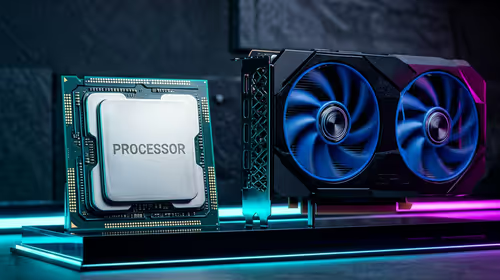
So, you’ve got your hands on the beastly Intel Core i9-14900KF, a CPU that promises to tear through any game you throw at it. But you keep seeing "Intel Turbo Boost Max 3.0" mentioned. Is it just marketing noise, or is it the secret sauce that pushes your frame rates to ridiculous new heights? 🚀
Let's cut through the jargon. We're going to explain exactly what Intel Turbo Boost Max 3.0 on your i9-14900KF is, how it works, and why it matters for your gaming in South Africa.
What is Intel Turbo Boost Max 3.0, Exactly?
Think of your CPU's cores like a team of workers. Standard Turbo Boost tells the whole team to work a bit faster when needed. But Intel Turbo Boost Max Technology 3.0 is smarter. It’s like a clever manager that identifies your two best and fastest workers (or "favoured cores") and assigns the most critical, demanding tasks directly to them.
For gaming and heavy applications, this is huge. It means that single-threaded or lightly-threaded tasks—which many games still rely on for key calculations—get processed at the highest possible speed, giving you a smoother, more responsive experience. It’s an intelligent, automatic performance uplift built right into many of the latest CPU processors available today.
How the i9-14900KF Uses This Tech
The Core i9-14900KF is a hybrid monster, mixing high-performance P-cores (Performance-cores) with E-cores (Efficient-cores). Intel Turbo Boost Max 3.0 focuses exclusively on the P-cores.
Here’s the simple breakdown:
- Identification: During manufacturing, Intel tests and identifies the one or two P-cores on the i9-14900KF die that can achieve the highest stable clock speeds.
- Driver Communication: A specific driver tells your operating system (like Windows 11) which cores are the "favoured" ones.
- Intelligent Scheduling: When you fire up a game like Apex Legends or Warzone, Windows knows to send the most performance-critical game threads to these super-fast cores first.
This ensures you get the maximum possible single-core frequency, pushing your FPS higher and reducing stutters. This level of smart boosting is a key feature across the latest range of Intel CPUs, making them a powerful choice for any build.
Check If It's Working 🔧
Curious if your PC is using Turbo Boost Max 3.0? Open Windows Task Manager (Ctrl+Shift+Esc), go to the 'Performance' tab, and click on 'CPU'. While running a game, watch your clock speed. If it frequently jumps above the "Base speed" listed, the technology is actively boosting your performance! For more detail, Intel's free Extreme Tuning Utility (XTU) can show you exactly what each core is doing.
Do You Need to Do Anything to Enable It?
Mostly, no. It’s designed to work out of the box. However, for it to function correctly, you need three things:
- A compatible Intel CPU like the i9-14900KF.
- A compatible motherboard with the feature enabled in the BIOS (it's usually on by default).
- The Intel Turbo Boost Max Technology 3.0 driver installed on your system.
This technology is a standard feature on Intel’s high-end desktop chips. While similar boosting tech exists on even powerful Intel Core i7 models, the 3.0 version is reserved for the top-tier processors to guarantee elite performance. This differs from the approach on next-gen laptop chips like the Intel Core Ultra 9, which have their own unique boosting strategies for balancing power and battery life.
The Real-World Gaming Advantage ✨
So, what does this all mean when you're trying to clutch a win?
Imagine you're in a massive firefight in Helldivers 2. The game engine is frantically calculating physics, enemy AI, and bullet trajectories. Many of these critical calculations run on just a few threads. By pushing those threads to the fastest possible cores on your i9-14900KF, Turbo Boost Max 3.0 delivers higher and more stable frame rates precisely when you need them most.
It’s not about making every core faster all the time. It’s about making the right cores faster at the right time. That’s the simple, brilliant explanation of Intel Turbo Boost Max 3.0.
Ready to Unleash Maximum Performance?
Understanding tech like Intel Turbo Boost Max 3.0 is the key to building a rig that truly dominates. Whether you're eyeing the flagship i9-14900KF or another beast from our lineup, we've got the heart of your next build waiting. Explore our massive range of Intel CPUs and find the perfect processor to conquer your world.