Staring at your PC build budget, wondering if you’ll ever hit a smooth 60 FPS in the latest titles without selling a kidney? We get it. For South African gamers, getting the most bang for your buck is everything. What if we told you there’s a smart AI-powered feature that can dramatically boost your frame rates on affordable hardware? Enter NVIDIA DLSS, the secret weapon for budget-conscious builders looking for premium performance. ✨
How DLSS Gives Your Budget GPU a Turbo Boost
So, what is this tech wizardry? DLSS stands for Deep Learning Super Sampling. In simple terms, it uses artificial intelligence to boost performance. Your graphics card renders a game at a lower resolution (say, 1080p), which is much easier on the hardware. Then, DLSS’s AI brain, running on dedicated Tensor Cores found in the latest NVIDIA RTX GPUs, intelligently reconstructs the image to a higher target resolution (like 1440p). The result? You get a picture that looks sharp and detailed, but with significantly higher frame rates. It’s like getting a free hardware upgrade with a software switch.
Unlocking Performance: NVIDIA DLSS for Entry-Level Graphics Cards
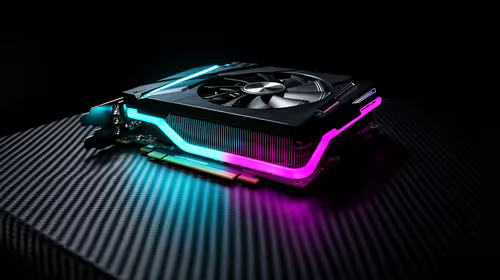
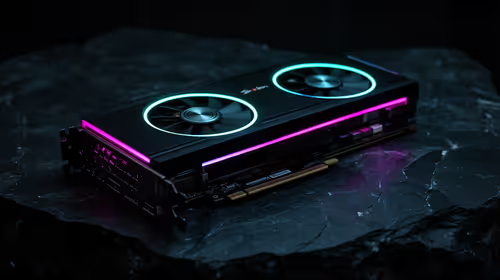
This technology is particularly powerful when we talk about NVIDIA DLSS for entry-level graphics cards. Think about cards like the GeForce RTX 3050, RTX 4060, or even the RTX 4050 in gaming laptops. These GPUs offer a fantastic entry point into PC gaming but might struggle with demanding ray-tracing effects or hitting high frame rates at 1440p in games like Alan Wake 2 or Cyberpunk 2077.
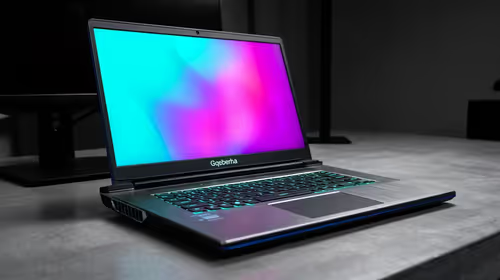
Flick on DLSS, and the story changes. Suddenly, that choppy 40 FPS can jump to a silky-smooth 60+ FPS. This means you can turn up more graphical settings and enjoy the game as the developers intended, without your PC sounding like it's about to take off. Many of the most popular MSI models in this price bracket become incredible value propositions thanks to this AI assistance.
Optimising Your Settings for Maximum Gain
To get the most out of DLSS, you need to know which setting to choose. In most games, you’ll find a few options: Quality, Balanced, Performance, and sometimes Ultra Performance.
Pro Gamer's DLSS Tip ⚡
Always start with the "Quality" setting. It offers the best image fidelity with a substantial performance boost. Only switch to "Balanced" or "Performance" if you're playing a fast-paced competitive shooter and need every single frame you can get for a high-refresh-rate monitor. The visual trade-off is often minimal, but the FPS gain can be huge.
It's also worth noting that NVIDIA isn't the only player with upscaling tech. Competing solutions like AMD's FidelityFX™ Super Resolution (FSR) found on AMD Radeon graphics cards and Intel's XeSS on their lineup of Arc graphics cards offer similar benefits and work across a wider range of hardware. However, DLSS 3's Frame Generation feature remains an exclusive, powerful tool for RTX 40 series cards. While these AI tricks are amazing for gaming, remember that for pure professional workloads, specialised workstation graphics cards are built for a different purpose.
The Verdict: Is DLSS a Must-Have for Budget Builds?
Absolutely. For a South African gamer building a PC on a tight budget, DLSS is more than just a feature... it's a lifeline. It bridges the gap between affordable hardware and high-end gaming experiences. Choosing an entry-level RTX card means you’re not just buying the hardware for today; you're investing in AI-driven performance that will help your rig stay relevant for years to come. Using NVIDIA DLSS on an entry-level graphics card is one of the smartest decisions you can make for your build. 🚀
Ready to Boost Your FPS?
DLSS makes high-performance gaming more accessible than ever. Stop choosing between graphics and frame rates. Explore our wide range of NVIDIA graphics cards and find the perfect GPU to power up your rig today.