The AI Hardware Race Heats Up
The AI revolution is pushing hardware to its absolute limits. If you are rendering 3D scenes in Johannesburg or training massive language models in Cape Town, you need serious graphical horsepower. The tech world is already buzzing about the upcoming architectural clash: NVIDIA Rubin vs Blackwell. Just how much faster will these next-gen professional GPUs be when they finally hit South African shores? Let us break down the specs.
The Blackwell Baseline: A Massive Leap
Before we can understand Rubin, we have to look at Blackwell. Slated to replace the mighty Hopper architecture, Blackwell is built for extreme compute density. Early data suggests it could offer massive performance increases for large language model inference. For local creators and data scientists, this means less time waiting and more time doing.
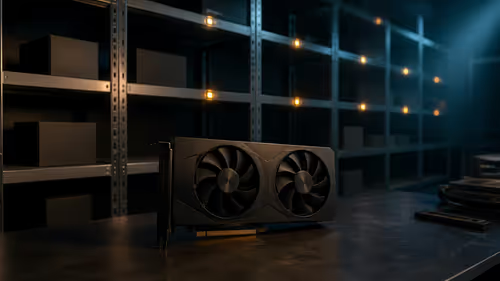
While you can currently browse the latest graphics cards to get a feel for top-tier performance, Blackwell will shift the goalposts entirely. It is expected to utilise a multi-die design to maximise yields. If you want to harness this level of power for your own setup soon, keeping an eye on custom gaming PC deals is a smart move.
Enter Rubin: The Next Frontier in Processing 🚀
So where does Rubin fit into the architectural timeline? Named after astronomer Vera Rubin, this architecture represents the generation after Blackwell. Rumours point to a late 2025 or 2026 release date.
The biggest upgrade? Rubin is expected to adopt ultra-fast HBM4 memory and a highly efficient 3nm manufacturing process. This translates to significantly higher memory bandwidth. For professionals dealing with massive datasets, memory bottlenecks will become a thing of the past. Upgrading your entire workstation might be necessary to avoid bottlenecking these beasts. A high-end system from our pre-built desktop PC range will eventually be the baseline needed to support them. Even mobile professionals will see a massive boost when these architectures eventually trickle down to premium high-performance laptops.
What This Means for South African Creators ⚡
When comparing NVIDIA Rubin vs Blackwell, the real-world impact comes down to efficiency and cost. South Africans know that power consumption matters. Load shedding might be suspended for now, but running a 1000W GPU on a backup inverter still drains batteries fast.
Rubin's rumoured 3nm node should offer vastly superior performance-per-watt compared to Blackwell. This means faster render times without tripping your solar setup. Of course, bleeding-edge tech will command a premium in ZAR. If you need massive compute power today and cannot wait for these future titans, you should definitely check out our current tech specials to maximise your budget right now.
Power Supply Pro Tip 🔧
Next-gen professional GPUs will draw serious wattage. If you plan to upgrade to a Blackwell or Rubin architecture in the future, invest in an ATX 3.0 power supply with a native 12VHPWR connector today. It ensures stable power delivery and saves you from using messy adapter cables in your pristine build.
Ready to Maximise Your Productivity? The NVIDIA Rubin vs Blackwell debate proves the future of professional compute is incredibly bright. Whether you are building an AI workstation or a high-end rendering rig in South Africa, you need the right components. Explore our massive range of hardware and find the perfect machine to conquer your next project.