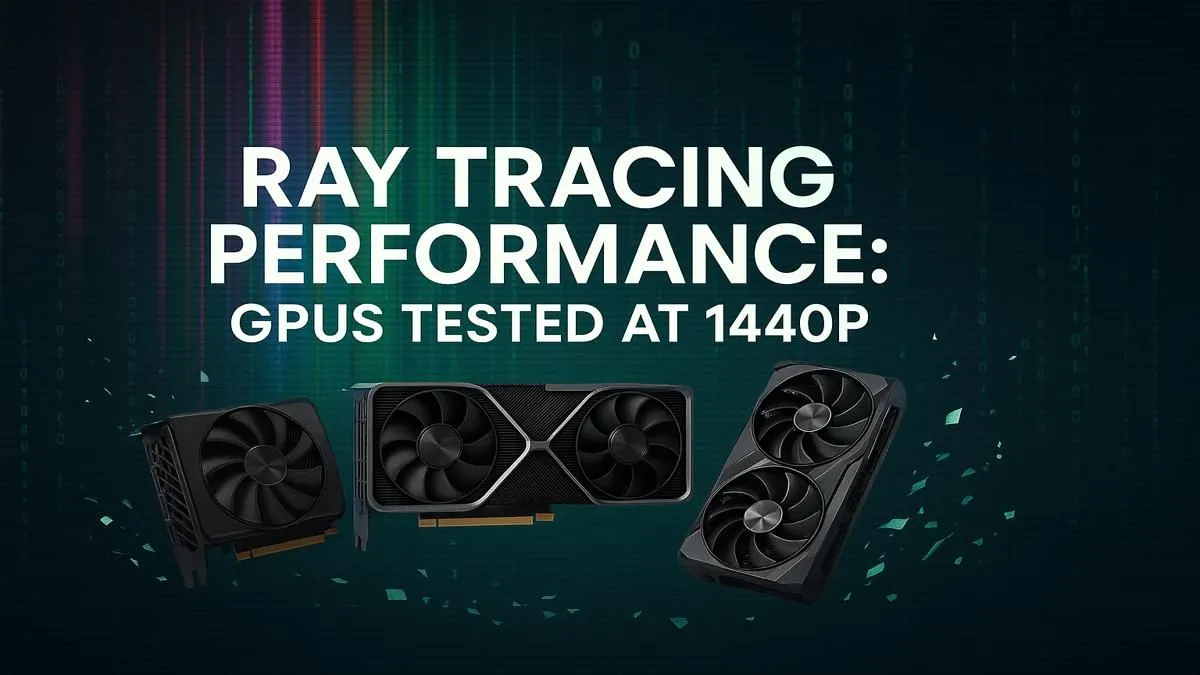
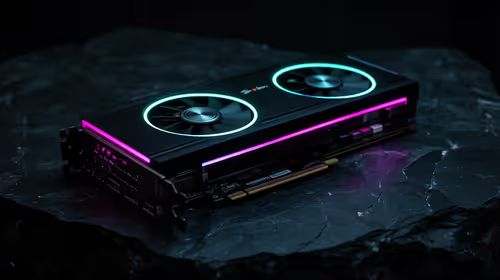
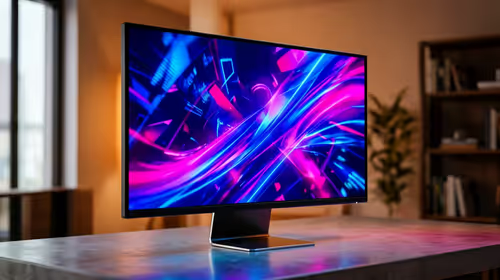
So, you’ve hit the gaming sweet spot: a crisp 1440p monitor. It’s perfect for seeing every detail without needing a supercomputer. But now you want the eye-candy… the stunning, realistic lighting of ray tracing. Suddenly, your trusty GPU starts to sweat. Finding the right card that delivers solid ray tracing performance at 1440p without emptying your wallet is the ultimate quest for South African gamers. Let's find your champion.
The 1440p Ray Tracing Challenge
Ray tracing mimics how light works in the real world, creating incredibly realistic shadows, reflections, and lighting. It's the difference between a game looking good and looking real. But this realism comes at a cost… a massive performance cost.
At 1440p, your graphics card is already pushing a lot of pixels. Add the complex calculations of ray tracing, and frame rates can plummet. This is why choosing the right GPU is crucial. You need a card with dedicated hardware built to handle this specific task efficiently.
The Main Contenders for the Crown 👑
The battle for the best ray tracing performance at 1440p is fiercely fought between three main teams. Each has its own strengths, weaknesses, and secret weapons.
### Team Green: NVIDIA's RTX Dominance
Let's be honest, NVIDIA had a head start. Their RTX cards were the first to feature dedicated RT Cores, and that maturity shows. For pure, out-of-the-box ray tracing muscle, cards like the RTX 4060 Ti and 4070 are phenomenal performers at this resolution. Paired with their AI-powered DLSS upscaling technology, they often deliver the smoothest experience in graphically intense titles.
While older NVIDIA GeForce GTX cards were legends in their own right, they lack the specialised hardware needed for modern ray tracing, making an RTX card a necessary upgrade for this feature.
### Team Red: AMD's Impressive Ascent
For years, AMD played catch-up in the ray tracing game, but not anymore. With their latest RDNA architecture, AMD's Radeon graphics cards have made huge strides. Cards like the RX 7700 XT and 7800 XT offer fantastic rasterization (non-RT) performance and now deliver a very competitive ray tracing experience. Combined with their open-source FSR upscaling, Team Red often presents an incredible price-to-performance argument that's hard to ignore.
### Team Blue: Intel's Bold Entry
The newest player on the block, Intel's Arc series, has surprised everyone. While they may not top the performance charts just yet, their Alchemist architecture shows remarkable strength in ray tracing workloads for its price point. For gamers on a tighter budget looking to dip their toes into ray-traced worlds at 1440p, an Arc A750 or A770, boosted by XeSS upscaling, is a seriously compelling option. 🚀
Upscaling Pro Tip ⚡
For the best 1440p ray tracing experience, don't just turn upscaling on... choose the right mode! 'Quality' or 'Ultra Quality' modes for DLSS, FSR, or XeSS will give you the best visual fidelity with a significant performance boost. The 'Performance' modes are better suited for 4K gaming where you need to claw back more frames.
What About Workstation Cards for Gaming?
You might see powerful workstation graphics cards and wonder if they're a good choice. In short, not really for gaming. These cards, like NVIDIA's Quadro or AMD's Radeon Pro series, are designed and optimised for professional applications like 3D modelling, video editing, and scientific calculation. Their drivers are built for stability, not raw gaming speed, so you'll often get lower frame rates for a much higher price. Stick to consumer gaming cards for the best results.
The Verdict: So, Which GPU Wins? ✨
The truth is… the "winner" depends on you.
- For the ultimate RT experience: NVIDIA's RTX 40-series generally holds the crown for the best ray tracing performance at 1440p, thanks to mature hardware and DLSS.
- For the best overall value: AMD offers a potent combination of strong gaming performance and rapidly improving ray tracing capabilities, often at a more attractive price point.
- For the budget-conscious enthusiast: Intel's Arc GPUs are the exciting underdogs, providing a legitimate entry into 1440p ray tracing without breaking the bank.
Analyse your budget, look at benchmarks for the games you play most, and you'll find your perfect match.
Ready to Light Up Your Gaming World?
Choosing the right GPU is the most important decision for your gaming rig. Whether you're Team Green, Red, or Blue, the perfect card for your budget and performance goals is waiting. Explore our massive range of graphics cards and find the perfect engine to power your 1440p adventures.