Quick Answer
The Ryzen 7 9800X3D leads convincingly in gaming thanks to its 3D V-Cache technology, delivering lower average frame times and significantly higher minimum frame rates in CPU-bound scenarios. The Core i5-14600K remains a strong all-rounder for productivity and mixed workloads, offering excellent value for users who split time between gaming and content creation.
Choosing between AMD''s Ryzen 7 9800X3D and Intel''s Core i5-14600K comes down to understanding what your workload actually demands from a CPU. These two processors represent different philosophies - AMD''s stacked cache architecture prioritises gaming-specific data access patterns, while Intel''s hybrid design with its mix of performance and efficient cores targets broad multithreaded productivity. For South African builders, price-per-performance in rands is a real consideration, and both platforms have meaningful implications for total system cost.
Gaming Performance: Where 3D V-Cache Changes the Equation
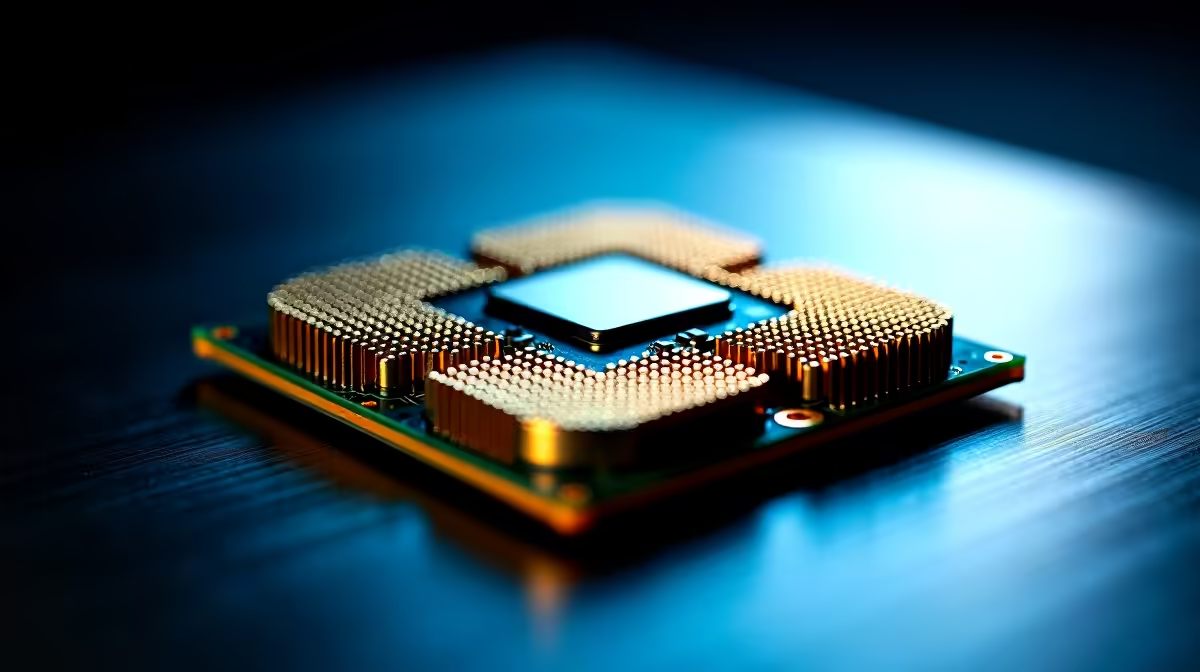
The Ryzen 7 9800X3D''s defining feature is its 3D V-Cache - a large slab of additional L3 cache stacked directly onto the CPU die. This architecture reduces the frequency with which the processor must fetch game data from slower system RAM, keeping more of the game''s critical data resident in ultra-fast cache. In practice, this translates to meaningfully higher minimum frame rates in open-world games, strategy titles, and simulation games where the CPU becomes the bottleneck. At 1080p with a high-end GPU - the resolution where CPU impact is most visible - the 9800X3D can outperform the i5-14600K by 20 to 40 percent in particularly cache-sensitive titles. At 1440p and 4K, the GPU becomes the bottleneck for most games and the gap between the two CPUs narrows substantially.
The i5-14600K is not a weak gaming CPU. Its combination of six performance cores and eight efficient cores delivers smooth frame rates in the vast majority of titles, and for gamers running at 1440p or higher, the real-world gaming experience difference between the two processors is often imperceptible. The 14600K punches well above its pricing in games that are not heavily cache-sensitive.
Productivity and Multithreaded Workloads
For productivity tasks - video rendering, compilation, data processing, and content creation - the picture shifts. The i5-14600K''s fourteen cores (six P-cores plus eight E-cores) provide strong multithreaded performance in workloads that can distribute tasks across many threads. Video encoding, 3D rendering, and compression benchmarks often favour the 14600K because these tasks scale well with core count and the 3D V-Cache offers limited benefit in throughput-bound scenarios.
The 9800X3D is competitive in lightly-threaded productivity tasks and performs well in code compilation workloads, but it is not the optimal choice if heavy video production or 3D rendering is your primary use case. If your workday involves rendering 4K footage while simultaneously gaming, the 14600K''s multithreading advantage becomes tangible.
Platform Costs and Upgrade Paths in SA
The total system cost extends beyond the CPU itself. The Ryzen 7 9800X3D requires an AM5 motherboard (X670E or B650 chipset for optimal support) and DDR5 memory. AM5 is AMD''s current platform with a stated commitment to socket longevity, meaning your motherboard investment extends further into future CPU generations. The i5-14600K uses the LGA1700 socket on Intel 600 or 700 series motherboards and DDR4 or DDR5 depending on the board - DDR4 compatibility makes it cheaper to build around if you have existing memory. However, LGA1700 is Intel''s previous-generation socket with limited upgrade headroom beyond 13th and 14th Gen.
In the South African market, both CPUs sit at different price points. The 9800X3D carries a premium that reflects its gaming performance lead. Factor in that premium against your primary use case: if gaming is your dominant activity and you want the best CPU gaming performance available in this tier, the 9800X3D justifies the cost. If you split time more evenly between gaming and productivity and value platform flexibility, the 14600K system can be meaningfully more affordable without a significant gaming experience penalty at higher resolutions.
Thermal Performance and Power Draw
Both CPUs require capable cooling. The i5-14600K runs hotter under extended all-core load due to Intel''s power limit behaviour, frequently drawing 180 W or more when limits are removed - as many Z690/Z790 motherboards do by default. A 240 mm AIO or a high-end tower cooler is recommended for sustained performance. The 9800X3D is architecturally more thermally constrained by its V-Cache stack, which cannot tolerate the same temperatures as a standard die. This means AMD enforces tighter power limits, resulting in more predictable and generally lower power consumption. A quality 120 mm or 240 mm AIO keeps the 9800X3D well within its thermal envelope.
Frequently Asked Questions
Q: Is the Ryzen 7 9800X3D worth the extra cost for gaming in SA? A: If gaming is your primary use and you play at 1080p or 1440p with a high-end GPU, the 9800X3D''s V-Cache advantage is real and consistent in CPU-bound titles. At 4K, the GPU bottleneck reduces the gap significantly, making the premium harder to justify purely for gaming.
Q: Can the i5-14600K be overclocked for better gaming performance? A: Yes, the 14600K is an unlocked CPU and overclocks well on Z-series motherboards. Pushing all P-cores to 5.4–5.5 GHz is achievable with adequate cooling, which closes some of the gaming gap versus the 9800X3D, particularly in non-cache-sensitive titles.
Q: Which CPU is better for content creation alongside gaming? A: The i5-14600K has a multithreading advantage in video rendering and encoding due to its higher total core count. If you spend significant time in video editors or 3D software in addition to gaming, the 14600K offers a better balance across that combined workload.
Q: What RAM speed should I pair with these CPUs? A: The 9800X3D on AM5 benefits from DDR5-6000 in EXPO mode - this is the well-established sweet spot for the platform. The 14600K on DDR5 boards similarly benefits from DDR5-6000; on DDR4 boards, DDR4-3600 in XMP mode is the recommended target for optimal performance.
Ready to Find Your Perfect Match? Shop at Evetech.