So, you’ve grabbed a shiny new AMD Ryzen 7000 series CPU. Lekker! You’re ready for insane frame rates and lightning-fast performance. But hold on a second… pairing that beast of a processor with sluggish RAM or a slow SSD is like putting retreads on a Ferrari. You’re just creating a bottleneck.
Getting the balance right is crucial. Let’s quickly break down how to properly pair RAM and storage for Ryzen 7000 to unlock its true potential.
Why Your RAM Choice is Critical for Ryzen 7000
With the move to the AM5 platform, Ryzen 7000 CPUs exclusively use DDR5 memory. This isn't just an incremental upgrade; it's a fundamental shift that brings higher speeds and more bandwidth to the table. Forgetting this is a common mistake we see with builders upgrading from older platforms.
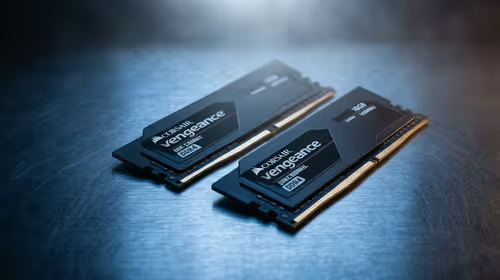
But not all DDR5 is created equal. For Ryzen 7000, the performance "sweet spot" is widely considered to be 6000MHz with the lowest CAS Latency (CL) you can afford, ideally CL30. This specific frequency syncs perfectly with the CPU's internal fabric clock, minimising latency and maximising data throughput. It's the key to getting the smoothest performance out of today's powerful CPUs. 🚀
Look for AMD EXPO
To make things even easier, look for RAM kits with AMD EXPO (Extended Profiles for Overclocking) technology. It's a one-click solution in your motherboard's BIOS that automatically configures your memory to its advertised optimal speeds. No manual tweaking, just pure, stable performance.
Quick BIOS Tip ⚡
After installing your new RAM, reboot your PC and enter the BIOS (usually by pressing DEL or F2 on startup). Look for a setting called 'AMD EXPO' or 'DOCP'. Enable it, save, and exit. Your PC will now run the RAM at its full rated speed, not the slower default setting.
Don't Skimp on Storage: Unleashing Ryzen's Speed
Your CPU and RAM can only process data as fast as your storage can deliver it. The Ryzen 7000 series supports the blisteringly fast PCIe 5.0 interface for NVMe SSDs. While Gen5 drives are still pricey, a high-quality PCIe 4.0 NVMe SSD is an absolute must-have for any modern gaming rig.
What does this mean for you?
- Vanishing Load Times: Games like Starfield and Cyberpunk 2077 load massive worlds in seconds.
- Smoother Gameplay: DirectStorage technology allows the GPU to pull game assets directly from your NVMe drive, reducing stutter and pop-in.
- Snappier System: Your entire PC, from booting up to opening apps, feels instantly responsive.
Even the best rival Intel CPUs benefit massively from fast storage, and for Ryzen 7000, it's non-negotiable. Using an old SATA SSD or a mechanical hard drive for your games will leave you staring at loading screens while your CPU waits impatiently.
The Perfect Pairing: A Balanced Build Strategy
The ultimate goal is a balanced system where no single component holds another back. Think of it as a relay race: your SSD passes the data to your RAM, which then feeds it to your CPU. If one runner is slow, the whole team suffers. ✨
When planning your build, allocate your budget wisely. It makes no sense to buy a top-tier Ryzen 9 7950X and then pair it with the cheapest RAM and storage you can find. A more balanced approach would be to match a Ryzen 5 7600X, one of the most popular latest AMD CPUs, with a solid 32GB 6000MHz CL30 EXPO kit and a fast 1TB Gen4 NVMe SSD. This combination delivers incredible gaming performance without breaking the bank. You can even find some seriously powerful processors under R7000 that form the perfect core for a high-value build.
Getting the combination of RAM and storage for your Ryzen 7000 CPU right is the secret to a PC that feels powerful, responsive, and ready for whatever you throw at it.