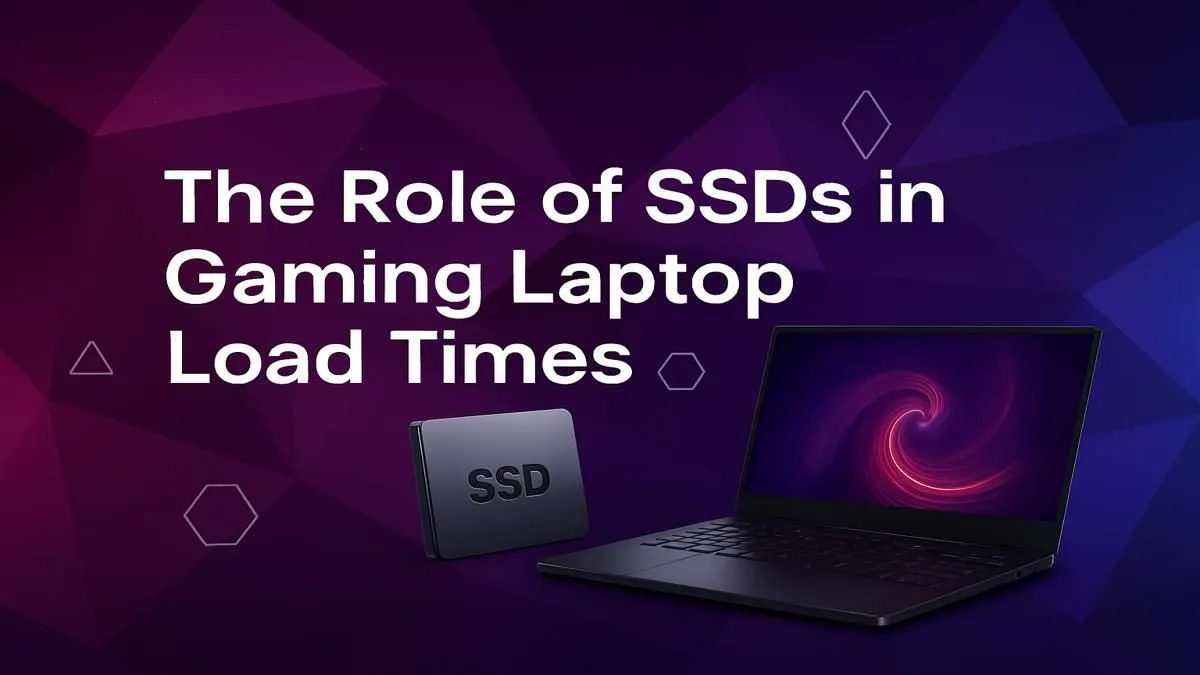
Staring at a loading screen while your squad is already dropping into the hot zone? We've all been there. That frustrating delay isn't your internet… it's likely your laptop's old-school storage. Upgrading the SSD for your gaming laptop is one of the single biggest improvements you can make. It’s not just about loading games faster; it's about gaining a competitive edge, eliminating stutter, and getting a snappier PC experience all-round. ⚡
The Real Enemy of Your K/D Ratio... Loading Screens
For years, traditional hard disk drives (HDDs) were the standard. Think of them as tiny, spinning vinyl records with a mechanical arm that has to physically find your data. It’s a slow process. A Solid-State Drive (SSD), on the other hand, uses flash memory—like a massive, lightning-fast USB stick. There are no moving parts, meaning data access is almost instant.
This difference is night and day in gaming. An SSD doesn't just slash the initial game load time; it helps textures and assets load instantly in open-world games like Cyberpunk 2077 or Starfield, reducing that annoying pop-in effect. Many of the best gaming laptop deals in South Africa now come standard with a speedy SSD for this very reason.
Not All SSDs Are Created Equal: NVMe vs. SATA
When you start shopping for a gaming laptop SSD, you'll see two main types: SATA and NVMe.
- SATA SSDs: These are the older standard and use the same connector as traditional HDDs. They are a massive leap from an HDD, offering speeds that will feel revolutionary if you're upgrading.
- NVMe SSDs: This is the new king. 🚀 NVMe (Non-Volatile Memory Express) drives use the M.2 form factor and connect directly to the motherboard's PCIe lanes—the same super-fast interface your graphics card uses. The result? Speeds that can be over five times faster than their SATA counterparts.
This raw speed isn't just for play; it dramatically accelerates complex tasks, which is why you'll find NVMe SSDs powering high-performance workstation laptops used for video editing and 3D rendering. For gaming, an NVMe SSD means you're not just loading the map first, you're loading it almost instantly.
Check Your Laptop's Compatibility 🔧
Before you buy, you need to know what your laptop supports. The easiest way is to search online for your exact laptop model + "SSD upgrade" or "M.2 slot". This will usually lead you to a forum or a spec sheet that confirms if you have an M.2 slot (for NVMe) or only a 2.5-inch bay (for SATA).
Key Specs to Check Before You Buy an SSD
Feeling ready to make the jump? Here’s what to focus on when choosing an SSD for your gaming laptop.
Capacity (How Much Space?)
Modern games are huge. Call of Duty alone can demand over 200GB. For a dedicated gaming machine, a 1TB SSD is the new sweet spot. It gives you enough room for your operating system, a few AAA titles, and your favourite apps without constantly having to uninstall things. If you're on a tighter budget, a 500GB drive is a decent starting point.
Read/Write Speeds
These are measured in megabytes per second (MB/s). Higher numbers are better.
- Read Speed: Affects how quickly your game loads levels and assets.
- Write Speed: Impacts how fast you can install games or save large files.
For an NVMe SSD, look for read speeds of 3,000 MB/s or more for a great gaming experience. You can often find great value by browsing the latest laptop specials to see what specs are currently hitting the price-to-performance sweet spot.
The Verdict: A Truly Worthwhile Upgrade ✨
Is upgrading the SSD for a gaming laptop worth the time and money? Absolutely. It’s one of the most noticeable and cost-effective performance boosts you can give your machine. You'll spend less time waiting and more time winning. Your entire laptop, from booting up Windows to opening Discord, will feel more responsive and modern. Don't let slow storage be the bottleneck holding back your skill.