Quick Answer
Optical scroll wheel precision refers to the accuracy and repeatability of step registration when the scroll wheel rotates, achieved by replacing the physical contact encoder with an infrared light-gate system. This eliminates contact bounce, step skipping, and the degradation over time that mechanical encoders are prone to, resulting in a scroll wheel that registers every micro-rotation consistently throughout its lifespan.
The Mechanics of an Optical Scroll Encoder ⚙️
A traditional mechanical scroll encoder uses a plastic or metal wheel with notches that intermittently close a spring contact circuit. Each notch registers as one scroll step. The spring contact produces a brief electrical bounce where the signal fires multiple times before settling, suppressed by firmware debounce. Over time the contact surface wears, increasing bounce duration and causing missed or doubled scroll steps.
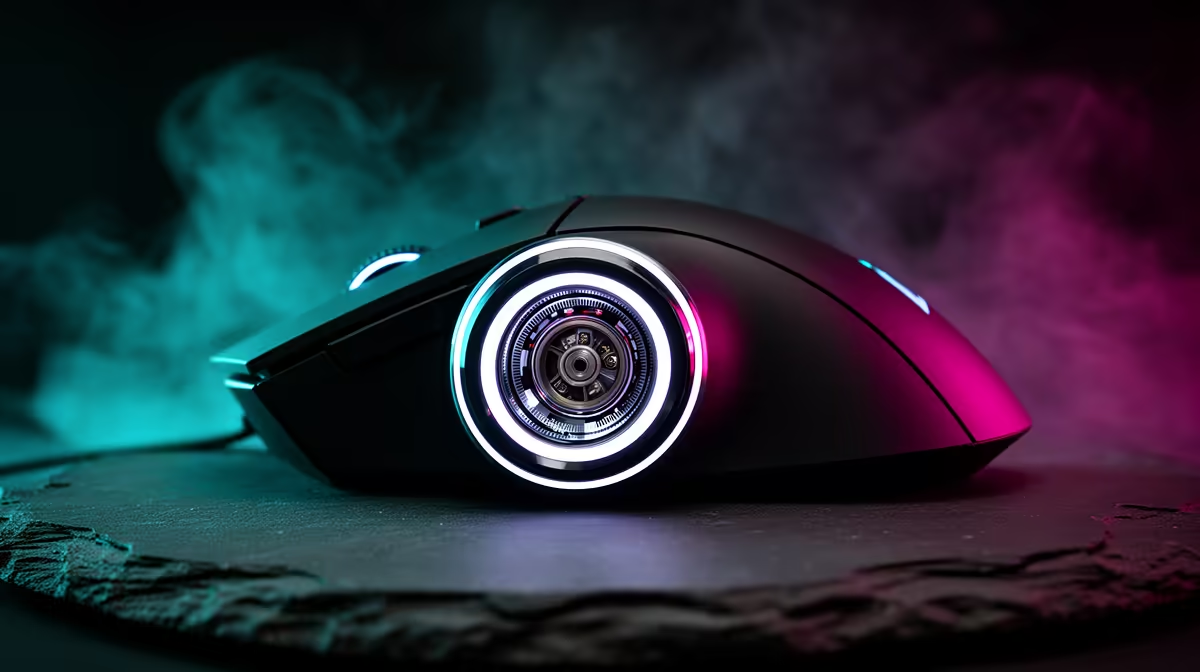
An optical encoder replaces this with a slotted disc between an LED emitter and a photodiode receiver. Slots pass through the beam, interrupting it with clean digital pulses. No mechanical contact, no bounce, no wear surface. Premium implementations resolve hundreds of steps per revolution versus 18 to 24 detents on a typical mechanical wheel.
Free-Spin and Tactile Modes Explained 🔄
Optical encoders decouple the counting mechanism from the scroll feel entirely. In a mechanical encoder, the detent click is produced by the same spring that registers the scroll step. In an optical encoder, a separate magnetic system generates the detent feel while the light gate handles counting. This allows switchable free-spin and tactile modes, toggled via a button press. The optical encoder registers scroll events accurately in both modes.
Durability and Long-Term Precision 🛡️
Because optical scroll encoders have no contact surfaces, their precision does not degrade with use. A mechanical encoder in a mid-range mouse may begin skipping or doubling scroll steps after 12 to 18 months of heavy daily use. An optical encoder in a premium mouse (available in South Africa from around R1,200 to R2,800) maintains identical step registration from its first use to its ten-thousandth hour.
For South African gamers using the same mouse for productivity and gaming, optical scroll precision also benefits spreadsheet navigation and web browsing by eliminating overscroll repositioning.
Free-Spin Mode for Long Documents ⚡
In free-spin mode, a single flick of the scroll wheel can traverse a 100-page document in under a second. Toggle to tactile mode for spreadsheet navigation where precise row-by-row movement is needed. The best optical encoder mice let you bind this toggle to a side button for instant switching without interrupting your workflow.
FAQ
Can I add optical scroll precision to an existing mechanical encoder mouse?
Not without significant hardware modification. Optical encoder boards for specific popular models exist in the enthusiast modding community, but sourcing them in South Africa is difficult and installation requires desoldering. Purchasing a new mouse with a factory optical encoder is the practical path.
Does free-spin mode affect how games register scroll wheel weapon switching?
Yes. In free-spin mode a single touch may register multiple scroll steps, switching through multiple weapons at once. For gaming, always use tactile mode where each detent registers as exactly one step. The optical encoder ensures this is precise and consistent.
How many steps does a premium optical scroll encoder register per revolution?
Premium optical scroll encoders typically resolve between 100 and 400 steps per revolution in free-spin mode. In tactile mode with a magnetic detent system, the user-felt clicks are typically 24 per revolution, though the encoder resolution beneath may be much finer.
Upgrade to optical scroll precision.
Evetech stocks gaming mice with premium optical scroll encoders for both desktop productivity and competitive gaming. Browse the full mouse range at Evetech to find the right scroll feel for your workflow.