Frame generation can make Marvel Rivals look dramatically smoother while making your controls feel no faster. That apparent contradiction is the whole buying and settings decision: generated frames improve motion between fully rendered frames, but they do not create new game-state updates or erase the latency of the underlying render.
Quick Answer
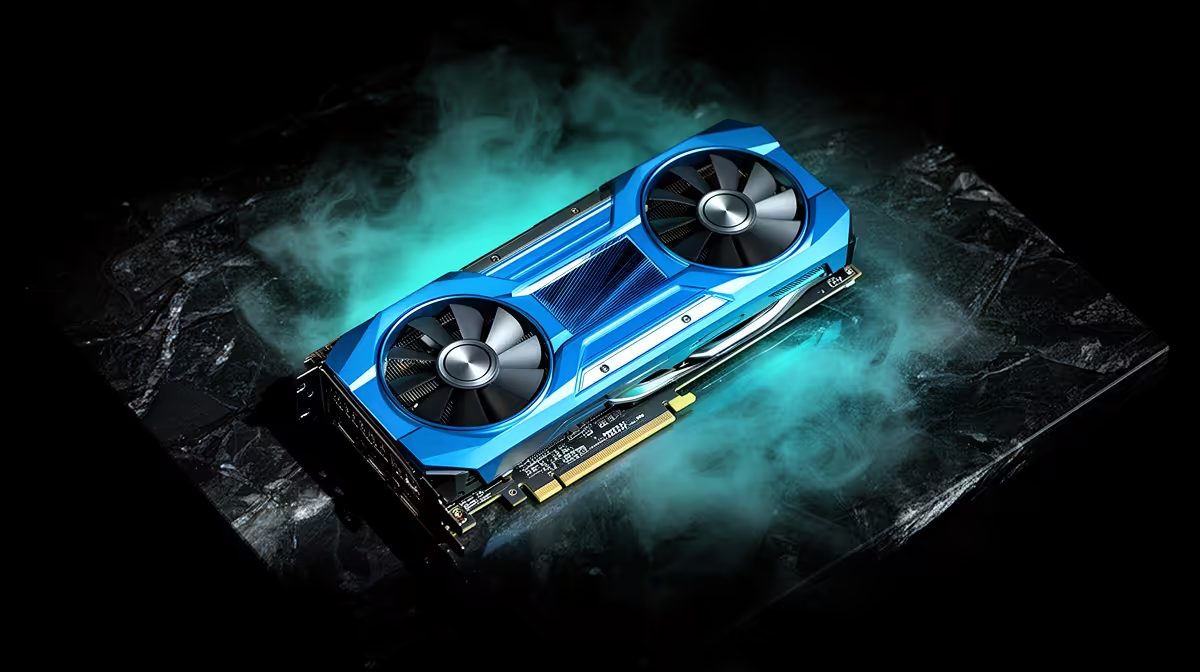
Use frame generation in Marvel Rivals when your normal frame rate is already stable and you value smoother motion. For ranked play, first optimise the base frame rate, enable NVIDIA Reflex where supported and test whether frame generation changes your aim timing. A Palit GeForce RTX 5060 8GB was R6,999 at Evetech as of July 2026, giving buyers a dated example of an RTX 50-series option; do not upgrade for the setting alone before checking what your present GPU supports.
🎯 Why the base frame rate still matters
Frame generation inserts calculated images between traditionally rendered frames. The display receives more frames, so camera pans and fast movement can look cleaner. Your mouse click, however, is still sampled and processed through the real rendering pipeline.
That is why low input frame rates remain low-latency problems. Turning 35 rendered frames into a much higher displayed count can improve fluidity, but it does not make the game respond like a native high-frame-rate run. Visual artefacts around effects, interface elements or rapidly moving characters can also become easier to notice when the source frames are sparse.
A sensible starting point is a stable base near 60fps. It is not a magic threshold, but it gives the interpolation system cleaner temporal information and leaves controls reasonably responsive before generated frames are added.
⚡ Competitive settings versus visual settings
Marvel Rivals supports NVIDIA DLSS Frame Generation and Reflex on compatible hardware. Reflex reduces system latency; frame generation raises displayed frame rate. They solve different problems and can be used together, but Reflex does not turn generated frames into fresh simulation updates.
For competitive matches, start with:
- a frame rate the GPU can hold during busy team fights;
- reduced settings that remove genuine render bottlenecks;
- Reflex enabled on supported GeForce hardware; and
- frame generation tested last, not first.
If aim feels less connected, switch frame generation off even if the counter falls. For casual play on a high-refresh monitor, the smoother presentation may be worth the trade.
Compare complete gaming-PC deals and PC best-sellers by their real GPU, CPU and monitor target rather than a single software feature.
Frequently Asked Questions
Does frame generation add input lag in Marvel Rivals?
It adds processing and generated frames do not carry newer input. Reflex can reduce the wider system latency, but the result still depends on the base frame rate.
Should competitive players use frame generation in Marvel Rivals?
Only after testing it. Players prioritising the quickest aim response may prefer a lower displayed count made entirely from rendered frames.
Does frame generation help a weak GPU run Marvel Rivals?
It can make motion look smoother, but it does not fix an unstable base frame rate, insufficient VRAM or severe stutter.
What base frame rate should I have before enabling frame generation?
Around 60fps or better is a practical starting point. Stability during heavy fights matters more than the exact number.
Is frame generation the same as upscaling?
No. Upscaling reconstructs each rendered frame from a lower internal resolution. Frame generation inserts additional frames between rendered ones.
Which graphics cards support frame generation in Marvel Rivals?
Support depends on the technology selected, the game version and the GPU generation. Check the in-game option and the GPU maker's compatibility guidance.
Will frame generation make Marvel Rivals feel smoother visually?
Usually, yes. It raises displayed frame rate, but perceived control response may not improve by the same amount.
Tuning a Marvel Rivals PC?
Compare Evetech gaming PCs by native performance first, then treat frame generation as a finishing option for a stable build rather than a substitute for one.