Quick Answer
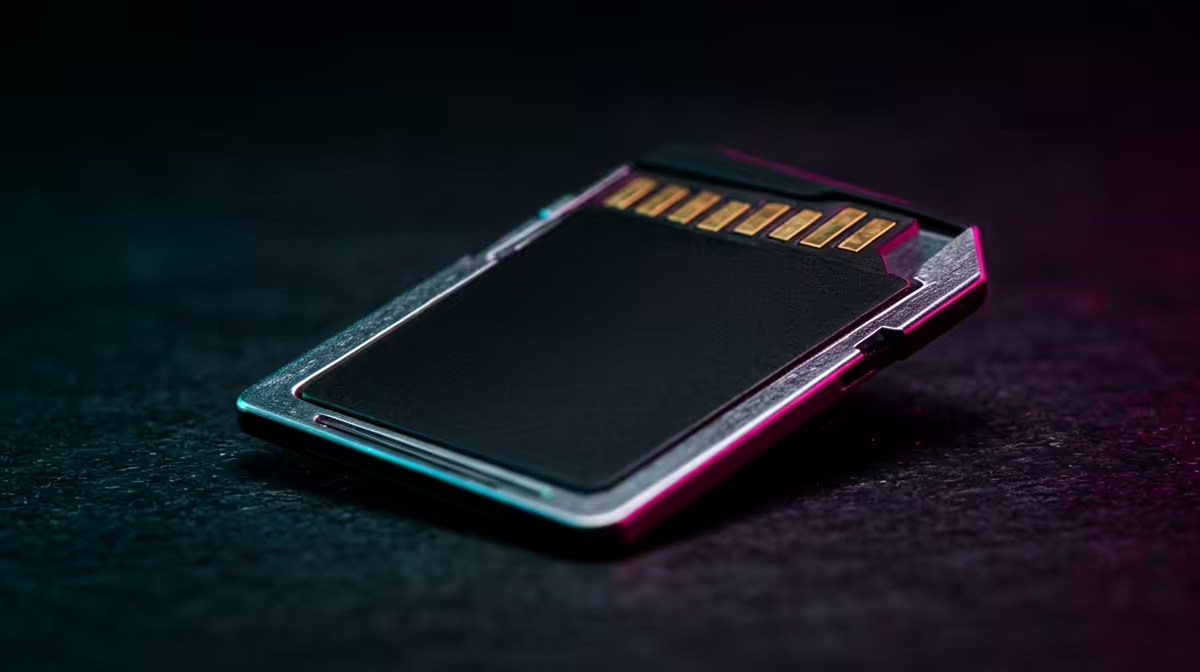
V30 means the SD card guarantees a minimum sustained write speed of 30MB/s, as defined by the SD Association's Video Speed Class standard. This is sufficient for 4K recording at bitrates up to approximately 200Mbps (25MB/s) and is the minimum recommended spec for 4K video on most consumer cameras, drones like the DJI Mini 4 Pro, and action cameras.
What the V Rating System Actually Measures 📹
The Video Speed Class rating (V6, V10, V30, V60, V90) was introduced by the SD Association to give camera users a reliable, standardised minimum write floor rather than relying on maximum speed numbers (which are peak, not sustained). V30's guarantee of 30MB/s sustained write applies even under thermal load and after extended recording sessions, distinguishing it from cards that achieve 30MB/s in a five-second burst but throttle to 12MB/s after two minutes of continuous recording. For a drone like the DJI Mavic 3 Classic recording H.265 4K at 150Mbps (18.75MB/s), V30 provides a solid buffer above the required write rate. For action cameras like the GoPro Hero 13 shooting 5.3K at 100Mbps, V30 also meets spec comfortably.
V30 vs V60 vs V90: When to Step Up 🎬
V30 is sufficient for 4K recording up to approximately 200Mbps. Above that threshold, step up to V60 (minimum 60MB/s). Sony's FX30 shooting XAVC S-I 4K at 600Mbps requires V60 or higher; V30 cards cause recording to stop and the camera displays a slow card warning. V90 (minimum 90MB/s) is specified for 8K recording and very high bitrate 4K raw workflows on professional cinema cameras. For the majority of South African content creators using mirrorless cameras, drones, or GoPro-style action cams, V30 UHS-I covers the workflow completely. Only creators shooting on Sony A7S III, Canon EOS R5, or DJI Inspire 3 at maximum bitrates need V60 or above.
What V30 Does Not Tell You: Read Speed and Capacity 💾
V30 only specifies write speed, not read speed. Read speed determines how fast you offload footage from the card to a laptop or hard drive after the shoot. A V30 card with a 100MB/s read speed offloads 64GB of footage in roughly eleven minutes. A V30 card with 40MB/s read speed takes over 25 minutes for the same amount of data. This matters practically: South African filmmakers and content creators who edit same-day need fast read speeds to turn around footage quickly. Card packaging lists both read and write speeds; for offload-intensive workflows, look for read speeds of 80MB/s or higher even on V30 cards.
V30 Is a Floor, Not a Speed Promise ⚡
cards vary widely in real-world sequential write speed above the 30MB s minimum: a budget V30 card may deliver 35MB s sustained while a premium V30 card achieves 90MB s. For 4K recording the minimum is met by both, but for offloading large video files to your editing machine quickly, a V30 card with higher sustained write also transfers faster from a card reader. Check the write speed figure on the box alongside the V30 label.
FAQ
Is a V30 card the same as a U3 card?
Partially. Both U3 and V30 guarantee a minimum of 30MB/s sustained write.
What SD card should I buy for a DJI Mini 4 Pro in South Africa?
DJI recommends a V30 or higher microSD card for the Mini 4 Pro recording at up to 150Mbps in 4K. A 64GB to 128GB V30 UHS-I microSD card handles all recording modes the Mini 4 Pro offers.
Can a V30 card handle 4K 60fps video?
4K 60fps in H.265 at 60Mbps to 100Mbps (typical on consumer cameras) requires only 7.5MB/s to 12.5MB/s write speed, well within V30's 30MB/s floor. At 4K 60fps with All-I codec at 200Mbps (25MB/s write rate), V30 still covers it with 5MB/s headroom.
Shooting 4K with a drone, camera, or action cam? Evetech stocks V30, V60, and V90 rated SD and microSD cards for a range of recording devices. Browse the memory card range at Evetech to get the right card for your gear.