So, you’re diving into the incredible world of AI art with Stable Diffusion, turning simple text prompts into stunning visuals. But as you push for higher resolutions and more complex creations, you hit a wall... the dreaded progress bar. It makes you wonder: is my hardware fast enough?
We hear a lot about the raw power of GPUs, but what about connectivity? This article explores the real impact of 5G on GPU performance in South Africa and answers the key question for local creators.
Unpacking 5G and GPU Performance: What's the Real Connection?
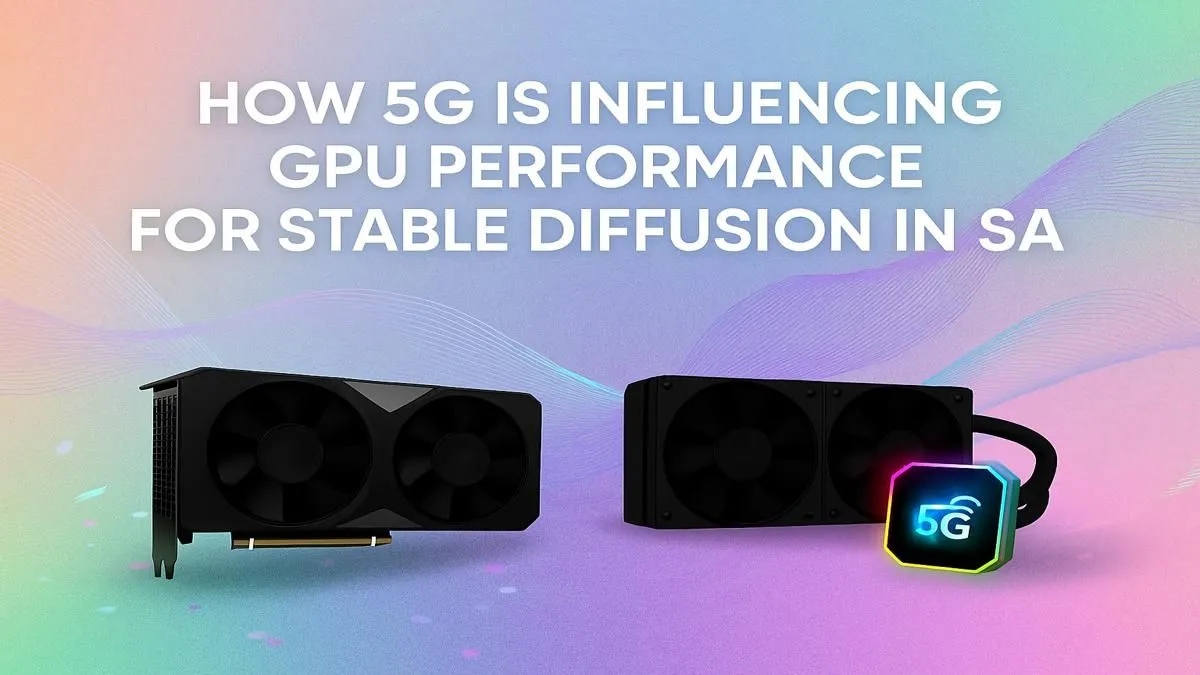
Let's clear this up first: 5G does not directly boost your graphics card's processing power. Think of your GPU as a high-performance engine and 5G as an incredibly wide, fast highway leading to it. The engine's speed (your GPU's clock speed and core count) is fixed, but the highway (5G) determines how quickly you can get fuel and materials (AI models, datasets, assets) to it.
For tasks like Stable Diffusion, the actual image generation... the heavy lifting... happens right on your PC. The complex calculations are handled by your GPU's VRAM and processing cores. However, the overall workflow can be significantly improved by a faster connection. Downloading a new multi-gigabyte AI model over a slow connection can take ages, but with 5G, it’s done in minutes. This is where the synergy between a fast connection and the latest graphics cards truly shines. ✨
Stable Diffusion in SA: Why Local Power Reigns Supreme
While cloud-based AI services exist, running Stable Diffusion locally on your own machine offers massive advantages for South African creators.
- Cost Control: Cloud GPU services can get expensive, with billing in dollars that quickly adds up. A one-time investment in a powerful GPU gives you unlimited rendering without worrying about a surprise bill.
- Privacy & Ownership: Your creations and prompts stay on your machine. You have full control over your data, which is a huge plus for commercial or sensitive projects.
- No Latency: The speed of generation is dictated purely by your hardware, not the whims of an international server.
For the best experience, especially with popular tools that rely on CUDA technology, having one of the many powerful NVIDIA GeForce cards is often the recommended path. Their architecture is exceptionally well-suited for the parallel processing that AI workloads demand. The GPU performance you get from a dedicated local card is simply unmatched for serious creative work.
Choosing Your AI Engine: Which GPU Fits Your Needs?
Selecting the right GPU is crucial for a smooth Stable Diffusion experience. The key is balancing your budget with your creative ambitions. While top-tier cards offer incredible speed, even mid-range options provide a fantastic entry point.
For those looking for excellent value and strong performance in both gaming and creative tasks, exploring AMD's Radeon lineup is a smart move. For professional creators, engineers, or data scientists who require certified drivers, maximum stability, and massive VRAM pools for huge datasets, stepping up to professional workstation graphics cards is the ultimate solution. 🔧
VRAM is King 👑
When running Stable Diffusion, VRAM (Video RAM) is often more critical than raw speed. A model like SDXL needs at least 8GB of VRAM to run comfortably. Before you buy, check the VRAM requirements for the models you plan to use. More VRAM lets you generate higher-resolution images and use more complex models without crashing.
The Future: A Hybrid Approach to AI Creation
So, where does this leave the conversation on 5G GPU performance? The future is likely a hybrid model. Imagine using 5G's low latency to instantly pull assets from a cloud library, running the core image generation on your powerful local GPU, and then using 5G again to upload the finished high-resolution piece to a client or portfolio.
In this workflow, 5G acts as a powerful enabler, removing friction from your creative process. It won't replace the need for a beastly graphics card... it will simply unlock its full potential by ensuring it's never waiting for data. Your local GPU remains the heart of your creative studio.
Ready to Unleash Your AI Creativity?
While 5G opens up exciting possibilities, the heart of any AI-powered creative rig is a powerful GPU. Stop waiting and start creating. Explore our massive range of graphics cards and find the perfect engine to bring your visions to life.