So, you’ve seen those mind-blowing AI-generated images online and thought, “I want to do that.” Welcome to the world of Stable Diffusion! It’s an incredible tool for creating everything from custom game assets to photorealistic portraits with just a few words. But before you can bring your imagination to life, you need the right gear. A powerful Stable Diffusion GPU setup is the key to generating images quickly and without frustration. Let's build your ultimate hardware checklist. 🚀
Why Your GPU is the Heart of a Stable Diffusion Setup
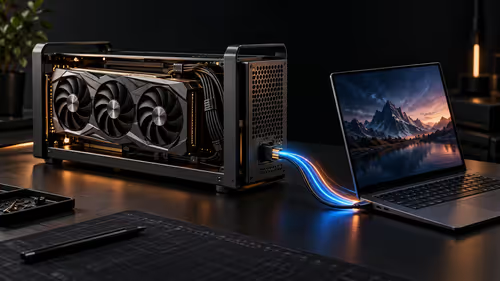
When it comes to AI art generation, your Graphics Processing Unit (GPU) does all the heavy lifting. Think of it as the engine of your creative workshop. The performance of your Stable Diffusion GPU setup hinges almost entirely on the power and, more importantly, the video memory (VRAM) of your graphics card. More VRAM allows you to create larger, more detailed images and process them faster, turning a tedious wait into a near-instant creative flow.
NVIDIA: The Top Choice for AI 🧠
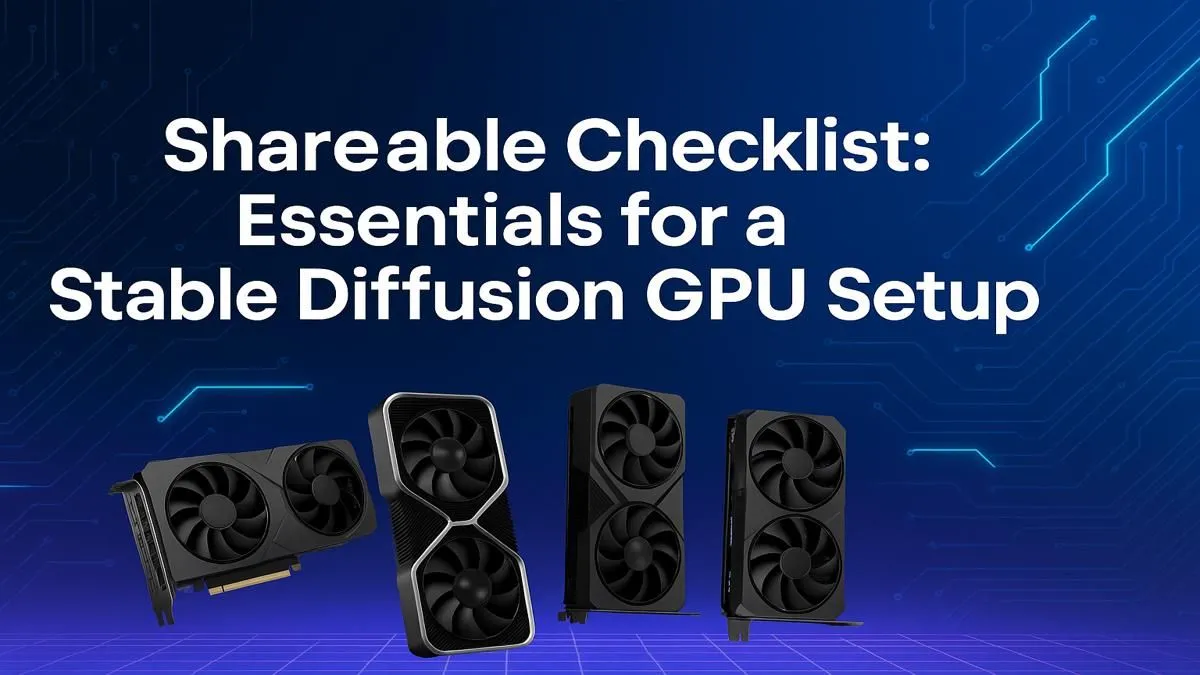
There's a reason NVIDIA dominates the AI space: CUDA. It's a parallel computing platform and programming model that Stable Diffusion and many other AI tools are heavily optimised for. This means you generally get better performance and wider compatibility out of the box. For a fantastic experience, models like the RTX 3060 12GB offer a great entry point, while the latest NVIDIA GeForce graphics cards from the RTX 40-series provide next-level speed for serious creators.
AMD: A Capable Alternative?
While NVIDIA is the straightforward choice, you can still build a Stable Diffusion setup with an AMD card. Thanks to frameworks like ROCm, support for AMD Radeon graphics cards is improving. However, it can sometimes require a bit more technical tinkering to get everything running smoothly. If you're a die-hard Team Red fan who loves a good challenge, it’s a viable path, but for plug-and-play simplicity, NVIDIA currently holds the edge.
Decoding VRAM Requirements for Stable Diffusion
VRAM is the single most important spec for your AI hardware. It determines the complexity and resolution of the images you can generate. Here’s a quick breakdown:
- 8GB VRAM (The Starting Line): This is the minimum for a decent experience. You'll be able to generate standard 512x512 pixel images without much trouble. It's a great way to learn the ropes, but you may feel limited when trying more advanced techniques.
- 12GB-16GB VRAM (The Sweet Spot): This is the ideal range for most enthusiasts. It gives you the freedom to generate high-resolution images, use more complex models, and train your own concepts (LoRAs) without constantly hitting a memory ceiling.
- 24GB+ VRAM (The Pro Zone): If you're serious about training entire models or working with massive 4K+ image batches, this is where you need to be. This territory includes top-tier consumer cards like the RTX 4090 and specialised professional workstation GPUs designed for these intensive workloads.
Check Your Model Sizes! ⚡
Before downloading custom models from sites like Civitai, check the file size. A typical model is 2-7 GB. A fast NVMe SSD is crucial, as loading these massive files from a traditional hard drive can take several minutes, completely killing your creative momentum.
Building a Balanced Stable Diffusion PC
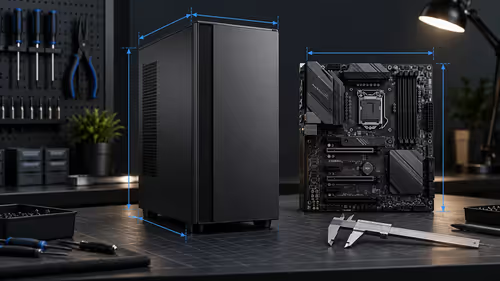
While the GPU is the star, the supporting cast is just as important for a smooth workflow. A bottleneck elsewhere in your system can still slow you down.
- System RAM: Aim for at least 16GB, but 32GB of DDR4 or DDR5 RAM is highly recommended. Your PC uses system RAM to load the AI models before they're passed to the GPU's VRAM, and having plenty of it prevents system stutter.
- Storage: An NVMe SSD is non-negotiable. The speed difference is night and day for loading the application, models, and saving your creations. A 1TB drive is a good starting point.
- CPU and Power Supply: You don't need a top-of-the-line CPU. A modern mid-range processor like an Intel Core i5 or AMD Ryzen 5 is more than enough. However, don't skimp on the Power Supply Unit (PSU). A high-VRAM GPU is power-hungry, so invest in a quality PSU with a sufficient wattage rating to ensure system stability.
Ultimately, choosing the right hardware comes down to balancing your budget and ambition. Before you make a final decision on your Stable Diffusion hardware, it's always a good idea to browse the full range of available graphics cards to compare the latest prices and specifications in ZAR. ✨
Ready to Build Your AI Art Powerhouse? A powerful Stable Diffusion GPU setup is your ticket to a new world of creativity. Don't let hardware hold you back. Explore Evetech's massive range of PC components and find the perfect parts to bring your imagination to life.