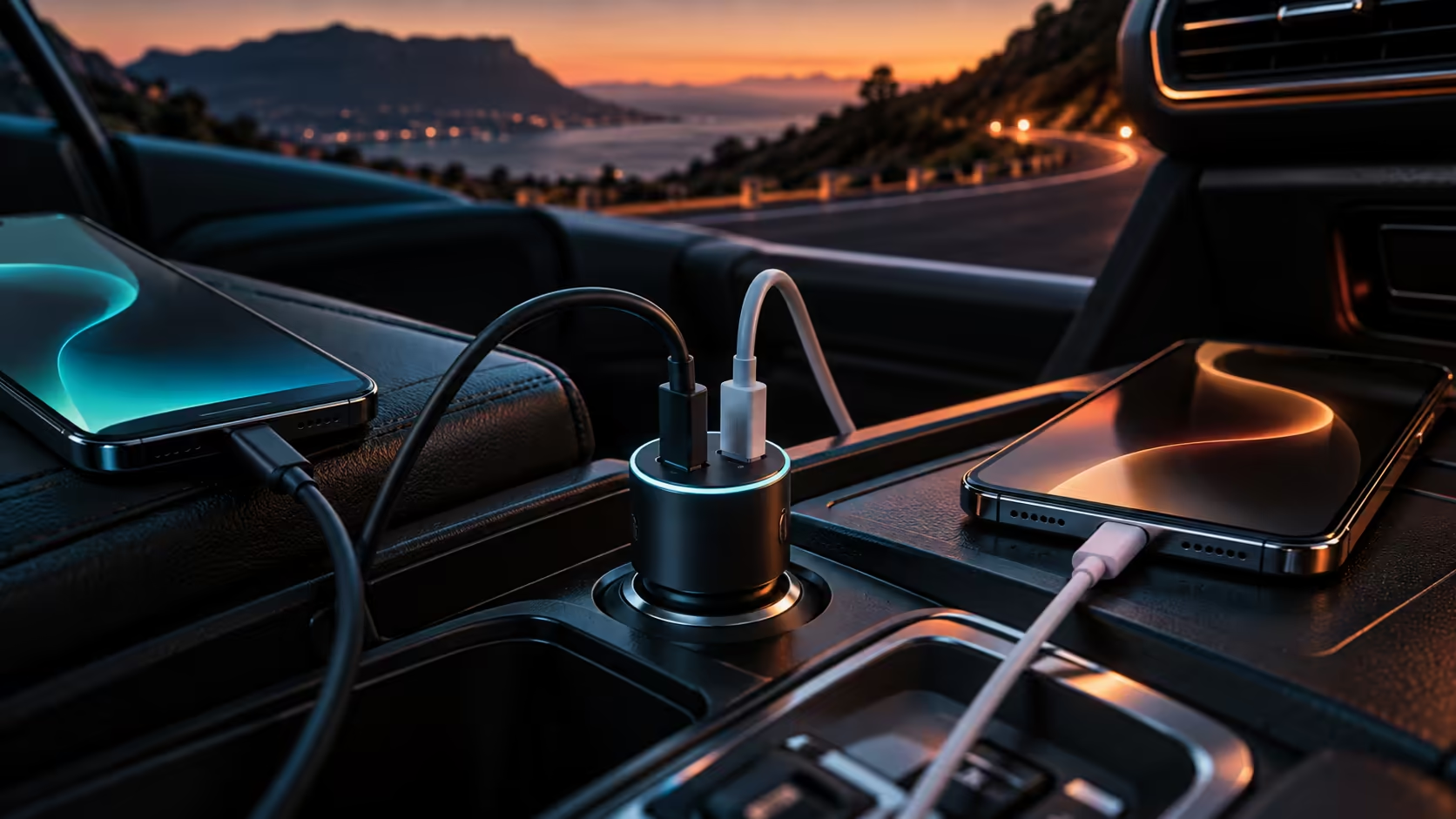
A family car charger has different requirements from a solo commuter's, and the December run to the coast is exactly the trip that exposes the gap between the two. What works fine for one person charging one phone often falls short the moment three or four people are all reaching for the same socket.
Quick Answer
A family trip needs two genuinely useful outputs, not one fast one and an afterthought: 30W USB-C PPS for the driver's navigation phone, 22.5W USB-A for a co-driver or the eldest passenger's device. The December run down to Durban or the Garden Route is hours of maps, music and back-seat screens running at once, and Gauteng or Highveld summer heat works against all of it simultaneously. Anker's compact two-port unit covering both outputs costs R349.
🧳 What a family road trip actually asks for
A solo commute rarely tests a charger's limits, one phone, one port, done. A family trip is a different problem entirely: the driver's phone running navigation continuously, a co-driver's phone handling music or calls, and often a tablet or a second phone in the back seat all wanting power across a drive that can run 4 hours or more each way.
No single dual-port charger comfortably serves more than two devices at their full solo rating simultaneously, since the shared converter behind both ports divides one fixed budget. Planning around that reality, rather than assuming every device gets its own dedicated supply, avoids disappointment on the day the whole family is charging at once.
🌡️ Summer heat compounds the demand
A December drive means summer cabin temperatures for most of South Africa, and a car left even briefly at a fuel stop in direct sun heats up well past outside temperature by the time everyone gets back in. Whatever warmth the phone picked up during that stop carries straight into the next stretch of navigation, leaving it with noticeably less room before it starts protecting itself by easing off its own charging rate.
PPS on the USB-C port matters more here than on a short local errand, since its finer voltage matching produces less charging heat at the same wattage, buying back some of that thermal margin exactly when a hot, hardworking phone needs it.
👨👩👧 Prioritising when the car has more devices than ports
With more devices wanting power than the charger has full-rate ports for, the driver's own navigation phone should generally claim the faster USB-C side, simply because keeping it topped up matters more to getting everyone there safely than any other device in the car. A power bank is a practical way to cover a back-seat tablet or a third phone without further dividing the car charger's own shared supply, since it draws from its own reserve rather than adding a third claim to the converter.
A smartwatch tracking the trip barely registers against either port's budget, so it rarely needs dedicated planning the way phones and tablets do.
Frequently Asked Questions
Can one dual-port charger really serve a whole family car?
For two devices charging at once, comfortably. Beyond that, a power bank or a genuinely separate 12V outlet, if the vehicle happens to have one, is the better answer rather than expecting a single converter to stretch further than it was built to.
Does the order devices get plugged in matter on a long trip?
A little, in the first moments after each connection, though over a multi-hour trip the difference evens out to whatever the shared budget allows for however many devices are active.
Is a car charger enough on its own for a full day of driving?
For most normal use, yes, since even the shared 12W figure comfortably outpaces typical phone drain, though a demanding task like continuous navigation narrows that margin.
Should I bring a spare cable on a long family trip?
Yes, given how often a cable rather than the charger itself is the actual point of failure, and a spare costs little against the inconvenience of a dead device mid-trip.
Does the heat argument apply equally on a Cape Town family trip as a Gauteng one?
Broadly yes, since a parked car in direct sun heats up in most parts of the country during summer, though the specific temperatures and timing vary somewhat by region and season.
Is it worth buying two separate chargers instead of one dual-port unit for a big family trip?
Only if the car genuinely has two accessible 12V sockets. Where there is only one within easy reach of the front seats, a single dual-port unit remains the more practical choice regardless of how many devices are along for the trip.
Should back-seat passengers bring their own power bank on a long family trip?
It is a sensible backup, particularly once more than two devices are competing for the car's own charging setup, since it removes one device from the shared budget entirely.
Ready to keep the whole family charged on the next road trip?
Have a look at the car charger range and plan around which device needs power most.