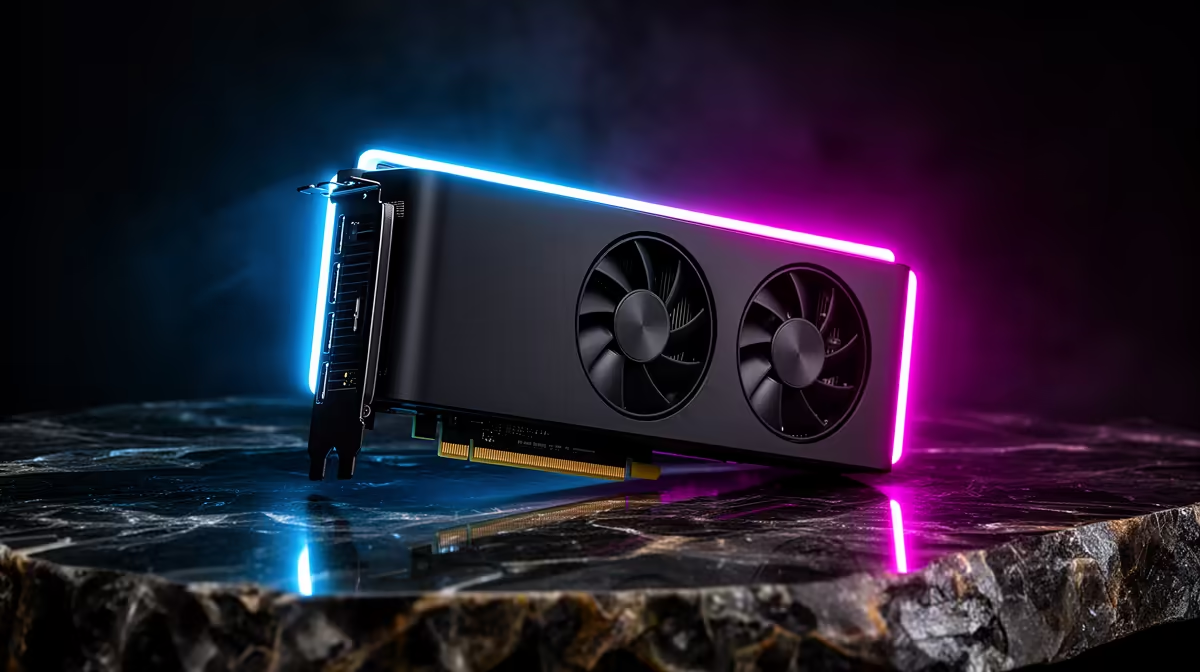
Colour banding after a RTX 5090 build change almost always traces back to the signal chain rather than the new part itself. South African builders tend to notice visible gradient steps in skies, dark scenes and loading screens right after a hardware swap because Windows HDR, the GPU output range, the cable or the monitor's bit-depth setting quietly reset at the same time. Work the display path in a fixed order so each test tells you something useful.
Quick Answer
Fix colour banding on a RTX 5090 build setup by forcing full RGB range, switching the desktop to 10-bit colour, and matching Windows HDR to the content you are viewing. Set the output to 10 bpc at your native resolution in the GPU control panel, confirm the cable supports it, then reboot. Most banding clears once the output bit depth and RGB range stop fighting each other.
The fixed order that clears banding
- Reset the monitor to its default picture mode and turn off aggressive dynamic-contrast or 'eco' presets. 2. In the NVIDIA or AMD control panel, set Output colour format to RGB, Output dynamic range to Full, and Output colour depth to 10 bpc. 3. Toggle Windows HDR off for SDR desktop work, since SDR content shown through an HDR pipeline bands heavily. 4. Update the GPU driver and, on the RTX 5090 build, the chipset and BIOS so the display engine runs current firmware. Change one item, look at a known dark gradient, then move on, so you can see which step actually helped.
High-bandwidth output on a RTX 5090
The RTX 5090 drives 4K at 240Hz, which only carries full 10-bit RGB over DisplayPort 2.1 UHBR. If you reused an older DisplayPort 1.4 cable, the link compresses and bands; swap to the bundled UHBR cable. A flagship card stocked at Evetech in the R50,000-plus bracket deserves a certified cable rather than a salvaged one.
FAQ
Why did banding only appear after the RTX 5090 build change?
A new part usually resets the display pipeline, so RGB range, bit depth or HDR flips back to a default that bands. Re-applying full RGB and 10-bit output restores the smooth gradients you had before.
Is the banding a sign of a faulty panel?
Rarely. True panel faults show as dead zones or tint shifts, while banding is a settings and bit-depth issue you can fix in software. Only suspect hardware once full RGB, 10-bit output and a known-good cable still band.
Will DSC cause banding on the RTX 5090?
Display Stream Compression is visually lossless in normal use and is not the usual banding cause. Banding on a RTX 5090 almost always comes from 8-bit output or limited RGB range, both fixed in the NVIDIA control panel.
Quick check
Open a full-screen grey-to-black gradient image after each change. If the steps vanish, the last setting you touched was the culprit.