A no-signal screen is one of the most common post-build headaches, and ninety percent of cases are solved without opening a wallet, just by tracing the cable and driver chain. For South African builders the calm approach matters, since shipping a part back across the country costs days you do not need to lose.
Quick Answer
A no-signal screen on a x870e setup is almost always a wrong input, a tired cable, the motherboard port, or a driver state, not a dead card. Trace the physical signal path first, then check Windows and drivers; budget around R4,500 to R12,500 only if a part truly fails. If a part does turn out to be faulty, expect roughly R4,500 to R12,500 for a like-for-like swap, which is reason enough to test before you buy.
Rule out a sleeping or wrong-mode panel
A monitor that auto-switched inputs or dropped into deep sleep can mimic a dead build. Cycle the monitor power, manually select the right source on its menu, and give the panel a few seconds to sync after each change. Modern high-refresh panels sometimes need a moment to lock onto a new signal.
Check power and seating in the case
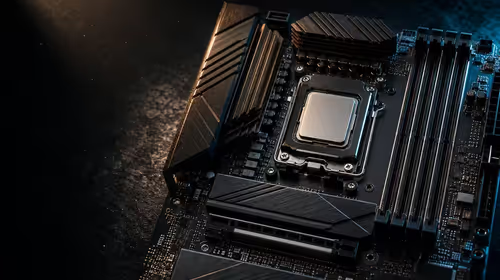
Power down, pull the plug, and confirm an X870E motherboard is firmly seated with every power lead clicked home and the support bracket holding the card level. A slightly lifted slot or an unplugged auxiliary connector can leave a build at no-signal even when fans spin. Reseat once, then retest before assuming a part is dead.
Set the correct primary output in BIOS
Some boards default display priority to onboard graphics, which leaves a discrete card silent. Enter BIOS, set the primary or initial display to the PCIe slot, and disable onboard video if the build has no use for it. Save, exit, and the picture usually returns on the next post.
FAQ
How much should I budget if a part is actually faulty?
For this class of gear plan on roughly R4,500 to R12,500 depending on tier and brand, and only buy after the free checks rule out cables, settings, and seating. Most readers never reach this step.
Why does my screen work on the motherboard port but not the card?
That means video is leaving through onboard graphics instead of the discrete card, usually because of a BIOS display priority or a cable in the wrong socket. Move the cable to the card and set the PCIe slot as the primary output.
Will a better cable really change this?
Yes, on a high-refresh or high-resolution panel the cable standard sets the bandwidth ceiling, so a certified DisplayPort or high-spec HDMI run can unlock rates a cheap cable hides. A good cable is a small spend against the cost of the rest of the build.
Sort the signal path before you replace anything.
Compare X870E motherboards alongside cables and panels so the card, cable, and display target all line up the first time.