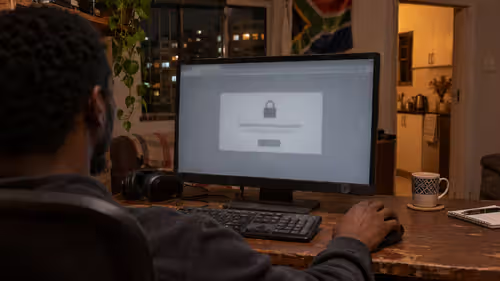
Rolling dark bands across your picture are not a broken webcam. They come from a mismatch between the camera's timing and the pulse of your lights. For webcam 50hz vs 60hz, South Africa's 230V mains runs at 50Hz, so the 50Hz anti-flicker option is the correct choice for most rooms here.
Quick Answer
Set the power line frequency or anti-flicker option to 50Hz in your camera software or in OBS. Many webcams ship set to 60Hz for other markets, which is the usual cause of banding under mains lighting. If bands remain, lock exposure by hand or swap a cheap flickering LED for a steadier lamp costing roughly R150 to R400.
⚡ Why mains frequency matters
Lights powered from the mains pulse at twice the supply frequency, so 50Hz mains gives a 100Hz flicker. Your eyes average it out, but a camera that exposes in short slices catches the dark part of each pulse. When the camera's frame timing does not divide cleanly into that pulse, you see slow rolling bands.
Setting the anti-flicker option to 50Hz tells the camera to choose exposure times that line up with the local cycle. That is why the setting is called power line frequency in several programs.
🛠️ Where to change the setting
- Maker software: look for Anti-flicker, Power line frequency or Light frequency, and choose 50Hz.
- OBS: right-click the Video Capture Device source, choose Properties, then Configure Video, and find Power Line Frequency.
- Windows Camera app: has no such option on most devices, so use the maker's tool.
Not every webcam exposes the control. If yours does not, the next two sections matter more.
💡 Fix the light, not just the camera
Cheap dimmable LED bulbs and desk strips often pulse far faster or slower than the mains, and a camera notices. Run a dimmable LED at full brightness, since dimming by pulse-width makes flicker worse. A light with a flicker-free rating, or a plain incandescent or halogen globe, is a quick test. Daylight from a window removes the problem entirely, though it changes through the afternoon.
Keep monitors and TVs in mind too. A screen in frame can add its own banding, so turn it away or lower its brightness.
🎚️ Lock the exposure by hand
Auto exposure keeps hunting, which makes flicker obvious. In the camera properties, turn off automatic exposure and choose a manual shutter value. Exposures of about 1/50 or 1/100 of a second line up with a 50Hz supply, so pick one of those and raise the gain or light if the picture is dark. A longer exposure can add motion blur, so find a compromise by testing. Gear from the streaming essentials range includes lights built for camera use.
Check your fix on a recording
Banding that you cannot see live can still show up in a recording, so record ten seconds, then open the file and scrub through it. Pause on a flat wall or the lamp itself, where flicker is easiest to spot. Compare the clip before and after each change to the frequency setting, the light and the exposure, one at a time, so you know which change worked. If you cannot remove the banding in one room, move the camera to face a different wall or switch off the offending bulb. A steady daylit window in the morning is often the quickest test of whether the light or the camera is to blame. In older Pretoria houses with mixed fittings, one dated downlight is often the culprit, so unscrew bulbs one at a time.
If you stream from a res room or a shared flat, the lights are often not yours to change, which makes the camera-side fixes more important. Set 50Hz first, then lock exposure, then move the camera so the brightest fitting is out of frame. Most of the time these three steps alone remove the bands without buying anything new, and you can confirm the result in the preview before going live.
Frequently Asked Questions
Why does my webcam flicker?
Mains lights pulse at twice the supply frequency. If the camera's timing does not match, you see rolling bands in the picture.
Should I choose 50Hz or 60Hz in South Africa?
Choose 50Hz, because the local mains supply runs at 50Hz. Many webcams default to 60Hz, so check the camera software.
Where is the anti-flicker option?
It sits in the maker's camera software or in the OBS device properties as Power Line Frequency. Not every webcam exposes it.
Can LED desk lights cause flicker?
Yes. Cheap dimmable LEDs often pulse quickly. Run them at full brightness or choose a steadier light.
Will changing the exposure help?
Often. A longer exposure that fits the light cycle hides flicker, though it can add blur. Set exposure by hand rather than leaving it on auto.
Ready to stop the flicker for good?
Look through Evetech's webcam and streaming essentials categories for cameras and lighting that stay steady on camera.