Quick Answer
A 420mm AIO radiator cools a high-TDP CPU more effectively than any fan-only configuration at equivalent noise levels, keeping a Ryzen 9 9950X under 80 degrees Celsius at all-core load where a seven-fan air setup might hit 85 to 88 degrees Celsius. Multiple fans alone win on cost and simplicity for mid-range builds where CPU TDP stays under 125W.
What a 420mm Radiator Actually Adds 🌬️
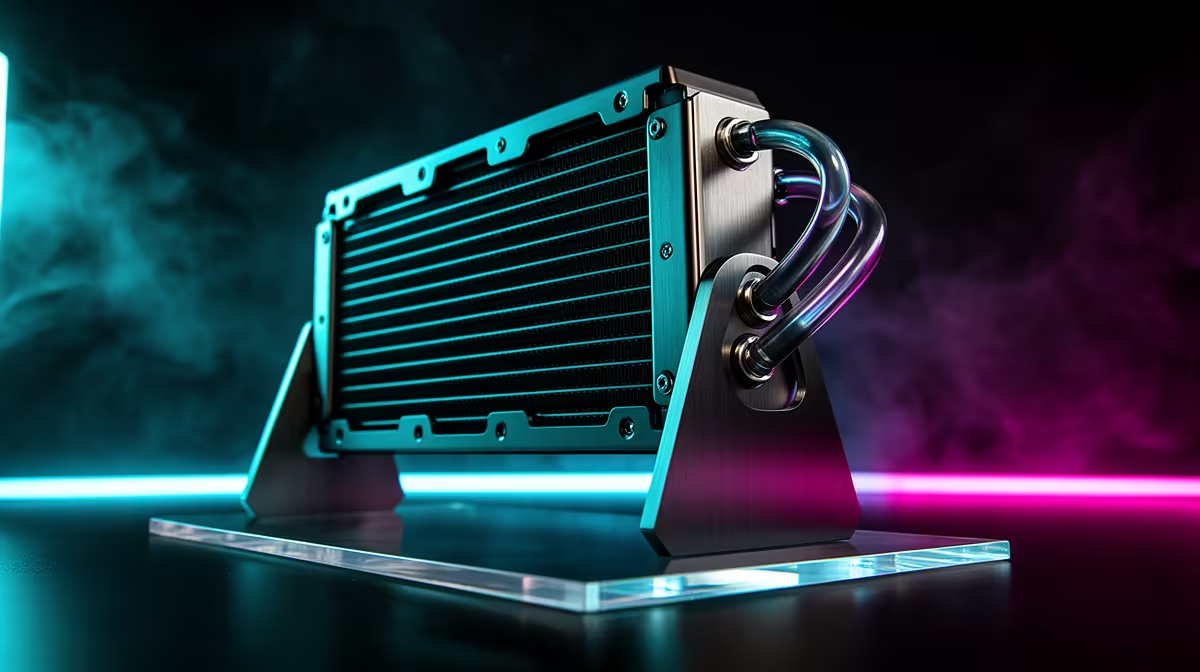
A 420mm radiator uses three 140mm fans across a surface area roughly 40 percent larger than a 280mm unit. The Ryzen 9 9950X and Intel Core Ultra 9 285K both regularly pull 170W to 200W in extended multi-core workloads, territory where smaller AIOs struggle to sustain peak boost clocks. A 420mm radiator mounted at the front of a full-tower achieves junction temperatures 8 to 12 degrees Celsius lower than a 240mm AIO under the same workload. In South Africa's warmer summer ambient, this margin is even more meaningful.
When Multiple Case Fans Beat a Large AIO 💨
For mid-range builds with 65W to 105W TDP processors, three intake plus two exhaust fans in a mesh-front mid-tower keep CPU temperatures well under 70 degrees Celsius at full load. A quality 420mm AIO runs R2,500 to R5,000 locally, while five quality 140mm case fans cost R1,000 to R2,500. The case fan route has fewer failure points since there is no pump, radiator bracket, or coolant loop to concern yourself with over a five-year lifespan.
Combining Both for Maximum Performance 🔧
High-end builds do not have to choose: a case with 420mm support and additional fan mounts lets you run the AIO for CPU cooling while case fans manage ambient temperature and GPU thermals. This combined approach, common in flagship builds pairing a Ryzen 9 9950X with an RTX 5090, keeps both CPU and GPU junction temperatures in sustainable ranges during extended gaming or rendering sessions. What case fans do is prevent hot GPU exhaust from recirculating to the radiator intake.
Front Radiator as Intake, Not Exhaust ⚡
Mount your 420mm radiator at the front as an intake (fans pulling outside air through the radiator into the case). Mounting as exhaust introduces pre-heated air from the radiator fins into the case, raising baseline internal ambient by 3 to 6 degrees Celsius and reducing the cooling margin available to your GPU and VRM heatsinks.
FAQ
Does a 420mm AIO require a specific case size?
Yes. A 420mm AIO fits only in cases explicitly listing 420mm front or top radiator support. Most mid-towers support up to 360mm; 420mm support appears in large mid-tower and full-tower designs. Confirm the spec sheet before purchasing the AIO.
How long does an AIO pump last compared to case fans?
Quality AIO pumps are rated for 50,000 to 70,000 hours, roughly 10 to 15 years at typical usage. The practical difference is that a failed pump means a full AIO replacement, whereas a failed case fan is an R80 to R300 swap.
Is a 420mm AIO noticeably louder than a fan-only setup?
At the same thermal load, a quality 420mm AIO with PWM fans runs quieter because the larger radiator surface allows slower RPMs for the same heat rejection. Noise levels of 25 to 32 dBA at idle are typical.
Picking between an AIO or fans for your next build?
Browse Evetech's cooler and case fan range to compare options and prices before committing to your cooling strategy.