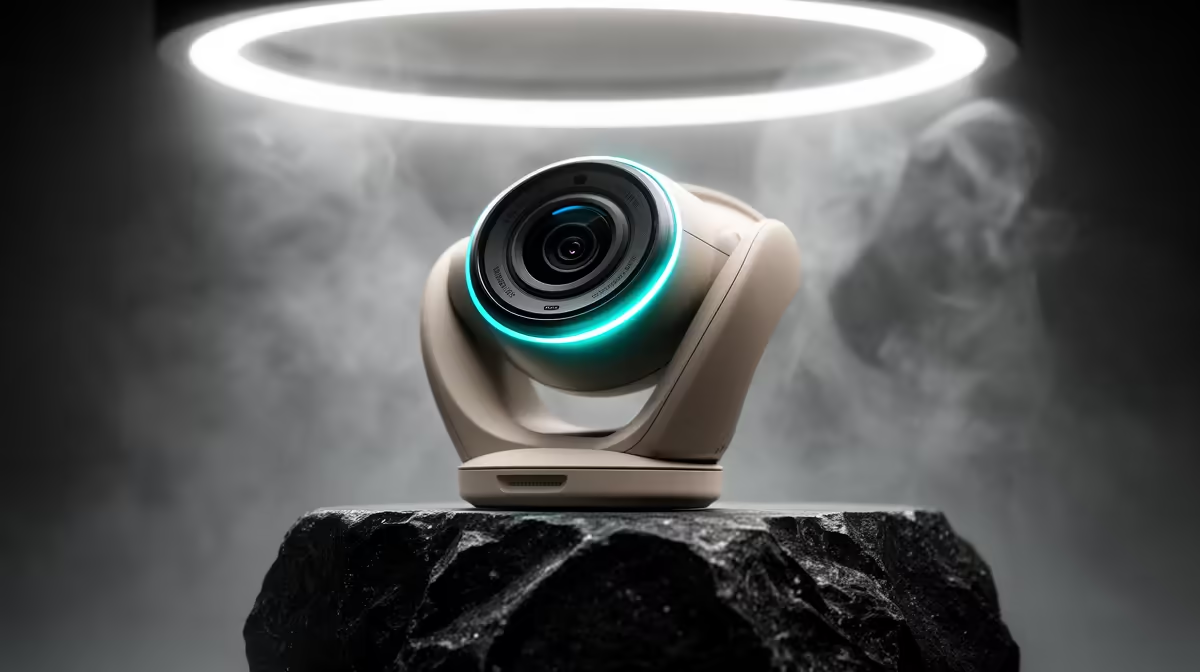
Pricing on 4K webcams in South Africa spans a range wide enough to confuse anyone who has not spent time comparing what each tier actually delivers. A label reading "4K" on a R1,500 model and a R5,000 model represents two very different things underneath the resolution badge. Understanding what a 4K streaming webcam costs in South Africa and what each ZAR tier actually buys makes the choice straightforward rather than a guess.
Quick Answer
Entry 4K webcams in South Africa start around R1,500 to R1,800 and deliver basic 4K30 plug-and-play recording without AI features. Mid-tier models between R2,500 and R3,500 add better optics and often AI auto framing. AI-equipped flagship models push past R5,000. Most SA creators hit the best value in the R2,500 to R3,500 range.
💰 Entry Tier: R1,500 to R1,800
At the bottom of the 4K webcam range you find basic plug-and-play models that deliver 4K resolution at 30 frames per second through USB, require no driver installation, and work immediately with any conferencing or streaming app. The value proposition is straightforward: genuine 4K capture at a price close to the better end of the 1080p range.
What this tier does not include is equally straightforward. Sensors in this price bracket are small, typically 1/4 inch, which limits low-light performance. Autofocus, where it exists, is basic and can struggle with fast movement or shallow depth of field. There is no AI auto framing, no on-camera noise cancellation, and no background blur processing. The lens optics are adequate for well-lit conditions but soften noticeably in lower light.
For a South African student in a koshuis with a well-lit desk, or a home user who only needs 4K for occasional recordings in good light, this tier delivers what it promises. For anyone recording in the evening or in a room with variable light, the small sensor limits what the 4K resolution can actually resolve cleanly.
The R1,500 to R1,800 entry tier is also worth considering as a fallback for anyone whose primary use case is 1080p conferencing but who wants the option to record 4K clips occasionally. The investment over a good 1080p model is modest.
✨ Mid-Tier: R2,500 to R3,500
This is where the 4K webcam market concentrates its best practical value for South African creators and remote workers. Models in the R2,500 to R3,500 range typically step up to a larger sensor, better-corrected optics, and the beginning of the AI feature set.
At R2,500 you find webcams with noticeably better low-light performance than the entry tier, often paired with a field of view in the 78 to 90-degree range and an autofocus system that tracks a moving subject reliably. At R3,000 to R3,500 the field starts including basic AI auto framing or at least improved firmware processing that sharpens the output in variable light.
The mid-tier also tends to produce better audio from the built-in microphone, with some models including stereo mics or basic noise reduction at the hardware level. For a Joburg freelancer on a mix of client video calls and occasional product recordings, a R3,000 4K webcam covers both use cases without requiring a separate microphone for conference calls.
Build quality typically improves across this range, with all-metal mounting clips and more precise tilt adjustment replacing the plastic clips of entry-tier models. For a fixed desk install where the webcam stays in position, build quality is a secondary concern. For a laptop-tethered setup that gets packed away regularly, the sturdier mounting mechanism justifies part of the price increase.
Pro Tip ⚡
If you are sitting on the R2,500 to R3,000 fence, check the sensor size listed in the spec sheet rather than just the resolution. A mid-tier 4K model on a 1 2.8 inch sensor will outperform an entry 4K on a 1 4 inch sensor in any evening stream or dim home-office call. The sensor size number tells you more than the price tier alone.
🔥 AI-Equipped Tier: R4,500 to R6,000 and Above
The top of the South African 4K webcam market is occupied by models that pair large sensors with AI auto framing, background segmentation, gesture control, and often on-camera noise cancellation. These are built specifically for creators, educators, and professionals who spend significant time on camera.
At R4,500 to R5,000 the sensor architecture typically steps up to back-illuminated designs that perform measurably better in low light. AI auto framing uses the full 4K sensor to crop a tracked 1080p or 1440p region, meaning presenters can move naturally without manually adjusting the camera. Background blur runs in on-camera firmware, keeping system resources free.
Above R5,000, and into the R6,000 range, you find models with multiple output ports, higher frame rates at 4K, and advanced colour processing aimed at broadcast-quality output. These are the right tool for a South African content creator building a permanent studio, a university lecturer recording course material for multiple platforms, or a business producing regular video content. For a standard remote work or streaming setup, the price premium over the R3,500 mid-tier is harder to justify on the spec delta alone.
🔧 Where 1080p Still Makes More Sense
The 4K label deserves scrutiny before any purchase. Video conferencing platforms compress their feeds and cap incoming video quality, often at 1080p or lower. The 4K detail captured by your webcam is discarded before the other participants see it.
A well-specified 1080p webcam at R1,800 to R2,000 with a 1/2.7 inch sensor and accurate autofocus will produce a superior result on a Teams or Zoom call compared to a budget 4K model at the same price. The 1080p resolution is delivered cleanly without the noise that comes from cramming 4K onto a tiny sensor. For conferencing as the primary use case, pixel count alone does not determine image quality on the other end.
4K earns its price when you record locally, crop into footage after the fact, or broadcast to platforms that do support 4K. If those scenarios describe your use, the investment is straightforward. If your primary need is video calls that cap at 1080p, the extra resolution is invisible to your audience and the better sensor in a R2,000 1080p model may serve you better.
Frequently Asked Questions
What does a R1,500 4K webcam actually deliver compared to a R3,500 one?
The R1,500 model gives you 4K resolution at 30fps in good light with basic plug-and-play connectivity. The R3,500 model adds a larger sensor for better low-light performance, sharper optics, and often the beginning of the AI feature set like auto framing or improved firmware processing. The gap is large enough to matter if you record in anything other than bright daylight conditions.
Why do 4K webcam prices vary so widely in South Africa?
Sensor size, optical quality, on-camera AI processing capability, build quality, and brand all contribute. The R1,500 and R5,000 price points both say "4K" but the first uses a small front-illuminated sensor with a basic lens, while the second uses a larger back-illuminated chip with corrected optics and dedicated AI firmware. The resolution is shared; everything that determines image quality in practice is not.
Is the mid-tier R2,500 to R3,500 range the right choice for most SA creators?
For the majority of South African content creators, yes. This tier delivers sufficient low-light performance for the typical streaming or recording environment, good enough AI features for solo content production, and optics clear enough for thumbnail-quality stills from video captures. The price is justifiable against the output quality without requiring a studio-grade setup.
When does a 4K webcam make no practical difference for video calls?
When the meeting platform caps your outgoing video below 4K, which all major platforms do. Teams, Zoom, and Google Meet compress feeds and typically cap incoming quality at 1080p. The 4K data your webcam captures is never seen by the other participants. For call-only use, a strong 1080p model at R1,800 to R2,000 with a good sensor is usually the better investment.
Are there good 4K webcam options under R2,000 in South Africa?
Entry models from established brands appear near R1,500 to R1,800 and deliver functional 4K30 recording in good light. They lack the AI features and sensor quality of higher tiers but represent a real option for budget-conscious buyers who need 4K primarily for bright-light recordings. Do not expect low-light performance; the small sensors in this range require well-lit conditions to perform as advertised.
Ready to find the right 4K webcam at the right price for your South African setup?
Browse the full streaming webcam range at Evetech, compare sensor specs and AI features side by side, and pick the tier that matches what you actually do on camera.