Quick Answer
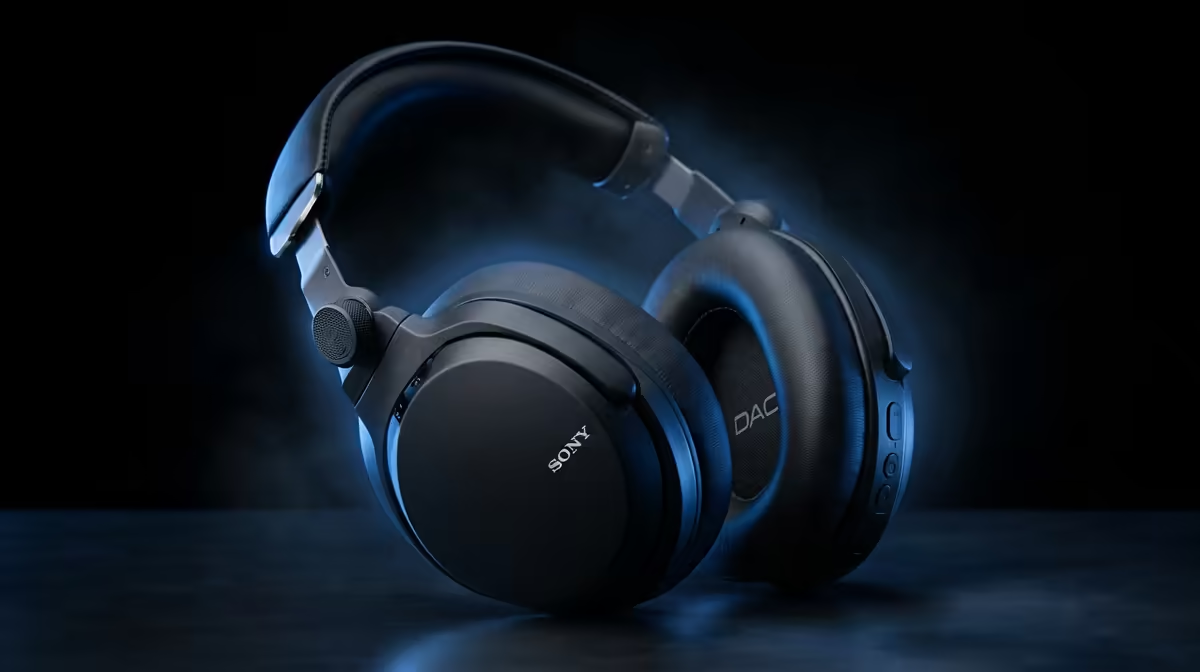
Bio-cellulose diaphragms are stiffer and lighter than standard Mylar or PET plastic, enabling faster transient response and lower distortion especially in the upper midrange and treble. In direct comparison, 50mm bio-cellulose drivers produce cleaner, more detailed high-frequency audio than standard drivers of the same diameter.
The Science Behind Bio-Cellulose Drivers 🔬
Conventional gaming headset drivers use a Mylar or PET diaphragm, cheap and consistent, making them ubiquitous in headsets from R500 to R1,500. The limitation is that plastic diaphragms flex unpredictably at high drive levels, producing harmonic distortion that smears fine detail. Bio-cellulose is derived from bacterial fermentation and forms a fibre structure with exceptional stiffness-to-mass ratio. The diaphragm moves as a single rigid piston rather than flexing unevenly, keeping total harmonic distortion measurably lower across the frequency range, particularly above 5 kHz.
What the Difference Sounds Like in Games and Music 🎧
Bio-cellulose improvements are most obvious in two scenarios: complex orchestral game soundtracks and competitive shooter audio. Soundtracks with layered strings and brass sound less congested because each instrument has more perceived space in the stereo image. In shooters, crisper high-frequency transients make it easier to distinguish the direction and distance of enemy audio events. For music, cymbal work and acoustic guitar plucks are more resolved than on comparable standard drivers. Bass response is largely similar between the two types, as low-frequency performance is controlled more by driver size and the surround material than by diaphragm stiffness. SA audiophile gamers spending R2,000 to R4,000 are in the bracket where bio-cellulose becomes a realistic differentiator.
Is the Premium Justified for Everyday Gaming? 💰
For casual gamers running at moderate volume in mixed sessions, standard 50mm drivers in a well-tuned headset will sound satisfying and the bio-cellulose difference will be subtle without a direct comparison. The advantage is most tangible at higher volume where distortion compounds and during long sessions where listening fatigue accumulates. If your headset doubles as your primary music headphones and you listen to complex audio for two to three hours daily, the upgrade is justifiable. For players focused on competitive gaming at moderate volume, where bass punch for explosions matters more than treble refinement, the practical difference narrows.
Driver Break-In Reality Check ⚡
Bio-cellulose drivers may sound slightly stiff in the first few hours of use as the suspension settles. This is normal and not a defect. Give the headset 10 to 20 hours of normal use before forming a final judgment on bass extension and soundstage width.
FAQ
Do bio-cellulose drivers require special care?
No special care beyond protecting any quality headset from extreme heat, moisture, and physical impact. Bio-cellulose diaphragms are sealed inside the driver housing and not exposed to the environment during normal use.
Are 40mm bio-cellulose drivers better than 50mm standard Mylar drivers?
Driver size and material are independent factors. A well-tuned 40mm bio-cellulose driver can outperform a poorly tuned 50mm Mylar driver. That said, 50mm bio-cellulose combines the advantages of both larger surface area for bass and lower distortion in the treble.
Can I hear the difference when gaming on PlayStation 5?
Yes, via USB or 3.5mm connection. The PS5's Tempest 3D audio benefits from clean high-frequency transient reproduction, and bio-cellulose drivers render Tempest's spatial cues with slightly more precision than standard drivers in the same class.
Want to hear what premium drivers actually sound like?
Evetech stocks gaming headsets from entry-level 40mm Mylar up to bio-cellulose flagship models, all available for immediate dispatch.