Quick Answer
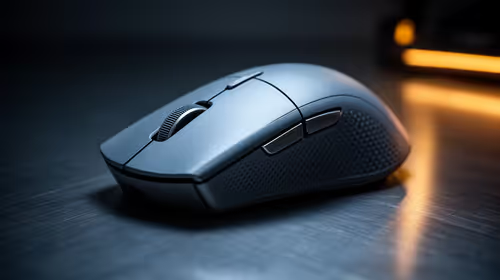
Pro gamers benefit most from a polling rate of 1,000 Hz minimum, with 4,000 Hz or 8,000 Hz providing measurable advantages on 240 Hz-plus monitors. Sensor precision should come from a native optical sensor rated above 20,000 DPI with zero acceleration, such as the PixArt PAW3395 or PAW3950, rather than interpolated budget options.
Polling Rate Explained for Competitive Players 🎮
Polling rate measures how many times per second your mouse reports its position to your PC. At 125 Hz, a report arrives every 8 milliseconds. At 1,000 Hz that drops to 1 ms. At 8,000 Hz it drops to 0.125 ms. The practical impact is that fast wrist flicks produce smoother cursor trajectories: at 125 Hz a rapid movement may show only two or three data points, creating a stepped cursor path. At 1,000 Hz the path is resolved with far more points and tracks your intent more faithfully.
The advantage of 4,000 Hz and 8,000 Hz becomes most visible at 240 Hz monitors and above. At 360 Hz panels, each frame is 2.78 ms apart, meaning a 1,000 Hz mouse delivers fewer than three position updates per frame. An 8,000 Hz mouse delivers over 22 updates per frame, virtually eliminating motion quantisation during fast sweeps.
Sensor Precision: What the Spec Sheet Should Say 🔬
For professional-grade use, the spec sheet must confirm native optical tracking across the full DPI range (no interpolation), acceleration below 50 G, speed tracking above 250 IPS, and lift-off distance below 2 mm (ideally configurable). The PixArt PAW3950 meets all of these. Avoid any sensor described only by max DPI without listing acceleration or IPS specifications.
Sensor LOD matters for players who frequently reposition by lifting the mouse. A long LOD continues tracking fractionally after the mouse leaves the surface, which can shift the crosshair on re-plant.
Matching Hardware to Your Monitor Refresh Rate 🖥️
Running an 8,000 Hz mouse on a 60 Hz monitor provides no competitive benefit: the display shows 60 new frames per second regardless. Match your hardware tier to your display. A 144 Hz monitor pairs well with 1,000 Hz, 240 Hz pairs with 2,000 to 4,000 Hz, and 360 Hz justifies 8,000 Hz. South African semi-professional setups commonly use 1080p 240 Hz monitors paired with mice from the Razer Viper V3 Pro or Logitech G Pro X 2 Superlight tier, priced around R2,000 to R2,800 locally.
USB Port Choice Affects Polling ⚡
Plugging your mouse into a USB hub rather than a direct motherboard port can cap your effective polling rate regardless of what the mouse is set to. For consistent 4,000 Hz or 8,000 Hz, connect directly to a rear USB 3.2 port on your motherboard.
FAQ
Does a higher polling rate drain more battery in wireless mice?
Yes. Running at 8,000 Hz wireless can reduce battery life by 60 to 70 percent compared to 1,000 Hz. Most wireless mice with 8,000 Hz support allow switching between rates, so you can use 4,000 Hz for casual play and 8,000 Hz for competitive sessions.
Will my older gaming PC struggle to process 8,000 Hz mouse input?
A small CPU overhead is associated with high polling rates. On a modern Ryzen 5 or Core i5 processor the impact is negligible, but on CPUs older than five to six years you may see a measurable increase in CPU usage from mouse interrupt handling at 8,000 Hz.
What polling rate do most South African pro esports players use?
The majority still run 1,000 Hz, as it is the tournament-standard setting. 8,000 Hz hardware is used in practice environments by players whose rigs support it, building muscle memory on the most responsive input possible.
Ready to game at pro-level polling rates?
Evetech stocks high-polling-rate mice from Razer and Logitech. Browse the gaming mouse range at Evetech and find a sensor that matches both your monitor refresh rate and your competitive goals.