Quick Answer
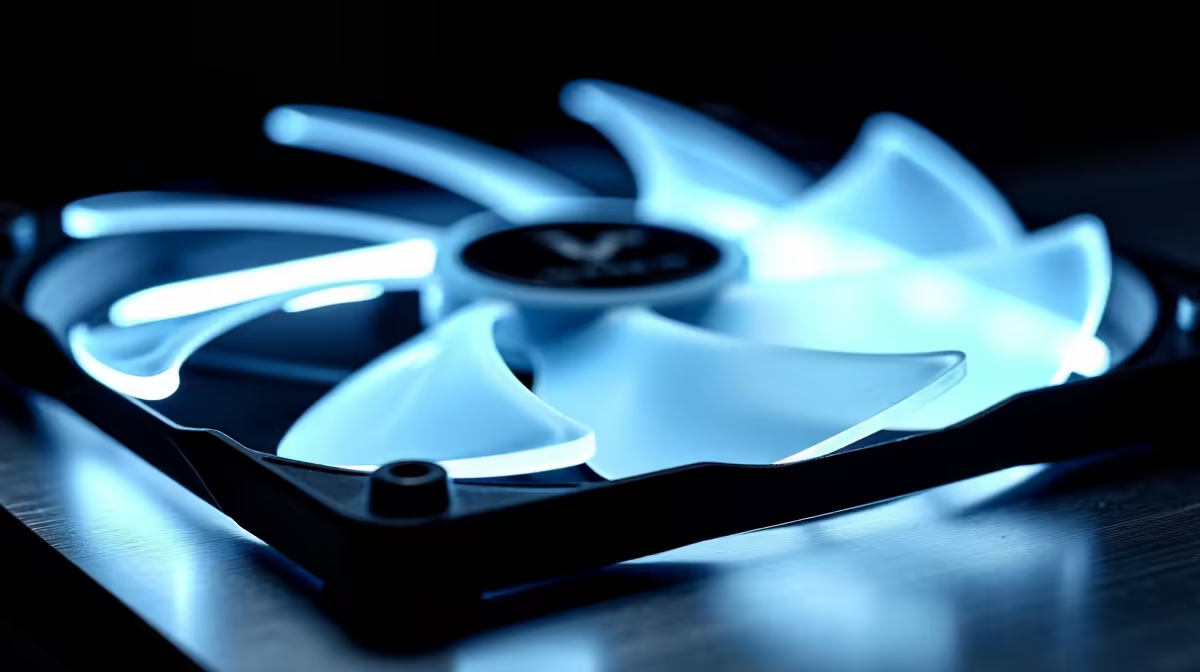
Liquid crystal polymer (LCP) fan blades maintain their designed aerofoil shape under load where ABS or PBT blades flex and deform. This stiffness reduces tip turbulence, improves airflow consistency across the RPM range, and is the primary reason premium fans rated 55 to 65 CFM actually deliver those numbers in real use.
LCP as an Engineering Material 🔧
Liquid crystal polymer is a wholly aromatic polyester thermoplastic that aligns its molecular chains during moulding to produce exceptional directional stiffness. The flexural modulus of LCP exceeds 18 GPa in the primary orientation, compared to 2 to 3 GPa for standard ABS. This means an LCP blade at 2,000 RPM deflects roughly six to eight times less than an ABS blade under the same centrifugal load. At 120mm radius, that translates to tip displacement differences of 0.3 to 0.5 mm, which changes the tip-to-shroud clearance from tight (efficient) to loose (turbulent). Tighter clearances convert more motor energy into directed airflow rather than tip vortex noise.
Airflow Stability Across the PWM Range 🖥️
At low PWM duty (20 to 30%), all blade materials behave similarly because centrifugal forces are low. At mid-range (50 to 70% duty, 900 to 1,400 RPM on a 120mm fan), ABS blades begin to flex measurably, reducing effective blade pitch angle by 0.5 to 1.5 degrees compared to the zero-speed design. LCP blades hold pitch angle accurately across this range, delivering consistent CFM and static pressure that matches the manufacturer's published curve. For creator workstations running sustained medium-speed fan operation during long renders, this consistency prevents temperature drift across a multi-hour Blender or DaVinci Resolve session.
Temperature Performance and SA Climate Relevance 🌡️
ABS begins to soften above 80 to 100 degrees Celsius and fatigues under repeated thermal cycling well below that. Inside a South African gaming PC during a Highveld summer, internal case temperatures of 40 to 50 degrees Celsius are not uncommon. Over 18 to 24 months of daily thermal cycling, ABS blades can develop micro-distortions that permanently alter their balance. An unbalanced impeller generates increasing vibration noise that cannot be corrected without replacement. LCP's thermal stability above 200 degrees Celsius means it completes thousands of thermal cycles with zero dimensional change, preserving blade geometry for the fan's full rated lifespan.
Spin Test New Blades Before Building ⚡
With the fan connected to a test header but not yet installed, spin it up to 100% duty and listen for any flutter or irregularity. Premium LCP-bladed fans produce a smooth, consistent airflow sound with no periodicity. Any rhythmic pulsing suggests a blade moulding defect. This one-minute check saves the effort of diagnosing vibration noise after a completed build.
FAQ
Are LCP blades available in ARGB fans, or only in plain models?
Both. Several premium fan lines combine LCP blades with ARGB LED rings. The lighting hardware is in the hub and shroud, not the blades, so ARGB and LCP are entirely compatible. Expect to pay R380 to R500 per fan for a unit that combines both.
Does LCP stiffness affect how the fan sounds at startup?
LCP fans produce a crisper, quieter startup sound because blade stiffness prevents the brief flutter that ABS blades exhibit spinning up from rest. This is a minor difference but noticeable if you are sensitive to PC acoustics.
Is there a meaningful airflow difference between LCP and ABS fans of the same rated CFM?
The real difference emerges at mid-speed operation where LCP fans consistently deliver 8 to 12% more airflow than their rated mid-speed interpolation because blade pitch is maintained throughout the RPM range.
Want consistent airflow throughout your build's lifetime?
Evetech stocks premium case fans with LCP and high-rigidity blades. Check the cooling section for 120mm and 140mm options with full spec listings.