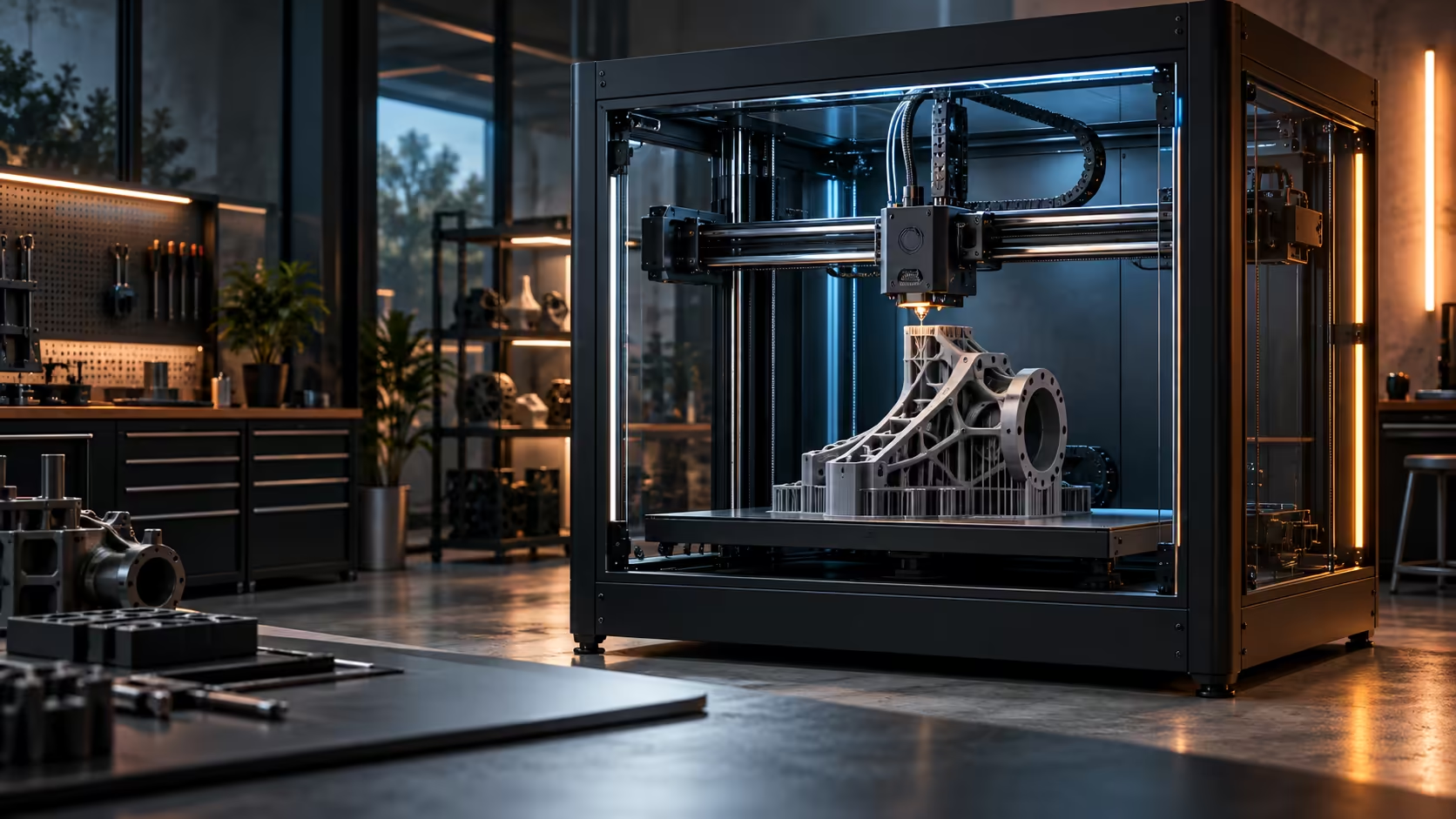
Ventilation advice for 3D printing usually assumes a garage door that opens onto fresh air whenever needed. Built-in air purifiers for South African indoor 3D printing matter precisely because that assumption does not hold for most people printing at home here.
Quick Answer
Yes, they are worth it, because almost nobody printing here has a separate, ventilated workshop for the machine. It ends up in a home office, a lounge corner or a small flat, and a Highveld winter means shut windows for weeks at a stretch, so the purifier built into the Creality K1 Max, at R13,999, does work that an open garage door would otherwise do for free.
🏠 Where the printer actually lives, versus where guides assume it lives
International printing guides are often written assuming a dedicated garage or workshop with easy ventilation, and that assumption quietly shapes a lot of generic advice about air quality. Locally, the printer is far more likely to be on a desk in a spare room, a corner of an open-plan lounge, or a small flat with limited separate spaces at all.
That difference matters because it changes the baseline: a purifier is solving a real problem in a room roughly 10 to 15 metres square, not adding an unnecessary extra to a setup that already has good airflow.
❄️ Winter closes the window that summer left open
A Johannesburg or Pretoria winter, with overnight temperatures regularly dropping below 5C from around June to August, often means windows shut for comfort and, at times, for security, for weeks at a stretch. That is exactly the season when relying on natural ventilation to clear a room after a print stops being realistic, and a built-in purifier keeps working regardless of whether a window is actually open.
🌬️ What the purifier is actually doing
An enclosed printer with filtration traps what a print gives off before it spreads into the room, rather than relying on the room itself to dilute and clear it naturally. This matters most for materials like ABS, which give off more during printing than PLA does, and it matters most of all in a small or poorly ventilated space, which describes a large share of South African homes.
Run it for the whole print, not just the busiest-looking part of the job, and pair the printer with a genuine smart home air quality monitor if the room has no reliable way to clear itself between prints, alongside other smart appliances if you are building out a fuller home office setup around it. Check the wider 3D printer range too if you are still deciding between an enclosed machine and an open-frame one for a small home.
🏢 Complexes and townhouses add their own restriction
A significant share, well over 20%, of South Africans printing at home live in a complex, a townhouse or another sectional title scheme rather than a freestanding house, and that reality changes the whole ventilation conversation again. Body corporate rules sometimes restrict structural changes like installing an external extraction vent, which rules out one of the more effective solutions a freestanding homeowner might otherwise reach for.
A built-in purifier sidesteps this entirely, since it needs no external venting and no permission from a body corporate to install or run. For anyone renting or living under a sectional title scheme, this is often the deciding factor over a separate standalone extraction unit that would need structural approval most bodies corporate are reluctant to grant for a single tenant's hobby.
🕐 Timing prints around the household, not just the machine
Beyond the room itself, when a print runs matters almost as much as where. Starting a long ABS print right before a household goes to sleep gives the purifier a full 8 hours to work through the print's emissions in an otherwise empty room, rather than running it during the day when the same space is occupied and windows might otherwise have been opened.
This timing habit costs nothing and pairs naturally with the built-in purifier rather than replacing it: run the print overnight, let the purifier do its job undisturbed, and air the room out briefly the next morning before anyone spends real time in it. For a household without a dedicated print room, this simple scheduling change does more for everyday comfort than any single hardware purchase could achieve entirely on its own, and it costs nothing beyond a small change in habit.
Frequently Asked Questions
Do I still need a purifier if I only print PLA?
Less critically, since PLA gives off less than ABS, but it does no harm and covers you for any future material change.
Is opening a window enough instead of using a purifier?
It helps when practical, but a purifier keeps working through winter months or security concerns that keep windows closed for extended periods.
Does room size affect how necessary a purifier is?
Yes, a smaller or less ventilated room benefits more, since there is less natural air volume to dilute what a print releases.
Should the purifier run for the entire print or just part of it?
The entire print, since emissions continue throughout rather than stopping after the first layer or two.
Can I install an external extraction vent if I live in a complex or townhouse?
Often not without body corporate approval, since it usually counts as a structural change to a shared wall or roofline, which is exactly the kind of restriction a built-in purifier avoids entirely.
Does printing overnight actually help air quality more than printing during the day?
Yes in most households, since an empty room overnight gives the purifier uninterrupted time to work before anyone spends real time in that space the next morning.
Is it safe to leave a printer running unattended overnight with filtration on?
Most enclosed machines with built-in monitoring are designed with unattended long prints in mind, though it remains sensible to keep the printer on a stable, cleared surface, away from anything flammable nearby, and to check it once more before turning in for the night.
Does a purifier reduce the smell of ABS as well as any genuine health risk?
Yes to both, since the same filtration stage that captures fine particles also reduces the distinct plastic smell ABS gives off while printing, which is usually the very first thing a household actually notices about a new printer running in the house.
Printing indoors without a dedicated workshop?
Let a built-in purifier do the ventilation job a closed window cannot.