Quick Answer
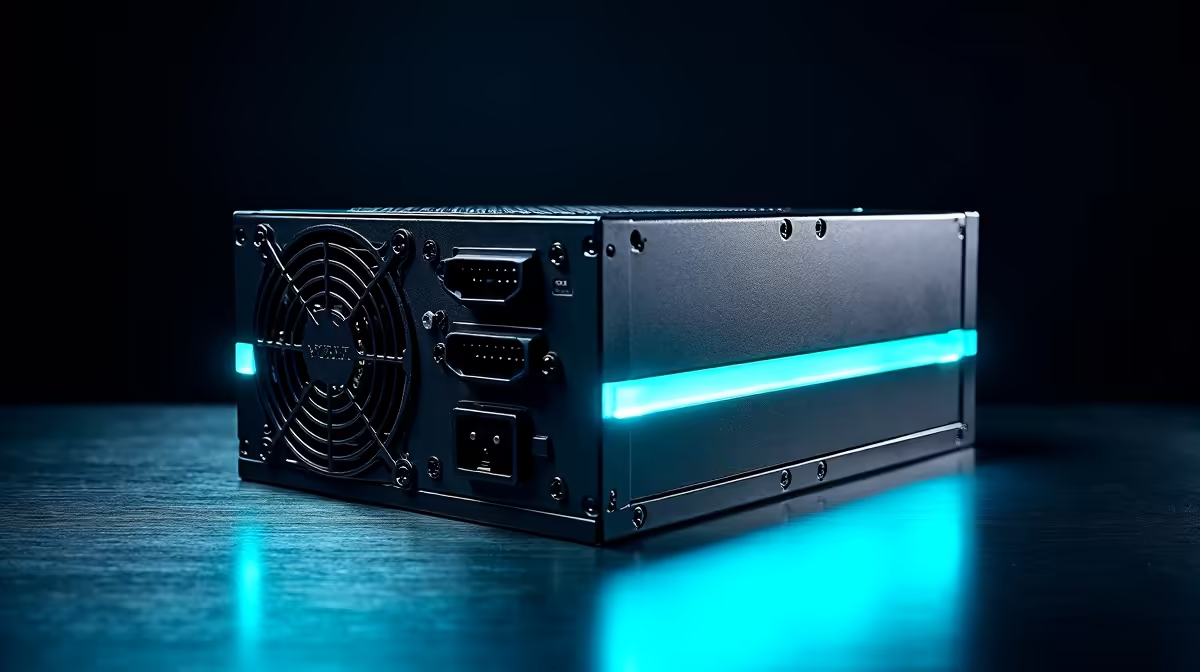
ATX 3.1 improves on ATX 3.0 primarily by replacing the problematic 12VHPWR connector with the safer 12V-2x6 connector, which has better contact design and latch retention. ATX 3.0 already introduced the 200% transient current tolerance; ATX 3.1 refines connector safety and adds minor cable management updates.
The Core Connector Change: 12VHPWR to 12V-2x6 🔧
The 12VHPWR connector introduced in ATX 3.0 came under scrutiny when reports of melted connectors emerged on RTX 4090 launches in 2022 and 2023. Investigation pointed to improper seating and flexing causing arcing at high-current pins. The 12V-2x6 connector in ATX 3.1 addresses this through a redesigned latch mechanism with better retention force, improved pin contact geometry less susceptible to partial insertion, and a modified cable strain relief profile. The sense pin configuration was also updated for more reliable power state communication between PSU and GPU. For South African builders installing GPUs in the R15,000 to R35,000 range, this connector improvement is not trivial: a melted connector event on an RTX 5080 could damage the GPU power circuit and result in a lengthy local warranty dispute.
What ATX 3.0 Got Right That ATX 3.1 Preserves 📊
The transient response requirement introduced in ATX 3.0 and carried forward unchanged into ATX 3.1 is the more impactful electrical specification. It mandates that a compliant PSU handle peak current at 200% of rated load for up to 100 microseconds without triggering OCP shutdown. This allows GPUs with large power-delivery spikes to run without nuisance shutdowns or black screen events. Both ATX 3.0 and ATX 3.1 PSUs share this capability. If you already own an ATX 3.0 unit with a properly-seated cable, you are not in danger from the electrical specification. The risk that ATX 3.1 addresses is specifically the connector physical design.
Should SA Builders Upgrade from ATX 3.0 to ATX 3.1? 💰
If you own an ATX 3.0 PSU in good condition with a properly-seated 12VHPWR cable, there is no urgent need to replace it for ATX 3.1. However, if you are buying a new PSU for a 2026 build, always choose ATX 3.1. The price difference between comparable ATX 3.0 and ATX 3.1 units has largely collapsed as ATX 3.1 becomes the mainstream standard. Most new-stock high-performance PSU ranges at Evetech in the R3,500 and above bracket are now ATX 3.1 certified.
Inspect Your Existing 12VHPWR Cable Before Trusting It ⚡
If you are keeping an ATX 3.0 PSU with its 12VHPWR cable, inspect the connector for any discolouration, melting, or deformation at the GPU-end housing. Any discolouration is a signal to replace the PSU or cable immediately. The 12VHPWR cable from one ATX 3.0 PSU brand cannot safely be used on a different brand's PSU due to pin layout differences.
FAQ
Can an ATX 3.0 PSU run an RTX 5090 safely?
The transient tolerance specification is identical in ATX 3.0 and ATX 3.1, so an ATX 3.0 PSU with adequate wattage (1000W to 1200W) can handle the GPU power delivery. The connector safety concern is the differentiator: use an ATX 3.0 unit only with a native 12VHPWR-to-12V-2x6 conversion cable supplied by the GPU manufacturer.
Are ATX 3.1 PSUs noticeably more expensive than ATX 3.0 in SA right now?
No. By mid-2026, ATX 3.1 has become the de facto standard for new-production high-performance PSUs. Most fresh stock at South African retailers including Evetech ships with ATX 3.1 certification. Residual ATX 3.0 stock at slight discount carries the older connector standard.
Does ATX 3.1 certification affect the PSU's Cybenetics efficiency rating?
No. ATX specification version and Cybenetics ETA or Lambda ratings are entirely independent certifications. ATX specification defines electrical tolerances, connector standards, and transient response; efficiency is determined by converter topology and component quality independently.
Upgrading your PSU to ATX 3.1?
Evetech carries the latest ATX 3.1 certified power supplies with native 12V-2x6 connectors from 750W to 1200W. Find your unit in the power supply section at Evetech.