Quick Answer
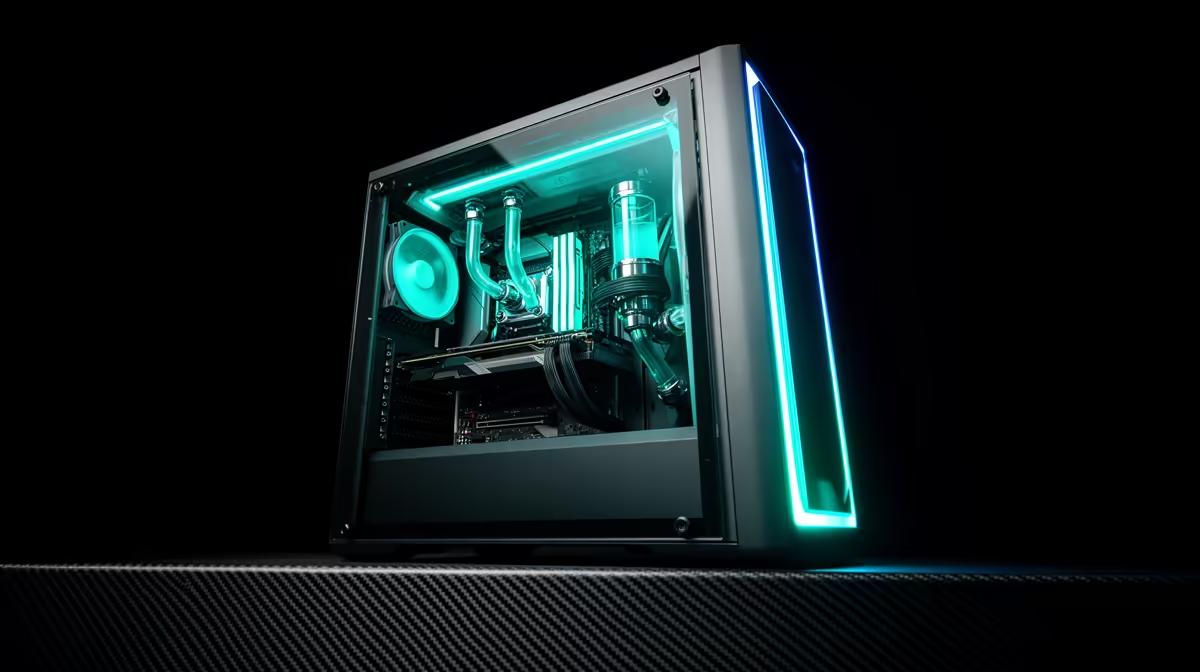
The best case features for a build combining a large GPU, liquid cooling, and future upgrade flexibility are: 380mm or more GPU clearance with a front radiator installed, support for both 360mm and 420mm radiator mounts, a built-in GPU sag support, tool-free side panels, and at least 25mm of behind-tray cable routing space. These five features handle today's hardware and leave room for every plausible upgrade over a five-year horizon.
GPU Clearance and How to Future-Proof It 📐
Current triple-fan flagship GPUs reach 360mm in length. Cases offering 400mm or more of GPU clearance with a front radiator installed give a comfortable margin over two GPU generations. At R2,500 to R4,500, full-tower cases with 400mm-plus clearance are available at Evetech and represent the most future-safe option.
GPU slot support is a separate consideration. Multi-GPU configurations are rare for gaming but relevant for professional workloads. If your build might incorporate a compute card in future, confirm that the case has an empty PCIe slot position below the first x16 slot to accommodate the second card's height.
Liquid Cooling: Planning for 360mm and 420mm Radiators 🌡️
A case that supports a 360mm front radiator today can be upgraded to a 420mm unit only if the case also lists 420mm front mount support. These are not interchangeable: 420mm uses three 140mm fans requiring different mounting hole spacing than three 120mm fans of a 360mm radiator. Confirm both radiator sizes on the spec sheet if 420mm remains a future option.
For a Ryzen 5 9600X build today that might become a Ryzen 9 9950X in three years, the thermal step is significant. A 360mm AIO managing a 65W gaming CPU must handle a 170W all-core workstation CPU in the upgrade scenario. Having a 420mm-capable front bay means the case accommodates that upgrade without replacement.
Future Upgrade Pathways That Depend on Case Features 🔧
Beyond cooling and GPU clearance, future upgrades depending on case features include NVMe SSD expansion, memory clearance for tall heatspreader RAM kits, and front panel connectivity. A USB-C 3.2 Gen 2 or Thunderbolt 4 front panel header supports current and future high-speed peripherals without a motherboard change.
For South African builders who upgrade components incrementally over five-plus years, a case with broad feature coverage is financially rational. The case cost is amortised over a longer period than any other component, making quality and feature coverage the primary selection criteria.
Future-Proof Case Selection Test ⚡
finalising a case purchase, list the three most ambitious upgrades you could realistically make over five years: a 420mm AIO, a flagship GPU, and an E-ATX board. Check each against the case spec sheet. If two out of three are supported, the case is adequately future-proofed.
FAQ
Does cable management space affect future upgrades?
Yes. A modular PSU upgrade from 650W to 1,000W adds cable thickness. Cases with under 20mm behind-tray routing space become unmanageable after two or three component upgrades. A minimum of 25mm behind the tray future-proofs cable routing for at least two major upgrades.
Should I buy a case for the next GPU or the current one?
Always plan for the next GPU tier as a minimum. RTX 5090 and RX 9070 XT triple-fan variants set a new baseline for length and weight. A case that is tight with today's GPU will likely not accommodate the next generation without compromising on the front radiator mount.
Is it worth spending more on a case to avoid replacing it?
Yes, unambiguously. A R3,500 case lasting ten years costs R350 per year. A R1,500 case replaced after three years and again after six costs R500 per year in case spend alone, plus two full build teardowns. Quality cases are among the best long-term value investments in PC building.
Building with the next five years in mind?
Evetech stocks cases with 420mm radiator support, 400mm-plus GPU clearance, and robust cable routing to keep your build upgrade-ready well beyond your first hardware cycle.