Quick Answer
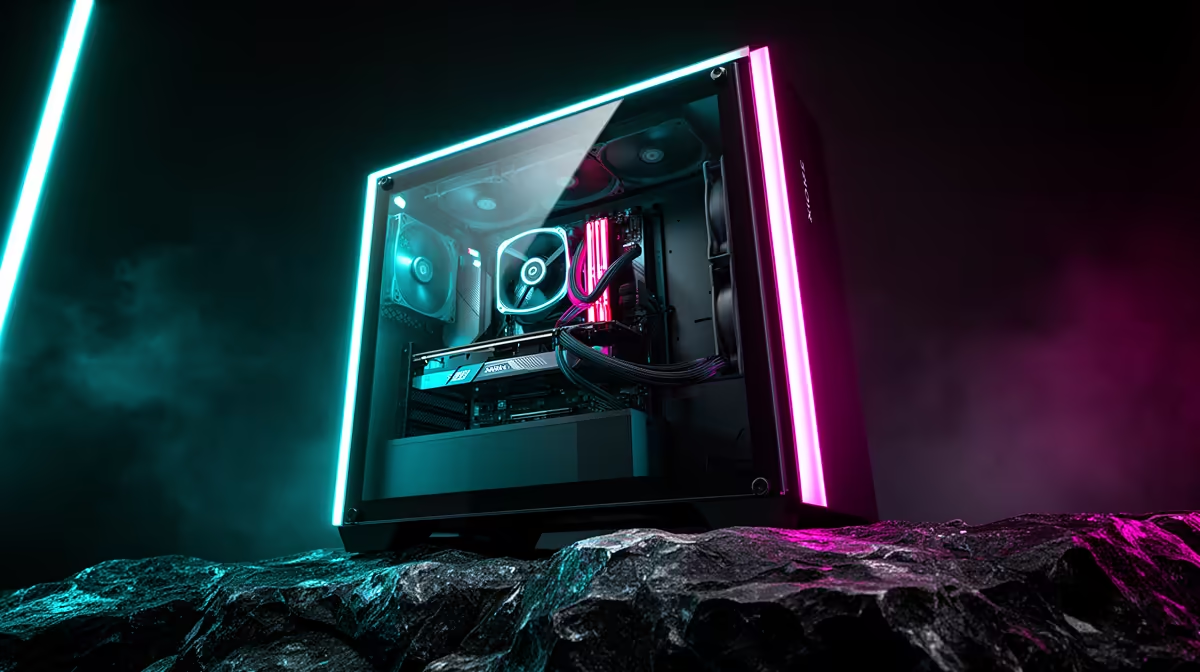
For extreme cooling on a tight budget, prioritise a full-mesh front panel, support for at least three 120mm or two 140mm front fans, a top 360mm radiator mount, and solid cable management. You can achieve this in South Africa for R1,800 to R3,200 without sacrificing meaningful cooling performance.
The Spec Sheet That Matters for Extreme Cooling 🌬️
Not every case spec that sounds impressive translates into real thermal performance. Focus on these six specifications when shopping rand-conscious. First, front panel material: mesh beats glass for airflow by a significant margin. Second, fan slot total: a minimum of three front intakes plus two top exhausts plus one rear exhaust gives a six-fan baseline that handles an RTX 5070 Ti or RX 9070 XT without thermal throttling. Third, radiator clearance: 360mm top support lets you pair an AIO cooler with the R2,500 to R4,000 range 360mm units. Fourth, PSU shroud: full-length shrouds improve airflow by hiding cable clutter that otherwise obstructs GPU airflow. Fifth, cable management depth: at least 20mm of space behind the motherboard tray for routing. Sixth, removable dust filters: a non-negotiable in South Africa's dusty inland environments.
Cases That Hit This Spec at South African Prices 💰
In the R1,800 to R3,200 bracket, cases from DeepCool, Antec, Cougar, and Fractal Design regularly appear on local shelves with full-mesh fronts and 360mm radiator support. The Fractal Design Pop Air and DeepCool Matrexx series are solid examples of cases that achieve genuine airflow-focused design without requiring premium materials. For builders running an AMD Ryzen 7 9700X or Intel Core i7-14700KF with a high-TDP GPU, these cases keep temperatures within acceptable ranges at a fraction of the cost of flagship options.
Where to Save and Where Not to Scrimp 🔧
Save on: aesthetics, RGB included fans (you can add ARGB fans later for R150 to R350 each), aluminium panels, and curved glass. These are cosmetic additions that do not affect cooling. Do not scrimp on: the number of fan mounts (you cannot add mounts later), the quality of the chassis steel (thin steel resonates and vibrates under high fan speed), and the presence of dust filters (retrofitting filters is difficult). A R2,200 mesh case with zero ARGB and no fancy glass will thermally outperform a R2,500 glass-front case with two fans and no radiator support.
Arctic P-Series for Budget Cooling ⚡
Arctic P12 and P14 PWM fans are among the best price-to-performance case fans stocked locally, typically around R120 to R200 each. A set of five P14 fans in intake-and-exhaust configuration on a mesh case delivers near-premium airflow at a fraction of the cost of Noctua or Corsair alternatives, freeing budget for CPU or GPU upgrades.
FAQ
Can a R2,000 case support extreme CPU cooling for a high-end processor?
Yes, if it has 360mm radiator support and a mesh front. A 360mm AIO on a Ryzen 9 9900X in a R2,000 mesh case will perform within two to three degrees Celsius of the same cooler in a R7,000 flagship case during sustained workloads.
How many fans should I buy separately when getting a budget case?
Budget three to six additional fans depending on the case. Most budget cases ship with one or two fans. To fully populate front, top, and rear positions, you will need to supplement the included fans. Budget R600 to R1,200 for a set of quality aftermarket fans.
Is it worth buying a second-hand case on local SA classifieds for extreme cooling builds?
Second-hand cases work well if you inspect them in person. Check dust filter condition, fan mount integrity, and front mesh for damage. Avoid second-hand cases where the PSU shroud is bent or where glass panels are chipped, as these indicate rough handling.
Need maximum cooling on a controlled budget?
Evetech stocks mesh-front gaming cases, AIO coolers, and case fans across all price points, with real stock available for fast SA delivery.