Quick Answer
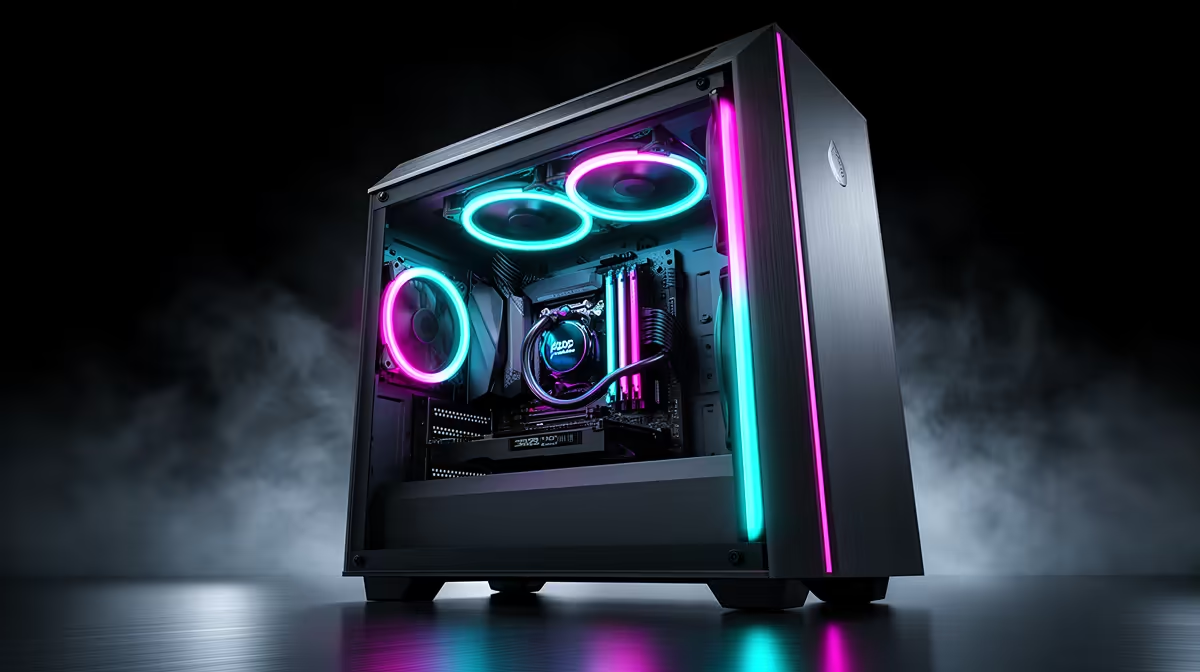
For a 420mm GPU, you need a case with at least 440mm stated GPU length clearance, a generous PSU shroud-to-PCIe-slot gap for 12VHPWR connectors, front mesh intake for thermal management, and strong GPU support bracket compatibility. Mid-tower and full-tower ATX cases are your realistic options; most compact mATX cases will not fit a 420mm GPU safely.
Why 420mm GPUs Need Full-Tower Dimensions 📐
A 420mm GPU is an unusually long card, exceeding the length of even most three-fan flagship GPUs. The RTX 5090 Founders Edition measures around 336mm, but select ASUS ROG and Gigabyte AORUS triple-fan triple-slot variants on high-end GPUs can push 380mm to 420mm. At 420mm, you are selecting a case that accommodates the absolute maximum GPU market length. Cases that specify 410mm or 420mm GPU clearance include full-tower designs like the Corsair 7000D AIRFLOW and mid-towers with simplified internal layouts. Expect to pay R2,500 to R4,500 for a suitable enclosure locally. Do not rely solely on the advertised clearance figure: subtract 30mm for a PSU cable connector protrusion at the rear of the card and 20mm for any front bracket or fan mount at the intake side to get the true usable clearance.
PSU Placement and Cable Management for Long GPUs 🔌
Cases designed for long GPUs generally use bottom-mounted PSUs with the intake fan pointing downward through a ventilated floor, which completely separates PSU airflow from GPU airflow. This layout also places the PSU cables closer to the GPU's 12VHPWR connector, reducing cable run length. For a 600W GPU like the RTX 5090, use a PSU of at least 1,000W and verify the 12VHPWR cable has a 90-degree right-angle end. Straight connectors protrude 60mm further into the case interior, which can physically block the side panel from closing when the GPU occupies the full depth of the chassis. Full-modular PSUs with individually routed cables make a meaningful difference in available cable routing space inside long-GPU builds.
GPU Sag Prevention in a 420mm Build 🏋️
A 420mm GPU is heavy, often 1.5kg to 2.0kg, and the leverage arm from the PCIe slot to the card's front edge creates significant sag force. Without a support bracket, you will see visible downward deflection of the card within weeks of building. Cases designed for extreme GPU lengths often include a dedicated GPU support rail or bracket position in their specification. If your chosen case does not include one, Evetech stocks aftermarket GPU support brackets compatible with standard rail positions, costing R250 to R600. Check that the bracket height is adjustable to match your specific GPU cooler thickness, as triple-slot coolers sit 15mm higher than dual-slot designs.
Verify True Clearance Before Building ⚡
Download the case's PDF installation manual before purchase and locate the GPU clearance diagram. Marketing pages list the maximum theoretical clearance; the manual shows the practical clearance with all brackets, rails, and cable routing panels installed. For 420mm GPUs, every millimetre counts.
FAQ
Which ATX mid-tower cases handle 420mm GPU length?
Cases like the Fractal Design Torrent, Lian Li O11 Dynamic EVO, and Corsair 5000D AIRFLOW all accommodate GPUs above 400mm. Verify the specific clearance figure for each as it varies between revisions.
Does a longer GPU always mean better performance?
No. GPU performance is determined by the chip, VRAM capacity, power limits, and cooling efficiency, not card length.
Is there a risk of PCIe slot damage from a 420mm GPU over time?
Yes, without a support bracket. Sustained GPU sag places a torquing force on the PCIe x16 slot, which can crack solder joints on the motherboard over months to years. A GPU support bracket eliminates this risk entirely and costs far less than PCIe slot repair or board replacement.
Fitting a flagship GPU in your next build?
Evetech stocks full-tower and large mid-tower cases with the clearance specs you need, plus GPU support brackets to keep your heavy card perfectly level.