Quick Answer
For high-end GPU builds on a controlled ZAR budget, prioritise in this order: correct wattage headroom (1000W minimum for RTX 5080, 1200W for RTX 5090), 80 Plus Gold or Platinum certification, full modularity, and a native 12V-2x6 cable. ATX 3.1 compliance and ten-year warranty are bonus features worth paying for if the price gap is under R500.
Wattage: Where to Draw the Line for Each GPU Tier 💰
Matching PSU wattage to GPU tier is the most cost-effective PSU decision. The RTX 5070 Ti at 285W combined with a Ryzen 7 9700X (65W) and system overhead totals around 430W: a 750W Gold PSU at R1,800 to R2,500 covers this with room to spare. The RTX 5080 at 360W plus a Ryzen 9 9900X at 125W peaks near 600W, putting a 750W unit at 80 percent capacity and an 850W unit at 70 percent. Spending R400 to R600 more for 850W over 750W in this scenario buys meaningful thermal headroom. The RTX 5090 is the only card that genuinely mandates 1000W or above for a complete system. Buying 1200W for an RTX 5070 Ti build is wasted money.
Efficiency Tier: Gold as the Budget-Smart Choice 🔧
On a ZAR budget, 80 Plus Gold is the most sensible efficiency tier for most high-end GPU builds. A quality 850W Gold unit from an established brand runs R2,000 to R2,800 in South Africa and provides 90 to 92 percent efficiency, lower ripple than budget Bronze units, and better transient response for GPU boost stability. The step to Platinum costs an additional R400 to R800, which is justified only for builds spending R20,000 or more on GPU hardware where the PSU will run sustained workloads. For a standard gaming build that peaks at 60 percent PSU load, Gold is the financially sound choice.
Connector and Modularity Priorities on a Budget 🔌
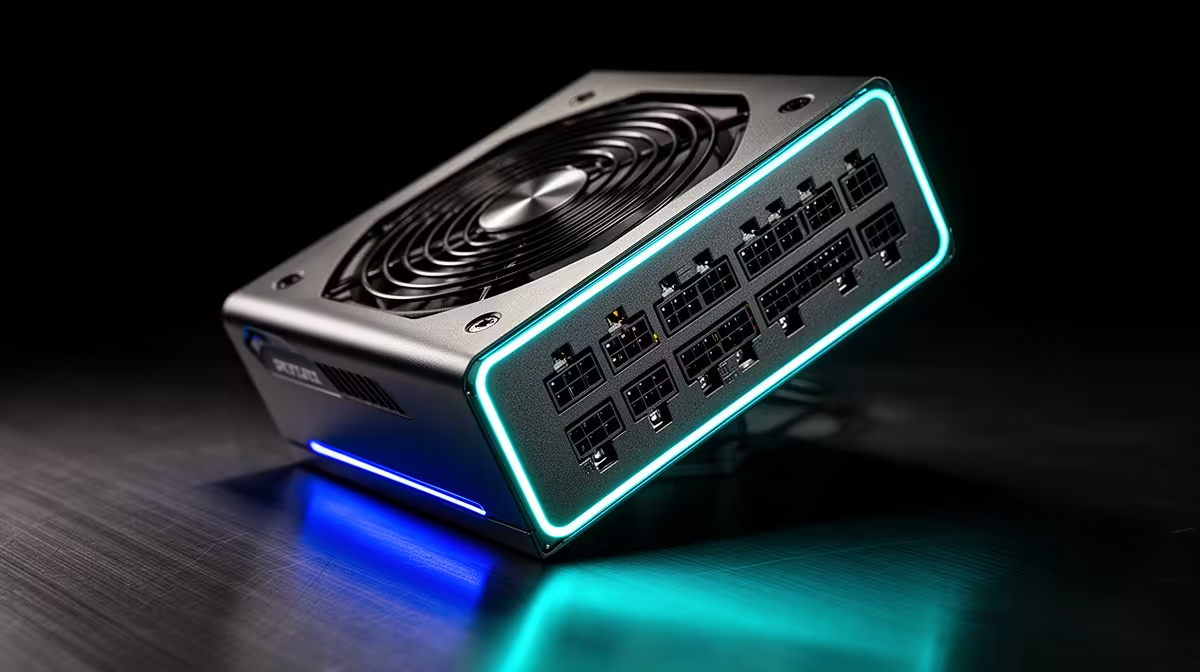
Full modularity is worth the R200 to R400 premium over semi-modular at any GPU tier above RTX 5060, because GPU cable management and future upgrade flexibility matter throughout the PSU's ten-year lifespan. The 12V-2x6 connector requirement depends on your GPU: RTX 5060 and RTX 5070 cards use 8-pin connectors and any quality Gold modular PSU works. RTX 5080 and RTX 5090 cards need the 12V-2x6, so confirm this cable is included before purchasing a PSU in the R2,500 to R4,000 range. Finally, avoid any PSU that does not specify a named certification: no-name 1000W units at R1,200 to R1,500 in SA with unverified efficiency ratings are false economy for a high-end GPU investment.
Buy One Tier Up on Wattage for Your GPU Pairing ⚡
If your calculated peak system load is 550W, buy an 850W unit rather than a 650W unit. The extra wattage headroom keeps the PSU running at 65 percent capacity rather than 85 percent, which directly extends capacitor lifespan and reduces fan noise over the unit's warranty period. The price difference between 750W and 850W Gold units in SA is typically R200 to R400.
FAQ
What is the best budget 80 Plus Gold PSU wattage for an RTX 5070 Ti build?
An 850W Gold fully modular unit is the ideal budget-smart choice for an RTX 5070 Ti paired with a mid-range CPU. It handles current loads comfortably and provides enough headroom to support a mid-generation GPU upgrade without PSU replacement.
Should I buy a cheaper non-modular PSU to save budget for the GPU?
Only if the build is in a non-windowed case and you do not plan future upgrades. For a windowed build or any build where cable management and airflow quality matter, the R200 to R400 modularity premium is worth the trade-off.
Do PSU brand names affect reliability at equivalent certification tiers?
Yes. Two Gold-rated 850W units from different brands can have significantly different capacitor quality, ripple suppression, and overcurrent protection design. Sticking to established brands with verifiable SA warranty coverage protects your investment more reliably than chasing the lowest price at a given wattage tier.
Maxing your GPU budget without compromising on power delivery?
Evetech stocks a full range of Gold and Platinum PSUs at every wattage tier, with local SA warranty and competitive pricing.