Quick Answer
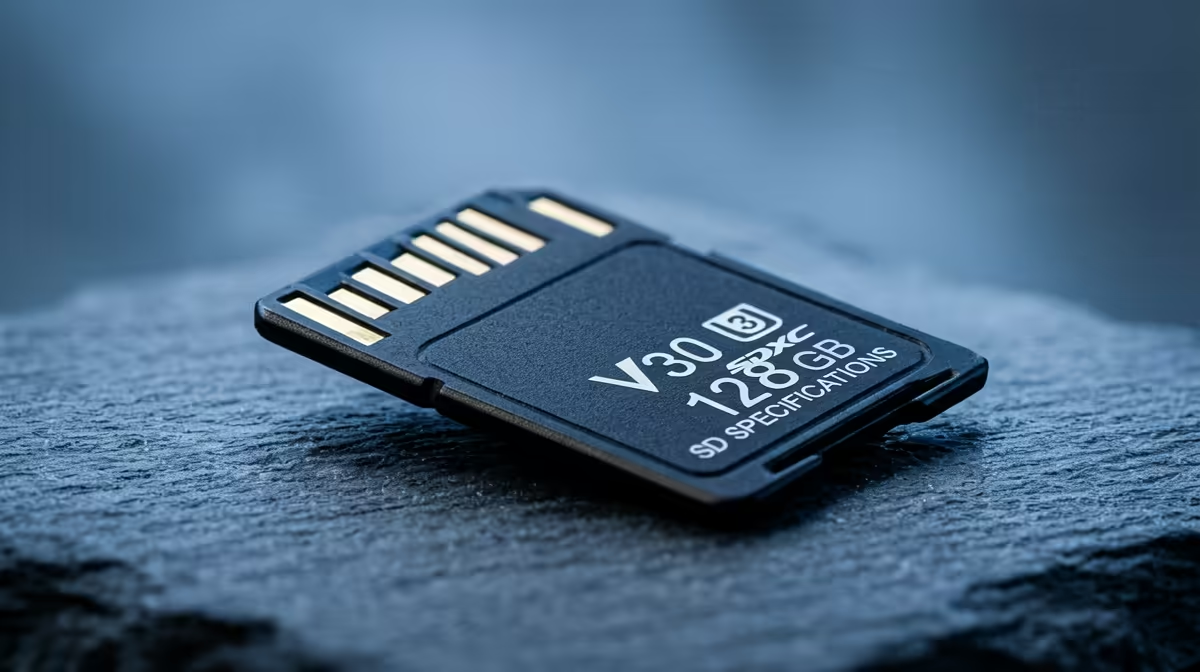
Yes. A V30 U3 SDXC card records 4K Ultra HD without dropped frames on the vast majority of consumer and prosumer camera bodies. V30 guarantees 30MB/s minimum sustained write, which comfortably exceeds the 12.5MB/s required for 4K at 100Mbps. The only exceptions are very high-bitrate formats above 200Mbps, which need V60 or V90.
What V30 and U3 Actually Guarantee 🔬
The Video Speed Class V30 is a standardised rating defined by the SD Association guaranteeing a minimum sustained sequential write speed of 30MB/s under real video recording conditions. UHS Speed Class U3 provides the same 30MB/s guarantee within the UHS-I bus framework. These two markings together confirm a card that will not drop below 30MB/s even in worst-case sustained recording scenarios. At 4K/30fps with H.264 or H.265 at 100Mbps, the camera demands 12.5MB/s. V30 provides 30MB/s, giving more than double the required margin. That headroom absorbs write spikes and background card management operations without dropping a single frame on bodies like the Sony ZV-E10, Nikon Z30, or Fujifilm X-S20.
When V30 Is Not Sufficient 📊
Three recording scenarios push beyond V30. First, 4K at 60fps at 200Mbps or above on bodies like the Sony A7 IV requires 25MB/s sustained; V30's 30MB/s floor barely covers it, making V60 the safer choice. Second, 4K All-Intra recording on Lumix and Sony cinema bodies reaches 400Mbps, demanding 50MB/s; V30 fails here. Third, some cameras in high-quality slow-motion modes generate data rates exceeding V30's safe zone even at 1080p. Always check the manual for your specific body's published minimum card requirement per recording mode. In South Africa, V60 SDXC cards start around R900 to R1,400 for 128GB, a meaningful but justified upgrade when the camera and workflow actually require it.
Real-World Reliability Beyond the V Rating 🌡️
Even genuine V30 cards can produce dropped frames under specific conditions. Thermal throttling can occur during very long continuous recording in South African summer heat, particularly at outdoor events. Counterfeit cards sold with false V30 markings are a real risk in informal markets. Near-full cards write more slowly as flash cells fill. Reformatting in-camera before each shoot, keeping cards below 90% full, and buying from a reputable local retailer with warranty support eliminates most of these variables. A V30 card from a known brand at R300 to R550 for 128GB, bought locally, is reliable for continuous 4K under normal conditions.
Confirm V30 with an In-Camera Test Before Any Paid Job ⚡
Record a continuous 15-minute 4K clip on your specific camera body at the highest bitrate you use for work. Check playback frame by frame at the end. Counterfeit or underspec cards reveal themselves within the first 10 minutes of sustained writing. This test takes 20 minutes total and prevents the most expensive mistake in camera storage.
FAQ
Does V30 work reliably for 4K at 60fps?
V30 provides 30MB/s guaranteed. 4K at 60fps at 200Mbps requires 25MB/s, so V30 technically covers it. However, V60 at 60MB/s provides a much more comfortable margin. For consistent 4K/60fps work, V60 is the recommended standard.
Can I use a V30 card in a V60-rated camera slot without problems?
Yes, with the caveat that you stay within the V30 card's safe recording modes. The camera accepts the card, but selecting a mode requiring V60 throughput causes the card to fail and recording to stall.
Is there a real quality difference between V30 cards from different brands?
Nominal real-world performance among reputable brands at V30 is similar. The differences are in build quality, thermal behaviour under long recording, and warranty service. Buying a reputable brand through a local South African retailer ensures you can return or replace a card that performs below spec.
Looking for a V30 SDXC card that handles 4K reliably?
Browse the SDXC card range at Evetech, with options from 64GB to 256GB in V30 and V60 ratings, to find the right match for your camera body.