A large click number sounds reassuring because it looks precise. Yet a 1.3 million-click button rating only has meaning when it is tied to a named control and test method. That figure is not confirmed for the R899 GameSir G7 HE, so it should not be used to describe this controller.
Quick Answer
For durability, track registration during repeated use and compare it with stick centring and trigger response. At R899, the GameSir G7 HE's practical case rests on its Hall controls, rear buttons and consistent observed input.
🔢 A test count is not a calendar
Laboratory-style actuation counts represent repeated cycles under defined conditions. They do not translate directly into years because players press different controls at different rates and with different force.
A rating may apply to one button mechanism rather than the complete pad. Without exact attribution, it cannot be extended to face buttons, rear inputs, triggers or stick clicks.
Environmental dust, impact, cable strain and game mapping also sit outside a simple click number. Durability is a complete ownership question.
Do not attach the 1.3 million figure to the G7 HE. Evetech's gaming controller category provides a better place to compare confirmed complete features.
🎮 Test registration rather than reputation
Open a menu or input display and press each face button ten times at ordinary force. Record missed, repeated or delayed-looking actions separately.
Test the two remappable back buttons through their active profile. Confirm the original face action too, which helps distinguish mapping from a physical input.
Repeat the sample inside the intended game. Software can change command timing or ignore an action in a particular state, so one screen is not enough for diagnosis.
Avoid hammering controls to prove durability. A normal-use test protects the device while producing relevant evidence.
🧲 Use facts the G7 HE does confirm
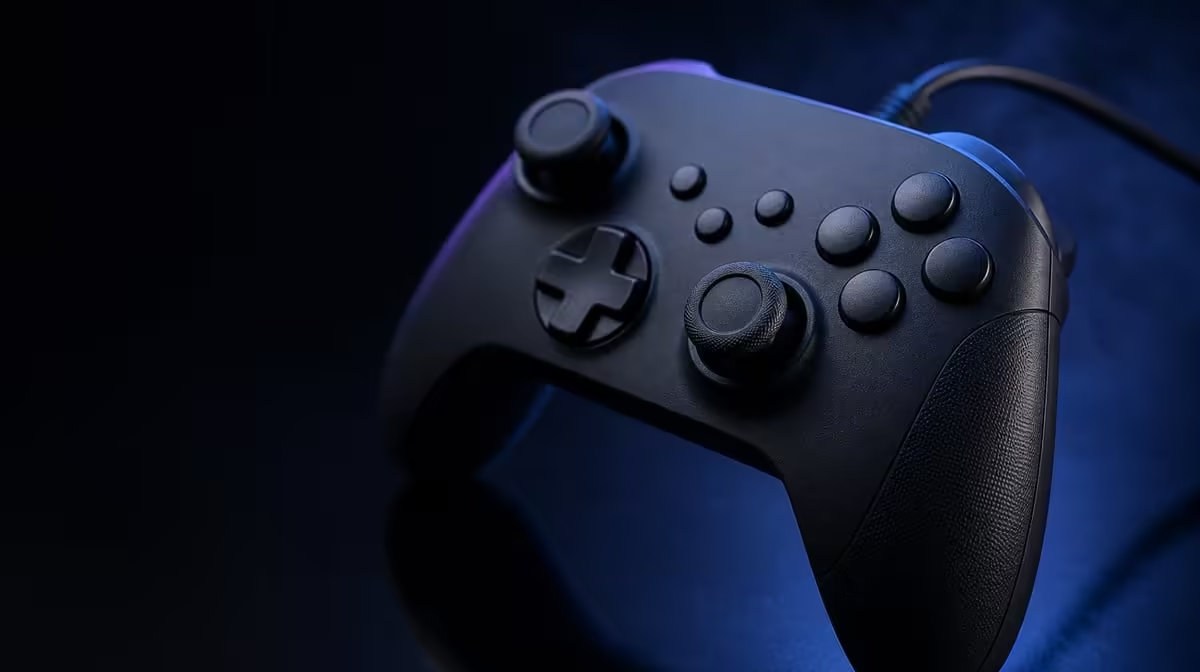
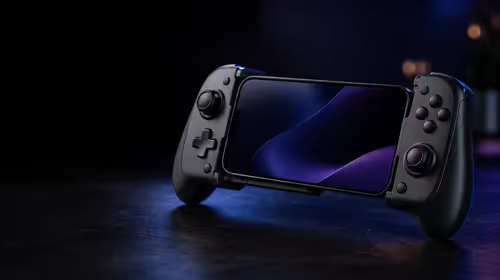
The controller has Hall sticks and magnetic triggers. These reduce rubbing contacts in analog position measurement, but they say nothing about an unconfirmed face-button cycle count.
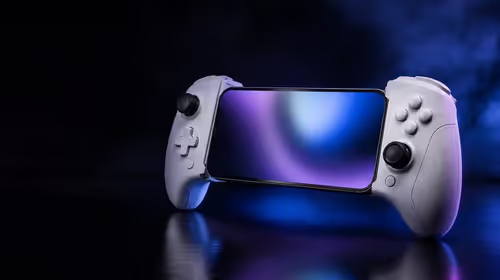
It includes two remappable rear inputs, dual rumble, a magnetic faceplate, 3.5mm audio and Mic Mute Button. Those features can be tested directly in a player's setup.
Its wired Xbox format makes cable care part of durability. Route the lead away from feet and pinch points, and store it without sharp bends.
At R899, the value case is already substantial without borrowing an unsupported number.
🧹 Ownership affects real longevity
Keep the pad dry, remove surface dust gently and store it without pressure on sticks, triggers or buttons. Good care addresses risks no click counter can summarise.
If a button changes, document the exact control, game, profile and screen. Compare its face and rear assignment before changing mappings.
Use Evetech's gaming accessories section and accessories best sellers to review current storage or setup choices. Do not treat popularity as durability evidence.
A credible controller guide is comfortable saying which number does not belong. The G7 HE should stand on R899, its named magnetic controls and repeatable input testing.
Build a registration record by control type. Face buttons, rear inputs, stick clicks and triggers have different jobs, so one cycle number would not describe them equally even if a rating were available.
For each face button, test normal taps, a deliberate hold and repeated game timing. The aim is to see whether input appears and releases correctly, not to simulate years of wear through aggressive pressing.
Rear inputs add a mapping layer. Record both the physical press and the game action. If the original face button works while the rear route fails, inspect the active profile before making a durability claim.
Stick clicks should be checked while the analog centre is also observed. Excessive thumb force can move the stick and produce a game effect unrelated to the click registration.
Keep time-based ownership notes rather than converting clicks into years. Date the test, record the title and note any change. Actual use patterns differ too widely for a simple calendar translation.
Cable condition belongs in the durability record because the G7 HE is wired. Inspect the visible lead and store it without kinks. Reliable buttons cannot compensate for careless connection handling.
Faceplate care matters too. Clean the outer surface gently and make sure a swapped panel does not rub a button edge. Cosmetic work should preserve the registration baseline.
At review time, use the confirmed feature list and observed history. The absence of a 1.3 million-click claim is not a weakness to fill with speculation; it is a boundary that keeps the R899 assessment credible.
Add a game-state column to the registration record. Some commands are intentionally unavailable during menus, cooldowns or animations. The same physical press should be checked where the action is permitted.
Use another input screen only when it helps isolate the symptom. A button that appears there but not in one title points towards software handling rather than a cycle-life conclusion.
Track rear mappings separately after every profile edit. A changed assignment can make an input appear to vanish even though the switch still registers.
Check faceplate clearance around every button. A panel edge that rubs a cap is a physical fit issue and should not be described with an unconfirmed click rating.
Review the cable and storage state on the same dates. Button reliability belongs to complete ownership, and a well-kept wired path supports more credible observations.
Create a monthly registration sample rather than a lifetime prediction. Ten ordinary presses per named control are enough to reveal a change worth reproducing.
Include the game state and active map beside every miss. Context prevents a disabled action from becoming a false durability complaint.
If cleaning is needed, keep it external and dry. Aggressive handling can create the very input problem the record is meant to track.
The honest R899 case relies on what the G7 HE actually includes and how it registers, not on a borrowed 1.3 million number.
Add a control-location photograph to the monthly record so another user can identify the button being discussed.
Keep missed, repeated and held-too-long inputs in separate columns.
Test a suspect button with its default mapping before seeking deeper help.
Store the pad without pressure on the face or rear controls.
This evidence-based routine respects durability without creating a false lifetime guarantee.
When registration changes, reproduce the exact control in a neutral view, its default map and the game state where the miss appeared. Date the three outcomes and preserve ordinary press force.
The record may support cleaning, remapping or a support conversation, but it still cannot establish a lifetime cycle count. Keep the 1.3 million figure out of every G7 HE conclusion unless direct product evidence changes.
Frequently Asked Questions
Does the G7 HE have a confirmed 1.3 million-click rating?
No. That figure should not be attributed to this controller.
What would a click count describe?
It would describe a controlled actuation benchmark for a named mechanism, not guaranteed years in every use pattern.
How should G7 HE buttons be assessed?
Test each control repeatedly in an input display and the intended game, keeping mappings documented.
Do Hall sticks prove face-button durability?
No. Hall sensing is an analog-stick feature and does not establish a button cycle rating.
What is the controller's real price?
The GameSir G7 HE costs R899.
Ready to choose on features you can actually test?
Compare Evetech's controller range and assess G7 HE registration, mapping and care without assigning it an unconfirmed click number.