Quick Answer
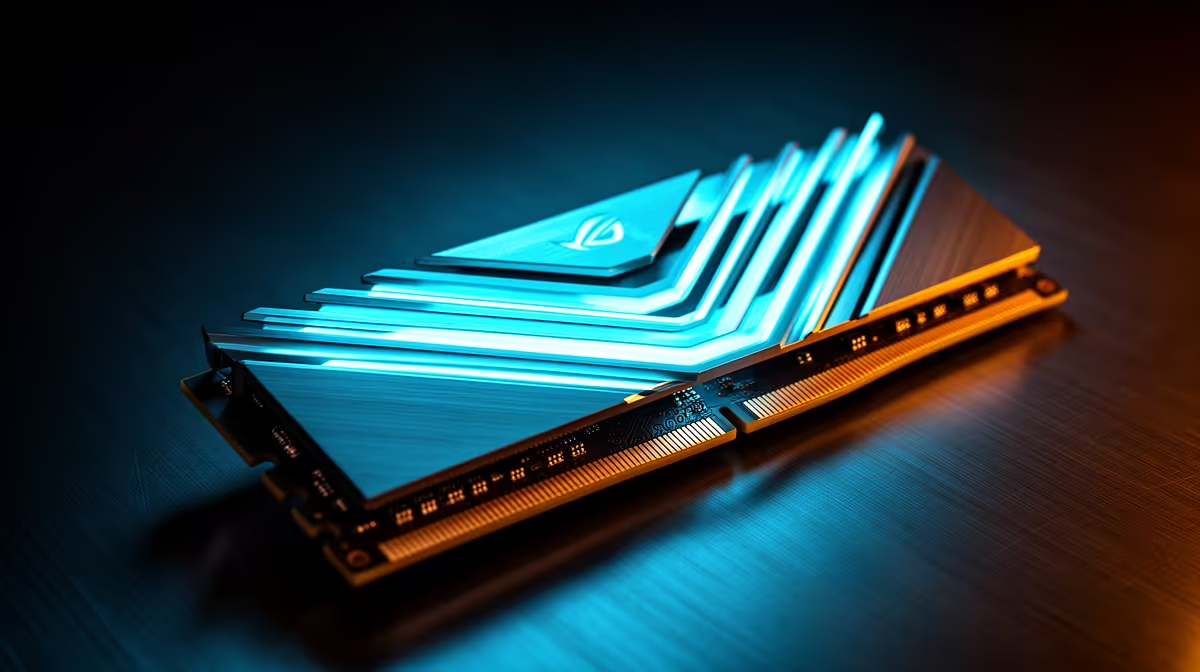
Yes, RAM speed matters noticeably in a Ryzen gaming PC. Ryzen processors use an Infinity Fabric interconnect that scales performance with memory frequency. At DDR5 5600MHz to 6000MHz, the Fabric runs at its optimised 1:1 ratio with memory, improving gaming framerates by 5 to 15% over DDR5 4800MHz in CPU-sensitive titles like CS2, Valorant, and open-world games with heavy NPC simulation.
How Ryzen Infinity Fabric Ties to RAM Speed 🔗
AMD's Infinity Fabric is the internal bus connecting CPU cores, cache, and the memory controller. Its frequency is directly linked to RAM speed on Ryzen platforms. At DDR5 6000MHz, the Fabric runs at 3000MHz, within the stable sweet spot. At DDR5 4800MHz (the JEDEC default), the Fabric runs at 2400MHz, noticeably lower. The gaming impact is most visible in titles stressing the CPU with many concurrent threads or large data streams: in CS2 on a Ryzen 7 7800X3D, running DDR5 6000MHz EXPO versus DDR5 4800MHz produces a 12 to 18% average fps improvement in competitive scenes. The difference is smaller in GPU-bottlenecked scenarios, but in CPU-limited competitive gaming it is substantial.
DDR5 5600MHz vs 6000MHz: Is the Extra Speed Worth It 💡
DDR5 5600MHz is the AMD-recommended sweet spot for AM5 platforms running the 1:1 Infinity Fabric ratio. DDR5 6000MHz with tight CL30 timings is marginally faster. The performance difference between 5600MHz and 6000MHz is 2 to 5% in gaming, smaller than the 4800MHz to 5600MHz jump. In South Africa, the cost difference between a 32GB DDR5 5600MHz kit and a 32GB DDR5 6000MHz kit is typically R200 to R500. Given the small performance gap, either frequency is a good choice: 5600MHz for budget-focused builds, 6000MHz CL30 for performance-focused builds where the marginal gain matters.
Intel DDR5 Platforms and Memory Speed Scaling 🖥️
Intel Z890 and B860 platforms benefit from faster DDR5 through a different mechanism. Intel's Ring Bus architecture is less sensitive to memory frequency than Ryzen's Infinity Fabric, so gaming gains from DDR5 speed are typically 3 to 8% improvement from 4800MHz to 6000MHz, compared to Ryzen's 10 to 18%. If you are using a Core Ultra 9 285K on a Z890 board, a DDR5 6400MHz XMP kit delivers genuine performance improvements, just not as dramatically as on a Ryzen platform.
Buy a Kit, Not Individual Sticks ⚡
DDR5 modules sold as a matched pair are tested together by the manufacturer, ensuring stable EXPO or XMP profiles in dual-channel mode. Mixing two individual DDR5 sticks from different production batches can prevent EXPO from loading or cause memory training errors at boot. Always purchase DDR5 as a labelled dual-channel kit, especially for Ryzen gaming builds.
FAQ
Does DDR5 speed affect GPU performance?
Indirectly, yes. In CPU-bottlenecked scenarios, faster RAM allows the CPU to feed the GPU more efficiently, raising average and minimum framerates. In GPU-bottlenecked scenarios, where the GPU is the sole limiting factor, RAM speed has negligible effect on GPU output.
Is DDR5 5600MHz the official JEDEC standard for Ryzen AM5?
The official JEDEC DDR5 standards are 4800MHz and 5600MHz. AMD's AM5 platform officially supports DDR5 up to 5200MHz without EXPO, but most AM5 boards default to 4800MHz without EXPO enabled. Enabling EXPO in the BIOS is required to reach 5600MHz or above.
Can I run DDR5 6000MHz RAM in a budget B650 motherboard?
Yes. Most B650 boards support DDR5 up to 6000MHz or 6400MHz with EXPO on QVL-listed kits. EXPO stability at high frequencies depends more on the specific RAM kit than the motherboard tier.
Upgrading your Ryzen build's RAM?
Shop DDR5 RAM kits at Evetech, including 5600MHz and 6000MHz EXPO-ready options for AMD AM5 and Intel LGA1851 platforms.