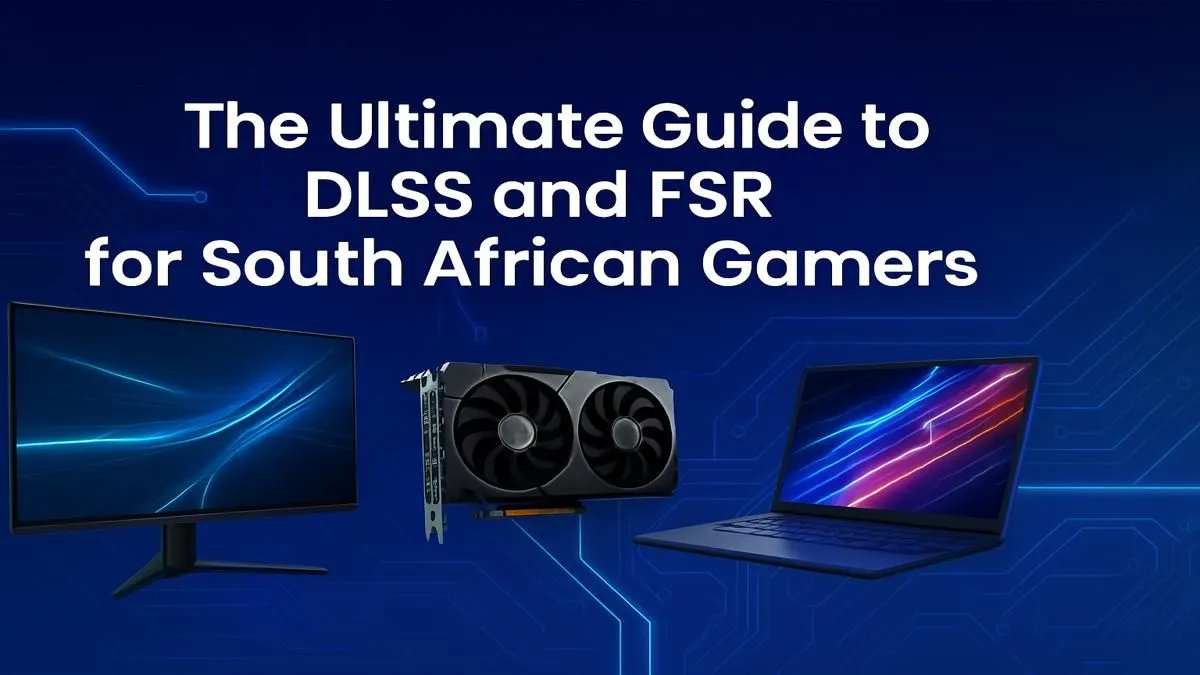
Staring at your FPS counter, wishing you could squeeze out a few more frames without breaking the bank? We get it. In the high-stakes world of PC gaming in South Africa, every frame counts. Luckily, two incredible technologies are here to help: NVIDIA's DLSS and AMD's FSR. But in the ultimate DLSS vs FSR showdown, which upscaling tech is the right choice for your rig? Let's dive in and find out. 🚀
Understanding the Magic: What is Upscaling?
Before we pit these two titans against each other, let's quickly cover what they actually do. Imagine your graphics card is an artist. To paint a beautiful 4K picture, it takes a lot of time and effort (processing power).
Upscaling is like giving the artist a clever shortcut. Instead of painting at full 4K, the GPU renders the game at a lower resolution (like 1080p), which is much faster. Then, a smart algorithm (or AI) instantly "upscales" that image to your target 4K resolution, filling in the details with incredible accuracy. The result? A massive boost in frames per second (FPS) with minimal loss in visual quality.
Team Green's Secret Weapon: A Closer Look at NVIDIA DLSS
NVIDIA's Deep Learning Super Sampling (DLSS) is the AI-powered veteran in this fight. It uses dedicated hardware, called Tensor Cores, found exclusively on NVIDIA's lineup of RTX graphics cards to work its magic. ⚡
By training a neural network on super-high-quality game images, DLSS has become incredibly good at reconstructing a sharp, detailed picture from a lower-resolution base.
Key Strengths of DLSS:
- Superb Image Quality: Often considered the gold standard for image reconstruction, preserving fine details that other techniques might miss.
- Advanced Features: Newer versions include DLSS 3 with Frame Generation, which inserts entirely new frames to make gameplay feel even smoother.
The main catch? It's an exclusive club. You need an NVIDIA RTX 20-series card or newer to join.
Team Red's Open Challenger: Breaking Down AMD FSR
AMD's FidelityFX Super Resolution (FSR) is the people's champion. Unlike DLSS, FSR is an open-source spatial upscaling technology. This means it doesn't require any specialised hardware to run. It's designed to work on a massive range of GPUs, including AMD's latest Radeon GPUs, older NVIDIA cards (like the GTX 10-series), and even integrated graphics on laptops.
Key Strengths of FSR:
- Massive Compatibility: If you have a graphics card from the last 5-7 years, chances are it can run FSR.
- Open Source: Developers can implement it into games more easily, leading to wider adoption.
- Competitive Performance: FSR 2.0 and later versions closed the quality gap significantly, offering a sharp image that's very close to DLSS.
Quick Tip for Choosing a Mode 🔧
Both DLSS and FSR offer different modes like 'Quality', 'Balanced', and 'Performance'. For most single-player, story-driven games, stick to 'Quality' for the best visuals. For fast-paced competitive shooters where every single frame matters, switching to 'Performance' will give you the highest FPS boost possible.
The Main Event: DLSS vs FSR for the South African Gamer
So, when the dust settles, who wins the DLSS vs FSR battle? The honest answer is... it depends entirely on the hardware you own and the games you play.
- If you have an NVIDIA RTX card (20, 30, or 40-series): Your first choice should almost always be DLSS. It's built specifically for your hardware and generally provides slightly superior image quality, especially when it comes to fine details and anti-aliasing.
- If you have an AMD GPU or an older NVIDIA card: FSR is your hero. It's an incredible piece of tech that unlocks performance you never thought your card was capable of, breathing new life into older hardware.
Ultimately, both technologies are fantastic for us Saffas. They let us achieve higher resolutions and frame rates, making high-end gaming more accessible without needing to spend a fortune. If you're looking to make the jump, it's always a good idea to check out the latest graphics card deals to see what fits your budget.
So, Which One Should You Choose?
The debate between FSR vs DLSS isn't about one being definitively "better" than the other for everyone. It's about which one is better for you.
Think of it this way: DLSS is a tailor-made suit, designed to perfection for a specific client (NVIDIA RTX owners). FSR is a high-quality, one-size-fits-most solution that brings huge benefits to the entire gaming community. ✨
The best thing you can do is enable it. If your game supports both, try each one out and see which you prefer. You might be surprised at the performance you can unlock with just a simple settings toggle.
Ready to Boost Your FPS?
Whether you're Team Green or Team Red, the DLSS vs FSR debate proves one thing: smarter performance is here. The right graphics card is your ticket to higher frame rates and stunning visuals. Explore our incredible graphics card deals and find the perfect GPU to power up your game.