Quick Answer
Yes, Axial-Tech fans measurably improve cooling performance in high-wattage PSUs by delivering higher static pressure and airflow volume at lower RPM than conventional designs. In a 1000W to 1600W PSU, this allows the unit to maintain safe internal temperatures at fan speeds 200 to 400 RPM lower than a standard fan, producing noticeably quieter operation under heavy load.
How Axial-Tech Fan Design Differs From Standard PSU Fans 🔧
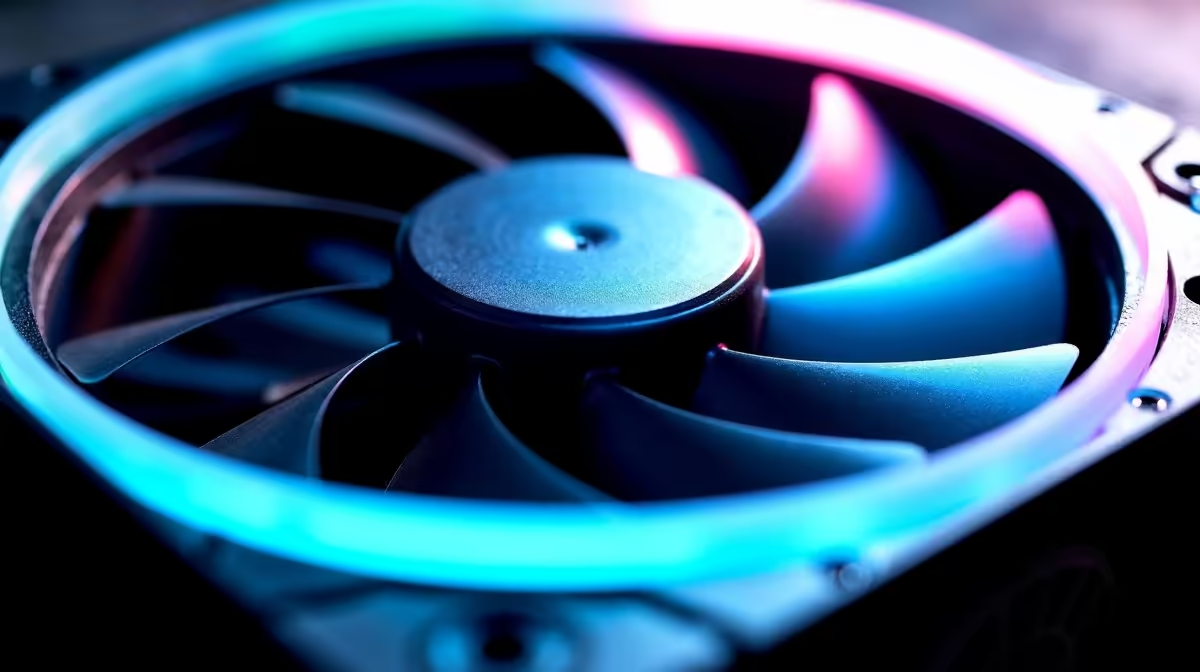
A conventional 135mm PSU fan uses long blades attached to a large central hub. The hub occupies a significant fraction of blade sweep area, limiting airflow at any given speed. Axial-Tech engineering reduces hub diameter and adds a barrier ring connecting blade tips, stiffening each blade against aerodynamic flex. Stiffer blades maintain their angle of attack more precisely at high RPM, generating higher static pressure per revolution. In a PSU, static pressure determines how effectively the fan forces air through dense component arrays and heatsinks rather than simply displacing air in open space. An Axial-Tech 135mm fan at 900 RPM moves as much effective air through a PSU heatsink as a conventional fan at 1,100 to 1,300 RPM. The noise difference at those lower speeds is typically 4 to 8 dBA, perceived as roughly half as loud. PSUs featuring this technology are generally priced from R3,500 to R6,500 for 850W to 1200W units at Evetech.
Temperature Benefits and SA Summer Conditions 🖥️
High-wattage PSUs above 1000W generate substantially more internal heat than lower-wattage units. A 1200W unit at 90 percent efficiency wastes 120W as heat internally. An effective fan is therefore more critical, not less, as wattage increases. Axial-Tech-style fans in 1200W to 1600W PSUs maintain primary-side heatsink temperatures 5 to 10 degrees Celsius lower under maximum load than standard fans at matched noise levels. For South African summer use where intake air may be 30 to 35 degrees rather than the 23-degree lab standard, this advantage directly protects capacitors: a 5-degree reduction at 70-degree operation extends capacitor life roughly 15 to 25 percent under the Arrhenius model. During gaming sessions at 600 to 800W draw, a well-designed PSU fan of this type typically operates between 600 and 900 RPM, producing 18 to 24 dBA: quieter than most 140mm case fans at similar speeds.
Check the PSU Fan at BIOS Idle First ⚡
your system is louder than expected and you suspect the PSU fan, check it in isolation: boot to BIOS with a hardware monitor open and record fan speed at idle. A PSU fan spinning above 1,000 RPM at idle with a light system load suggests elevated ambient temperature, a blocked PSU intake filter, or early bearing wear. Cleaning the filter and improving case airflow often resolves the issue without any component replacement.
FAQ
Is Axial-Tech fan design proprietary to one brand?
Axial-Tech is a marketing term primarily associated with ASUS products. Equivalent engineering concepts, reduced hub diameter and blade-tip stiffening rings, appear across premium fans from other manufacturers under different names. Compare static pressure ratings in mmH2O for an objective cross-brand metric.
How often should a PSU fan be cleaned in a SA home?
Every three to four months in typical SA conditions, or every two months near dusty roads or with pets. Dust on the PSU fan and internal heatsinks is one of the most common causes of premature thermal failure and takes only a few minutes to address with compressed air.
Does fan bearing type affect Axial-Tech performance?
Yes. The blade geometry provides the airflow advantage, but bearing type determines longevity and noise floor. Dual ball-bearing implementations last significantly longer than sleeve bearings, typically 100,000 versus 30,000 to 50,000 hours at rated temperature.
Want better cooling and lower noise from your PSU?
Evetech stocks power supplies featuring advanced fan technology for high-wattage builds from 850W to 1600W. Browse the power supply range to find your next upgrade.