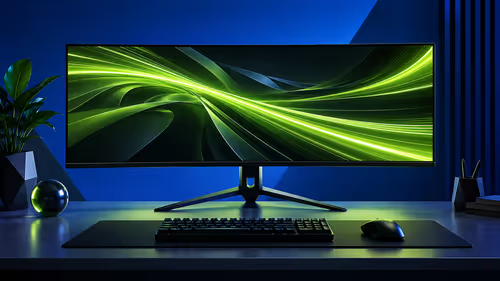
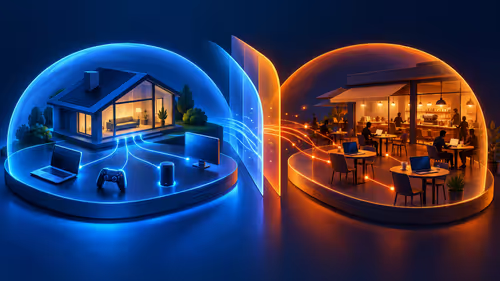
Panel technologies solve dark scenes, colour, motion and cost with different physical designs. Understanding WOLED, IPS and VA gaming monitors means separating self-lit pixels from two LCD approaches, then matching those differences to the room and workload. The R10,999 ASUS XG27AQDMG represents WOLED with QHD 240Hz and 0.03ms response.
Quick Answer
WOLED leads in pixel-level blacks and rapid transitions, IPS is a familiar LCD all-rounder, and VA often places strong LCD contrast high on its list. The R10,999 XG27AQDMG combines WOLED with 2560x1440, 240Hz and dual adaptive sync, but the best technology depends on gaming motion, static desktop time, room light and budget.
💡 Start with how each panel creates an image
WOLED pixels emit their own light. A black pixel can switch off, producing deep darkness directly beside a bright object. This per-pixel control supports strong local contrast and avoids relying on one shared backlight across the entire image.
IPS and VA are both LCD families. Liquid-crystal cells control light from a backlight, but the two arrangements produce different viewing and contrast behaviour. Grouping them together as simply LCD hides useful distinctions, while treating every panel within one family as identical is also too broad.
Evetech's full gaming monitor selection helps buyers compare actual resolution, refresh and sync features after understanding the panel families.
🌑 Compare black depth and room behaviour
WOLED is the strongest option of these three for pixel-level black because dark pixels can stop emitting light. VA can provide stronger native LCD contrast than many IPS designs, while IPS follows its own backlight and viewing characteristics.
Room reflections still matter. Direct daylight falling on an OLED panel can mask its deepest blacks, while a controlled room reveals its contrast advantage more clearly. LCD brightness behaviour may suit a bright environment differently, so the room belongs in the decision.
DisplayHDR 400 True Black on the XG27AQDMG gives compatible HDR material a way to use WOLED's dark-scene strength. The OLED monitor category is the natural comparison point for buyers who rank black level first.
⚡ Examine motion without shortcuts
WOLED can transition pixels very quickly, and the ASUS specifies 0.03ms response at up to 240Hz. That pairing helps moving edges settle between frequent updates when the source provides enough frames.
IPS and VA motion varies by model, refresh mode and transition behaviour. A high refresh label does not guarantee every transition is equally clean. Review the complete display rather than assigning one universal motion result to an entire panel family.
The computer remains part of the chain. QHD at high frame rates needs appropriate graphics performance, while the platform's matching adaptive-refresh route can align supported variable delivery. Neither panel technology creates frames.
🧑💻 Include desktop work and care
OLED benefits from limiting needless static exposure. Screen sleep, varied content and comfortable brightness support mixed work and gaming. The XG27AQDMG adds pixel safeguards backed by a dedicated thermal solution as its internal care layer.
IPS and VA follow different wear considerations and can be straightforward choices for fixed toolbars or repeated office layouts. Text rendering, viewing distance and scaling also affect desktop comfort independently of panel type.
Screen shape is yet another variable. The curved monitor range includes designs where geometry changes the peripheral experience. VA is common in curved products, but curve and panel should still be checked separately on every model.
Use a workload scorecard
Rank fast competitive motion, dark cinematic play, bright-room viewing, static desktop hours and panel care from most to least important. Then compare actual monitors against that order. This prevents a striking demo scene from outweighing the other seven hours of a normal day.
At R10,999, the XG27AQDMG is most persuasive when several WOLED strengths are valuable together: deep blacks, rapid response, 240Hz and HDR. A buyer who needs only one of those traits may find a different LCD balance more efficient.
Compare how the three panel families make an image
WOLED is self-emissive: individual pixels produce light and can turn down for deep blacks. IPS and VA are LCD technologies that modulate a backlight. IPS is widely associated with consistent colour and viewing behaviour, while VA often prioritises stronger native contrast than typical IPS. These are family tendencies, not guarantees that every model shares the same tuning, speed or brightness.
Motion depends on pixel transitions, refresh and implementation. The XG27AQDMG uses WOLED response rated at 0.03ms with a 240Hz ceiling, making its competitive direction clear. A high-refresh IPS or VA screen can still play quickly, but its transition behaviour must be judged through actual motion rather than the refresh label alone. VA dark transitions and IPS overdrive behaviour can vary by model, so avoid turning one observation into a rule for the entire technology.
Static work and ownership form another difference. OLED users benefit from varying content, sensible brightness and allowing protection routines to run. LCD buyers avoid OLED-specific wear concerns but still need good ergonomics, room placement and appropriate picture settings. The ASUS supports its panel through thermal design and burn-in safeguards, combining hardware care with the user's routine.
Let the room and workload choose the weighting
Use a dark game scene in controlled light, a bright daytime desktop and a rapid camera pan. WOLED should be evaluated for black depth and transition clarity, IPS for broad mixed-use behaviour, and VA for contrast plus its own motion characteristics. Keep resolution, size and refresh as comparable as possible so panel architecture remains the variable.
At R10,999, the 27-inch ASUS also includes QHD, True Black HDR and adaptive sync for both supported graphics families. Panel technology does not decide value by itself; connection compatibility, frame output, static-work hours and viewing environment complete the answer. A buyer may reasonably prioritise WOLED contrast and speed, IPS familiarity for long desktop use, or VA contrast at another balance. The best choice is the weighted result, not a permanent ranking.
Frequently Asked Questions
What fundamentally separates WOLED from IPS and VA?
WOLED pixels emit light individually, while IPS and VA use liquid crystals to regulate a backlight.
Which panel family produces the deepest blacks?
WOLED leads because individual dark pixels can switch off. Reflections and room light still affect the black appearance seen by the viewer.
Are IPS and VA identical because both are LCD?
No. Their liquid-crystal structures produce different contrast, viewing and transition behaviour even though both use backlighting.
Why is the XG27AQDMG a speed-focused WOLED monitor?
It combines a rated 0.03ms response with 240Hz refresh at QHD, supported by two adaptive-sync routes.
Does panel technology decide the best monitor by itself?
No. Size, resolution, refresh, room, graphics performance, desk layout and budget can change the best choice.
What panel-care point applies to the OLED choice?
Use automatic sleep, varied content and suitable brightness, while keeping built-in protection enabled and ventilation clear.
How do room conditions influence the panel decision?
Bright reflections can hide OLED black depth, while different LCD brightness and contrast characteristics may suit the same room differently.
Ready to choose the physical panel behaviour that matches your longest daily workload?
Compare Evetech's WOLED, IPS and VA gaming screens with a ranked scorecard for motion, black depth, room light, desktop use and care.