Master Your Controls with the Flight Stick Sensitivity Settings and Deadzone Guide
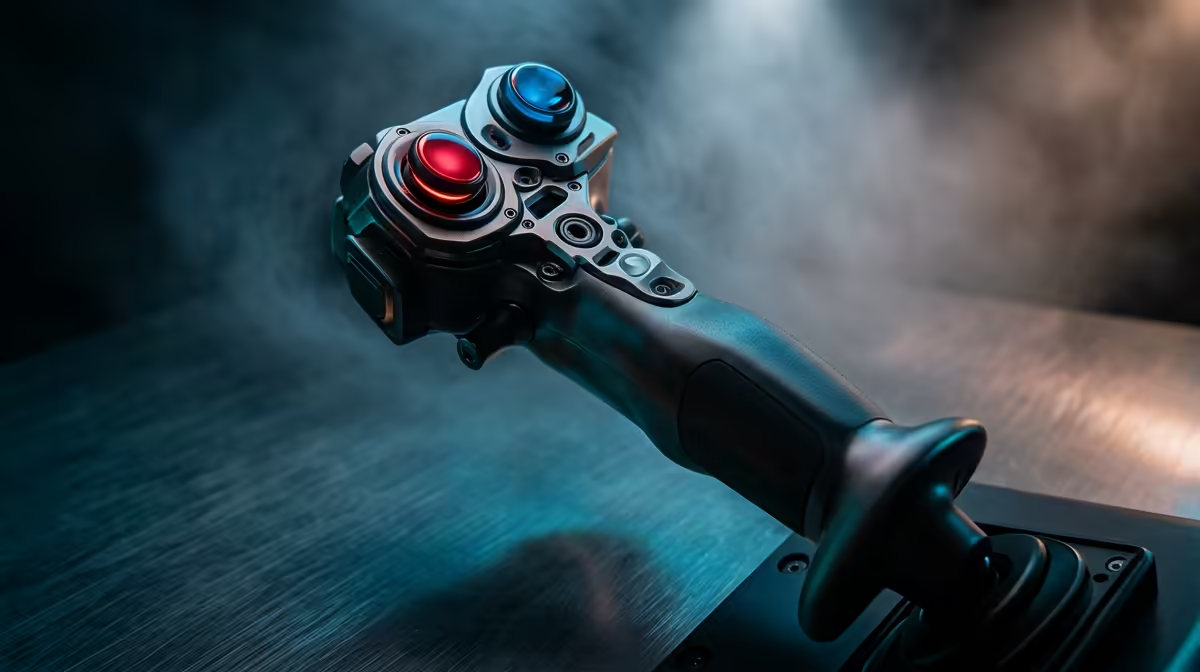
Ever felt like your bush plane in Microsoft Flight Simulator has a mind of its own? You nudge the stick, and suddenly you are banking hard over Table Mountain. It is a common frustration for South African simmers. Most pilots struggle with twitchy controls because they skip the calibration phase. Mastering your Flight Stick Sensitivity Settings and Deadzone Guide is the secret to smooth landings at OR Tambo. 🚀
Understanding Sensitivity Curves for Precision Flight
Sensitivity is not just about how fast your plane turns. It is about the relationship between your physical hand movement and the digital response. A linear curve means a 10% tilt equals a 10% input. For most, this feels far too raw... it makes fine adjustments nearly impossible during a crosswind landing.
Expert pilots prefer an "S-Curve" or a negative sensitivity slope. This makes the centre of the stick less sensitive. It allows for tiny, precise movements while taxiing or maintaining level flight. If you find your current hardware cannot keep up, browsing the latest flight simulator gear might reveal sensors with much higher fidelity. 🔧
Sensitivity Pro Tip ⚡
Always set your "Sensitivity -" and "Sensitivity +" values symmetrically first. In modern sims like MSFS, a setting of -20% to -30% is usually the "sweet spot" for joystick users. This provides a natural feel that mimics the heavy resistance of a real yoke without requiring massive physical effort.
Eliminating Ghost Inputs with Deadzones
Have you noticed your aircraft veering slowly to the left even when your hands are off the controls? This is known as stick drift. It happens when the internal sensors do not return perfectly to zero. This is where deadzones become your best friend.
A deadzone creates a small "null" area in the centre of your stick's travel. Any movement within this tiny circle is ignored by the game. Start with a deadzone of 2% and slowly increase it until the drift disappears. To keep your setup steady and avoid physical jitter, high-quality simulation gear and accessories like sturdy desk mounts can make a massive difference in stability. ✨
Consistency Across Different Simulations
The logic of fine-tuning your inputs applies to more than just aviation. Many South African enthusiasts enjoy multiple disciplines. If you are someone who swaps the flight stick for a steering wheel, you will notice that sim racing requires the same attention to deadzones and linearity.
Whether you are hitting the apex at Kyalami or touching down in Durban, your muscle memory relies on consistent settings. Take the time to calibrate. It is the difference between a frustrating crash and a perfect session. ⚡