Quick Answer
Fluid dynamic bearings (FDB) are quieter throughout their operational life and better suited to horizontal-shaft fan positions, while dual ball bearings (DBB) offer greater tolerance for high-temperature environments and vertical-shaft orientations. For standard SA case fan positions, FDB is the superior acoustic choice; for high-heat GPU cooler applications, DBB wins on durability.
The Mechanical Difference Between FDB and DBB 🔬
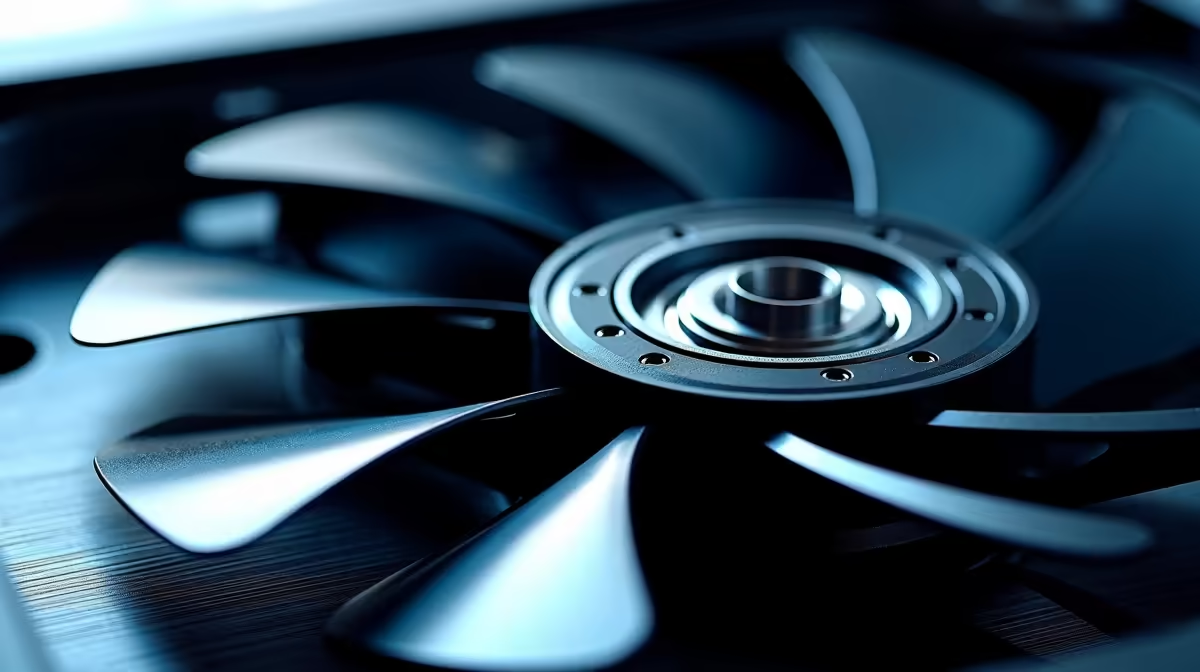
A dual ball bearing fan uses two rings of steel balls to support the rotating shaft, creating a rigid mechanical separation between the spinning shaft and the housing. The balls roll under load reliably across all orientations and temperatures, but produce a characteristic noise that becomes audible as the steel races wear over time. A fluid dynamic bearing replaces the ball rings with a hydrostatic oil film. As the shaft spins, its geometry pressurises the oil layer and centres the shaft without metal-to-metal contact.
Lifespan Comparison in Real-World Conditions 📊
FDB fans are typically rated at 100,000 to 150,000 hours MTBF under standard conditions of 25 degrees Celsius. Dual ball bearing fans rate similarly, often 50,000 to 100,000 hours, but their lifespan degrades less sharply with temperature increase because the mechanical contact of steel balls does not rely on oil film stability. At 60 degrees Celsius ambient (found in GPU heatsink fan positions), FDB oil viscosity decreases and film stability weakens, reducing effective lifespan.
Acoustic Character Over Time 🔊
The most important acoustic distinction is how the two bearing types age. A new FDB fan is near-silent at low to mid RPM. After five to eight years, the oil film thins gradually and a subtle low-frequency hum may develop. A new DBB fan produces a faint but identifiable ball bearing roll sound at all speeds. After several years, ball race wear creates a noticeably louder and more tonal characteristic. In both cases, acoustic deterioration is gradual, but FDB fans typically sound acceptable for longer before reaching an objectionable state.
Match Bearing Type to Fan Position Temperature ⚡
FDB for case intake and exhaust positions at standard temperatures, DBB for GPU cooler replacement fans or fans in hot-running mini-ITX cases where internal temperatures routinely exceed 50 degrees Celsius. Mixing bearing types in the same build is fine and often optimal for the specific thermal environment of each fan position.
FAQ
Which bearing type is better for an AIO radiator in a South African gaming build?
FDB is preferred for AIO radiator fans because the radiator position in a well-ventilated case operates at moderate temperatures (35 to 50 degrees Celsius), well within FDB's optimal performance zone. The quieter acoustic signature of FDB at 1,000 to 1,500 RPM makes it the clear choice for radiator use where fans run continuously during gaming sessions.
Do dual ball bearing fans need any maintenance?
No user-serviceable maintenance is required. The ball races are factory-lubricated with grease rated for the bearing's full service life. Compressed air cleaning of fan blades and keeping operating temperatures within the rated range is all that is needed to maximise DBB lifespan.
Can you identify a bearing type from a fan specification sheet?
Yes, bearing type is listed in the specification section of nearly all case fan datasheets and product pages. Look for the terms fluid dynamic bearing, FDB, ball bearing, dual ball bearing, or DBB. Some budget fans list only sleeve bearing, which is a third type with lower performance than either FDB or DBB and poorer longevity in warm environments.
Choosing between FDB and DBB fans for your SA build?
Evetech stocks both fluid dynamic and dual ball bearing case fans across multiple sizes and brands with clear specification listings. Visit the cooling section to compare bearing types, RPM ranges, and noise ratings for your specific build positions.