Quick Answer
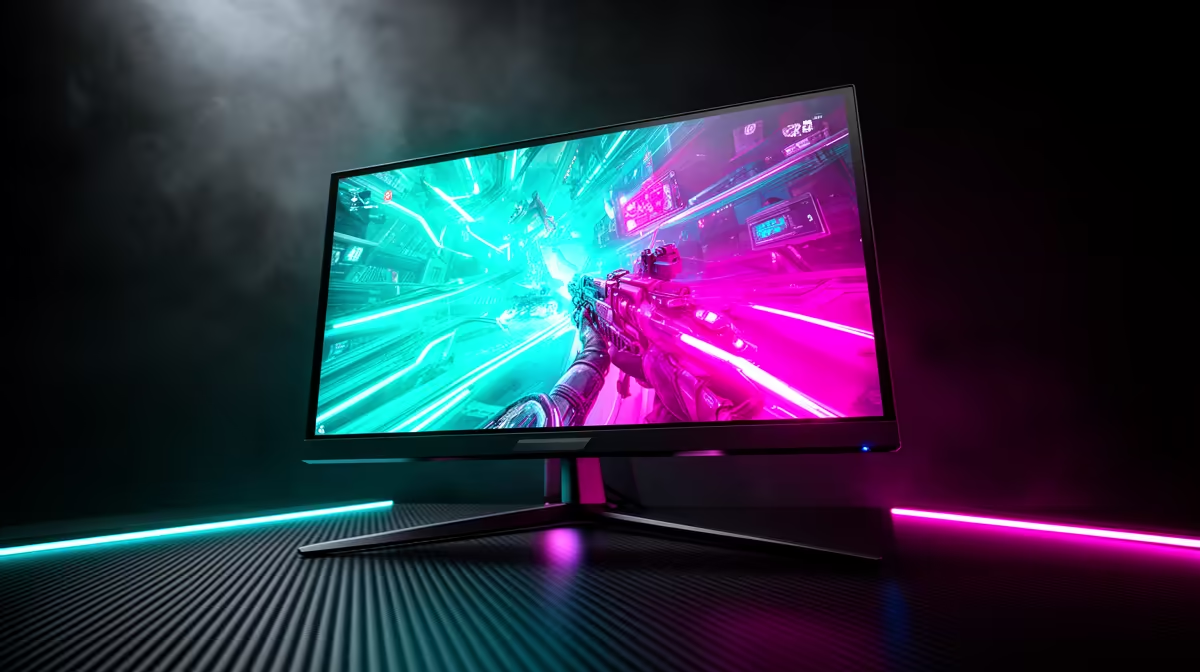
G-Sync Compatible (adaptive sync via FreeSync) eliminates screen tearing by matching the monitor's refresh rate to your GPU's output frame rate. ELMB Sync reduces motion blur by strobing the backlight once per frame. They solve different problems, and on supported monitors you can run both simultaneously.
G-Sync Compatible: Tearing Gone, Stutter Smoothed 🖥️
Screen tearing occurs when the GPU delivers a new frame mid-refresh, splitting the image horizontally. G-Sync Compatible uses FreeSync's variable refresh rate protocol, which NVIDIA validates on specific panels, to synchronise the display's refresh cycle to each completed GPU frame. The result is a tear-free image even when frame rates fluctuate between 48 and 160fps during a busy scene. Unlike the full proprietary G-Sync module (which adds significant cost), G-Sync Compatible validation is software-based, keeping monitor prices lower while delivering the same visible smoothness. For SA gamers on RTX 40-series or RTX 50-series cards, G-Sync Compatible panels provide the same practical experience as full G-Sync monitors in the vast majority of game scenarios.
ELMB Sync: Sharpening Each Frame ✨
ELMB Sync addresses a different problem. Even at 160Hz, the eye perceives blur when tracking a fast object because the brain interpolates between positions across frames. ELMB Sync counters this by cutting the backlight to black between frames, presenting only a brief snapshot of each rendered frame rather than a continuously lit image. The effect is most obvious in fast-paced games: a target at 160Hz without ELMB appears slightly smeared; with ELMB active the silhouette stays well-defined. The cost is brightness, dropping 30 to 50%, and a slight reduction in perceived fluidity compared to standard persistent backlight.
Using Both Together and Knowing When Not To 🎮
The "Sync" in ELMB Sync refers to the ability to run G-Sync Compatible and ELMB simultaneously, which older backlight strobing could not do. With both active, the monitor syncs its refresh to GPU output (eliminating tearing) and strobes the backlight each frame (reducing blur). This combination is the highest motion clarity available without moving to OLED. Use it for competitive shooters at high frame rates (100fps minimum for stable strobing). For slower RPGs or productivity, disable ELMB and let G-Sync Compatible handle smoothness alone. On bright South African summer days, the brightness penalty of ELMB can make the image uncomfortably dim unless you raise backlight compensation in the OSD.
Minimum FPS for Clean Strobing ⚡
Keep your in-game frame rate above 100fps when ELMB Sync is on. Below that threshold the strobe timing becomes inconsistent, producing a visible flicker in darker scenes. Use RTSS or your GPU's frame limiter to maintain a stable floor.
FAQ
Do I need an NVIDIA GPU to use G-Sync Compatible monitors?
G-Sync Compatible works exclusively with NVIDIA GPUs (GTX 10-series and newer, including RTX 50-series). AMD GPU users on the same panel use FreeSync directly, which provides identical adaptive sync functionality since G-Sync Compatible is built on the FreeSync standard.
Can ELMB Sync cause eye strain?
At very low frame rates, backlight strobing creates a visible flicker that can cause discomfort. At 144Hz and above with a stable frame rate, flicker is imperceptible to most users. If sensitive, keep sessions under two hours and take regular breaks regardless of display technology.
Is G-Sync Compatible the same as G-Sync Ultimate?
No. G-Sync Ultimate monitors include a dedicated NVIDIA scaler module with proprietary variable overdrive and HDR brightness above 1,000 nits at significantly higher cost. G-Sync Compatible is NVIDIA's certification of FreeSync panels for NVIDIA GPU use, which is what most current gaming monitors carry.
Want adaptive sync and blur reduction in one monitor?
Evetech stocks G-Sync Compatible gaming monitors with ELMB Sync support, stocked locally and backed by South African warranty.