Quick Answer
GaN MOSFETs switch faster and generate less heat than traditional silicon MOSFETs at the same wattage, allowing PSU manufacturers to build smaller, cooler, more efficient units. The difference shows up most clearly in 80 Plus Platinum and Titanium-rated units above 850W, where GaN designs routinely hit 94% to 96% efficiency at 50% load.
How GaN Differs from Silicon at the Component Level 🔬
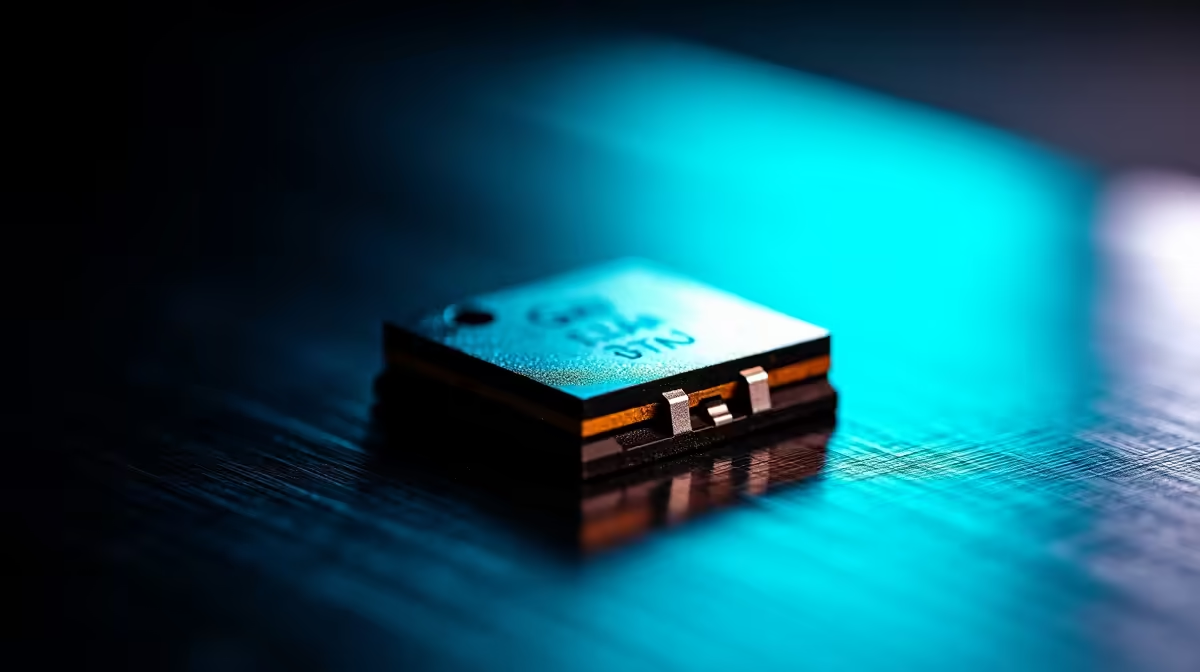
A MOSFET (Metal-Oxide-Semiconductor Field-Effect Transistor) is the switching element inside a PSU that converts AC mains voltage to the regulated DC voltages your PC needs. Silicon MOSFETs have been the industry standard for decades, but they carry a physical limitation: their switching losses increase sharply at higher frequencies. GaN (Gallium Nitride) operates on a wider bandgap, meaning it tolerates higher voltages, switches at frequencies up to ten times higher, and dissipates far less energy as heat during each switching cycle. In a 1000W PSU, the difference between silicon and GaN switching loss can amount to 15W to 25W of wasted heat. That heat has to go somewhere: into your case, your fans, and ultimately the ambient air of your room.
Real-World Efficiency and Thermal Gains 🌡️
In practice, a GaN-based 1000W PSU operating at 50% load (the sweet spot for efficiency ratings) will typically land at 93% to 95% efficiency versus 90% to 92% for a comparable silicon design at the same certification tier. That gap closes somewhat at 20% and 100% load, but GaN maintains an edge throughout. For South African builders running a Ryzen 9 9950X paired with an RTX 5080, where sustained gaming draw sits around 450W to 600W, a GaN PSU can save 10W to 20W continuously. Over a month of daily four-hour sessions, that adds up on an electricity bill charged at the 2025 Eskom tariff of around R3.50 per kWh. GaN units also tend to run quieter because their fans spin at lower RPMs when the reduced heat generation keeps internal temperatures down.
What to Look for When Buying a GaN PSU in SA 💡
Not every PSU marketed as high-efficiency actually uses GaN topology. Look for the term "full-bridge LLC" or "GaN switching stage" in the technical specs. Brands like Seasonic, ASUS ROG Thor III, and Corsair's HX Platinum series use GaN or hybrid GaN designs at the upper wattage tiers. Prices for GaN-equipped units in South Africa currently range from roughly R4,500 for an 850W Gold to over R9,000 for a 1200W Titanium unit. The premium over equivalent silicon designs runs about R800 to R1,500, which the efficiency savings partially recover over two to three years of heavy use. All current GaN high-end units sold locally also carry ATX 3.1 compliance and native 12V-2x6 connectors.
GaN Is Not Just for Enthusiasts ⚡
Mid-range builders often skip GaN PSUs assuming they are overkill, but a GaN 750W unit in an SA summer room can mean the difference between a fan that spins audibly and one that stays quiet under gaming load. If your case has limited airflow, the heat savings matter even at 500W total draw.
FAQ
Is GaN PSU technology proven and reliable?
Yes. GaN power technology has been in premium laptop chargers and industrial power systems for over a decade.
Will a GaN PSU work with my existing PC components?
Completely. GaN refers to the internal switching topology and has no effect on connector compatibility. A GaN PSU uses the same 24-pin ATX, EPS CPU, and SATA connectors as any other unit. The only connectors specific to newer PSUs are the 12V-2x6 PCIe cables for current-gen GPUs.
Does GaN make the PSU physically smaller?
Generally yes at equal wattage. A GaN 1000W unit from a premium brand often fits in a standard ATX length of 140mm to 150mm, where an equivalent silicon unit might need 160mm to 180mm. This matters in compact ATX cases with tight PSU clearance.
Want a PSU that runs cooler and costs less to run?
Evetech stocks platinum and titanium rated power supplies across the 750W to 1600W range, including units with GaN switching stages built for next-gen GPU builds.