Quick Answer
HDR over HDMI adds genuine visible quality improvement to any 4K display with a compatible panel: brighter highlights, deeper shadow detail, and wider colour in daily content. 3D over HDMI was a real but short-lived standard that required special glasses and dedicated 3D content; it is essentially unused in 2026 and not a reason to choose or avoid any cable.
What HDR Actually Delivers on a Real 4K Display 🎨
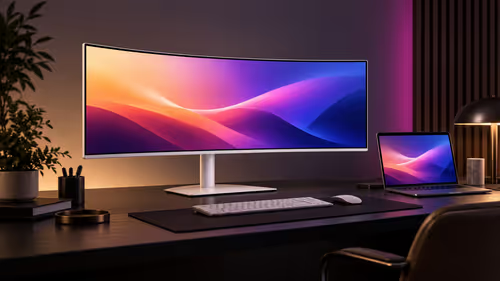
HDR10, the baseline HDR standard supported across South African 4K streaming services including Netflix 4K and Apple TV+, transmits metadata alongside the video signal that tells the display its peak brightness and colour gamut targets. A display with genuine HDR capability (wide-colour-gamut panel, peak brightness of 600 nits or above) produces visible improvements: specular highlights in game environments or films look bright and distinct rather than clipped white, and shadow areas retain detail instead of crushing to black.
The State of 3D Over HDMI in 2026 🔍
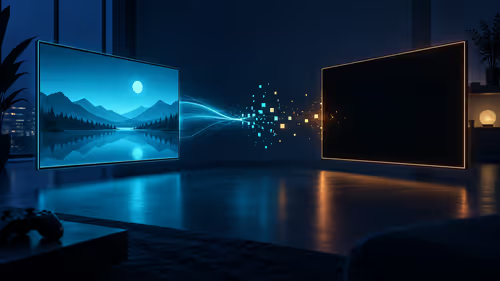
HDMI 1.4 introduced 3D support in 2009, allowing TVs and projectors to deliver active or passive 3D to compatible glasses. South African retailers stocked 3D-capable TVs through approximately 2016, after which consumer demand collapsed and manufacturers dropped the feature. No major TV brand currently ships 3D-capable panels to the South African market. No current gaming console or streaming service produces 3D content for home use. The HDMI 3D feature is present in the cable spec and in older devices, but it has zero practical relevance for a 2026 South African setup.
Dolby Vision vs HDR10: What the Cable Cares About 🖥️
Dolby Vision is a more advanced HDR format that uses dynamic metadata (scene-by-scene adjustment vs HDR10's static metadata for the whole film). Dolby Vision requires HDMI 2.0 bandwidth at minimum to accompany 4K/60Hz. For Dolby Atmos audio alongside Dolby Vision video, eARC on a Premium High Speed cable is needed. Both HDR10 and Dolby Vision are cable-agnostic beyond the 18 Gbps requirement: a certified HDMI 2.0 cable handles either format identically. Selecting between HDR formats is a choice made by the content source and display, not the cable.
Enable HDR in Both Windows and Your Display ⚡
on a PC gaming setup requires activation in two places: Windows HDR settings (Settings, System, Display, toggle HDR) and the GPU driver. If only one is enabled, the display may receive an HDR signal but not display it correctly, or show washed-out colours. For gaming on an RTX 50-series card, use Auto HDR in Windows 11 for SDR titles and verify HDR is active in the Nvidia Control Panel under Display settings.
FAQ
Does my HDMI cable need to be different for HDR10 versus Dolby Vision?
No. Both HDR formats require an 18 Gbps (HDMI 2.0) cable at 4K/60Hz. The cable carries the signal; the content and device determine which HDR flavour is active. A Premium Certified HDMI 2.0 cable handles both formats without distinction.
Can I still use a 3D TV as a standard 4K display?
Older 3D TVs were not 4K, so this is typically not a 4K question. If you own an older 1080p 3D TV, it works as a standard 1080p display using any High Speed HDMI cable. The 3D functionality requires 3D glasses and 3D-formatted content, neither of which is readily available in South Africa in 2026.
Is HDR worth enabling for gaming on a 4K monitor in South Africa?
Yes, if the monitor has genuine HDR capability (VESA DisplayHDR 600 or above certification). Many budget 4K monitors carry only DisplayHDR 400 certification, which improves HDR accuracy slightly but lacks the peak brightness for dramatic HDR impact. For a South African gaming setup, a monitor at DisplayHDR 600 or above in the R8,000 to R15,000 range shows the most noticeable HDR improvement.
Setting up 4K HDR gaming or home entertainment in South Africa?
Evetech stocks Premium Certified HDMI 2.0 cables alongside 4K HDR gaming monitors. Get the cable that actually carries HDR10 and Dolby Vision properly at 4K/60Hz.