


80+ Gold vs 80+ Platinum for Couch co-op gaming in SA
80+ Gold vs 80+ Platinum for couch co-op gaming is about PSU efficiency, heat, fan behaviour, quality, and wattage headroom, not direct FPS. SA buyers should compare the whole build.
Read moreCurious how FreeSync and G-Sync work to eliminate screen tearing? We're pulling back the curtain on the development of these game-changing adaptive sync technologies. Discover the engineering, the rivalry, and how they create buttery-smooth gameplay. 🎮💡
Ever been in the heat of a firefight in Apex Legends or lining up the perfect shot in Valorant, only for a jagged horizontal line to rip your screen in half? That, my friend, is screen tearing, and it’s the ultimate immersion killer. Luckily, there’s a solution. This deep dive explains how FreeSync and G-Sync work, the incredible tech that banishes tearing and stuttering for good, giving you the buttery-smooth gameplay you deserve.
Before we understand the fix, let's diagnose the problem. Screen tearing happens when your graphics card (GPU) and your monitor are out of sync.
Think of it like this: your monitor has a fixed refresh rate, say 144Hz. It redraws the entire screen 144 times every second, no exceptions. Your GPU, however, renders frames as fast as it can. In a complex scene, it might only manage 90 frames per second (fps). In a simple one, it could rocket up to 200 fps.
When the GPU sends a new frame while the monitor is still drawing the previous one, you get tearing. You’re seeing parts of two different frames at the same time. The result is that ugly, jarring line.
This is where the genius of how FreeSync and G-Sync work comes into play. Both are brand names for a technology called Variable Refresh Rate (VRR), or adaptive sync.
Instead of the monitor refreshing at a fixed rate, VRR allows the monitor to adjust its refresh rate in real-time to match the frame rate of your GPU. If your GPU renders a frame at 87 fps, your monitor refreshes at 87Hz. If it drops to 54 fps, the monitor matches it. The GPU is now the conductor, and the monitor is the orchestra. This perfect synchronisation completely eliminates screen tearing and dramatically reduces input lag and stutter.
NVIDIA’s G-Sync was the first to popularise VRR. Traditionally, premium G-Sync and G-Sync Ultimate monitors contained a proprietary NVIDIA hardware module. This chip handles the communication between the GPU and the monitor's panel, ensuring a flawless, premium experience. While this often comes at a higher price, the performance is typically rock-solid.
More recently, the "G-Sync Compatible" standard has emerged. These are monitors that don't have the dedicated chip but have been tested and certified by NVIDIA to provide a baseline VRR experience with NVIDIA GPUs. You can browse a wide variety of excellent PC monitors that support this technology.
On the other side, we have AMD's FreeSync. The core technology behind FreeSync is based on VESA's open Adaptive-Sync standard. This means manufacturers don't have to pay licensing fees to AMD to include it, which often translates to more competitive pricing for you, the gamer.
This approach has made FreeSync incredibly popular, and you'll often find fantastic performance without breaking the bank. It's a key reason why some of the best PC monitor deals feature FreeSync technology. FreeSync also has tiers:
a G-Sync or FreeSync monitor is only half the battle. You need to enable it in your graphics card's control panel! For NVIDIA, open the NVIDIA Control Panel and go to "Set up G-SYNC". For AMD, open the AMD Software: Adrenalin Edition and find the "AMD FreeSync" toggle under the Gaming > Display tab.
A few years ago, the choice was simple: if you had an NVIDIA card, you bought G-Sync. If you had an AMD card, you bought FreeSync.
Today, it's much more flexible. NVIDIA now supports FreeSync monitors through its "G-Sync Compatible" program, and many modern displays support both standards. The main deciding factor is often your budget and existing hardware. For most South African gamers, a high-quality FreeSync Premium monitor offers the best bang-for-your-buck. You can explore all gaming monitors to compare features and find what fits your setup.
The technology is just as vital whether you're looking at immersive curved monitors for that panoramic view or stunning 5K and 4K monitors for crisp detail. Even handy portable monitors benefit from smooth visuals. And remember, the right cables and mounts from our range of monitor accessories can complete your perfect setup. 🚀
Ready to Banish Screen Tearing for Good? The tech behind FreeSync and G-Sync is clever, but the result is simple: unbelievably smooth gameplay. Explore our massive range of gaming monitor specials and find the perfect screen to conquer your world.
They solve screen tearing and stuttering by synchronizing the monitor's refresh rate with the GPU's frame rate, ensuring a smooth and fluid visual experience in games.
G-Sync is primarily a hardware solution, requiring a proprietary Nvidia G-Sync module inside the monitor to manage the variable refresh rate and ensure a high standard of quality.
AMD developed FreeSync as an open standard built into DisplayPort's Adaptive-Sync feature. This makes it royalty-free for monitor makers, unlike G-Sync's hardware-first approach.
Screen tearing occurs when the GPU sends a new frame while the monitor is still drawing the previous one. Adaptive sync ensures the monitor only refreshes when a full new frame is ready.
G-Sync monitors have a dedicated Nvidia hardware module. G-Sync Compatible monitors are FreeSync displays that Nvidia has tested and certified to provide a good baseline VRR experience.
Yes, both technologies require a DisplayPort cable for the best performance and feature support. Some newer monitors may also support adaptive sync over HDMI 2.1.
80+ Gold vs 80+ Platinum for couch co-op gaming is about PSU efficiency, heat, fan behaviour, quality, and wattage headroom, not direct FPS. SA buyers should compare the whole build.
Read more
80+ Platinum or 80+ Titanium for competitive should be shortlisted around the job it must do. South African buyers should compare fit, performance, compatibility, and upgrade room, warranty path, and upgrade room before treating any pick as best.
Read more
The real world difference between IPS and OLED for AAA single-player gaming is immersion versus versatility. OLED lifts contrast and dark scenes, while IPS can suit bright rooms, mixed PC use, and SA buyers watching total setup cost.
Read more
HDMI 2.1 vs HDMI 2.0 for SA MMO needs a workload-first comparison. For SA buyers, judge real performance, platform fit, warranty path, power needs, and upgrade timing before choosing either side.
Read more
USB4 and Thunderbolt 4 differ for competitive esports through dock, display, and capture consistency. Use this real world difference between usb4 and thunderbolt 4 for competitive guide to keep SA tournament desks tidy without assuming better ping.
Read more
Magnetic switches vs Mechanical switches depends on Competitive esports needs, platform limits, and budget fit. Compare compatibility, latency, upgrade path, and real setup constraints before choosing for an SA build.
Read more
B850 motherboard FPS drops needs a methodical troubleshooting pass. Review drivers, thermals, power settings, background apps, cables and game settings before replacing parts in an SA gaming setup.

Gaming PC FPS drops in South Africa often come from drivers, thermals, background apps, power plans, or in-game settings. Check one change at a time and use the same scene before buying upgrades for your local setup.

Difference between PCIe 5.0 and PCIe 4.0 explained for PC builders starts with bandwidth, lanes, and support. SA builders should match the motherboard, GPU, NVMe drive, and budget before choosing a platform.
Windows 11 mechanical keyboard setups rarely cause display banding directly. Fix color banding by checking HDR, colour depth, GPU range, monitor profiles, and any new RGB utility conflicts.

Steam Big Art Mode enlarges library artwork in Big Picture Mode and on Steam Deck, while the same beta adds configurable screensavers. Both features are optional and currently require the Steam beta client.
Diablo 4 HDR settings work best after Windows and the display are calibrated, then the game's black point, brightness and white point are adjusted in that order. Use visible shadow detail and controlled highlights, not copied values from another screen.
The best HOTAS for Elite Dangerous is a separate stick-and-throttle set with enough analogue axes for pitch, roll, yaw and thrust, plus local support. Evetech's captured flight-simulation sample lists the complete Logitech X56 at R4,999.
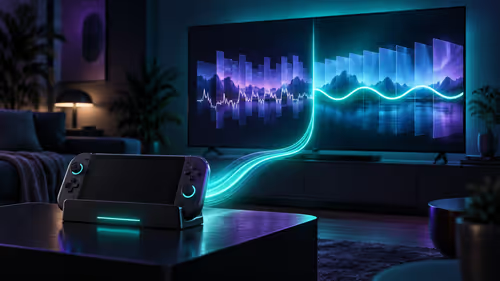
Nintendo Switch 2 docked VRR arrives with system version 23.0.0 and also requires a dock update. The connected TV or monitor and the running software must support VRR before the output can follow changing frame rates.

NVIDIA lists 550W required system power for the RTX 5060 reference specification, based on a high-end test system. A quality 550W unit can be enough, but CPU draw, transient load, connectors and ageing decide real headroom.
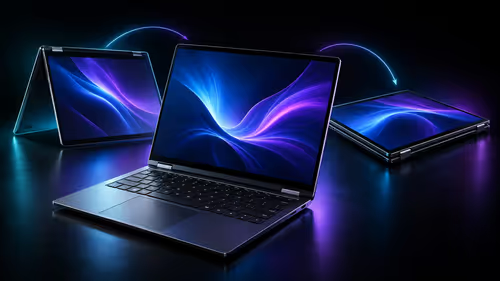
The VAIO T combines a 13.3-inch display with a multi-flip mechanism for laptop, tablet and outward-facing viewing modes. Orders begin in Japan on 18 September; South African availability is unconfirmed.
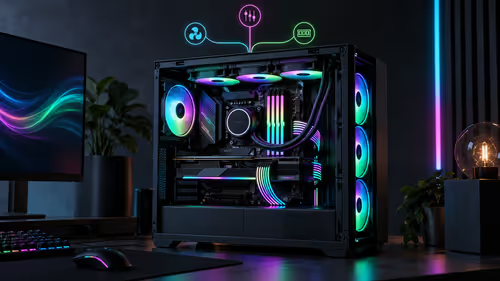
OpenRGB's master branch now carries changes labelled for 1.0 final, including translation and platform work, but the official tags page still lists 1.0rc3.1 as the newest packaged release. Stable users should wait for the signed release channel.
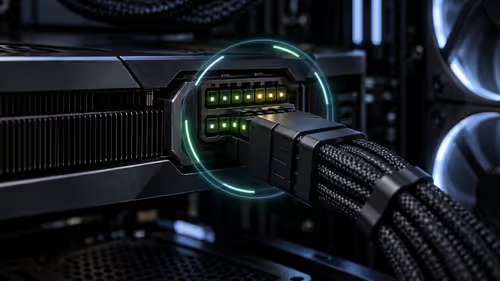
The Cooler Master GPU Shield Adapter monitors current on individual 12+4-pin contacts, adds visual and audible warnings, and can reduce system power during a severe abnormality. Local availability is unconfirmed.