Quick Answer
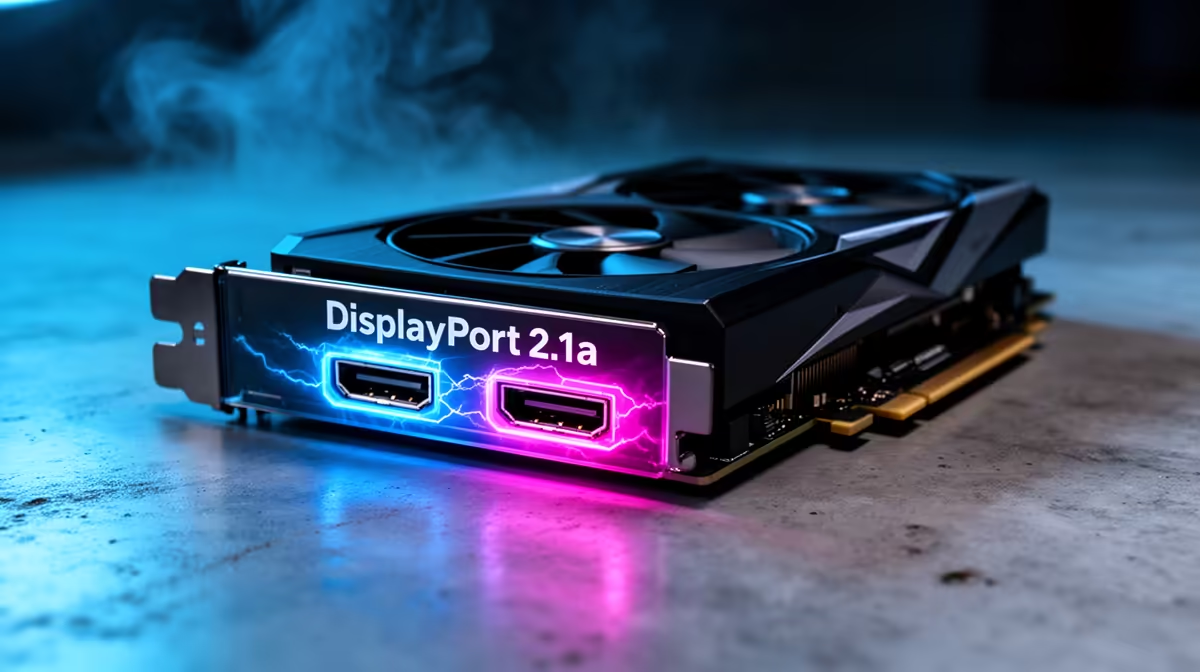
DisplayPort 2.1a UHBR20 is essential for native, uncompressed 4K 240Hz gaming. Without it, 4K 240Hz is only achievable using Display Stream Compression (DSC), which is largely transparent visually but technically a compressed signal. If you want the absolute cleanest signal at 4K 240Hz, UHBR20 is the only current interface that provides the full 47.52 Gbps bandwidth required without compression.
What UHBR20 Actually Provides vs Older Interfaces 📡
DisplayPort 2.1a introduces three link modes: UHBR10 (40 Gbps), UHBR13.5 (54 Gbps), and UHBR20 (80 Gbps). UHBR20 is the top tier and the only mode capable of 4K 240Hz with full 4:4:4 chroma sampling and 10-bit colour without compression. To contextualise: DisplayPort 1.4 provides 32.4 Gbps and requires DSC to reach 4K 240Hz. HDMI 2.1 provides 48 Gbps, enough for 4K 144Hz uncompressed or 4K 240Hz with DSC only.
For most gaming scenarios, DSC compression on DisplayPort 1.4 is visually indistinguishable from uncompressed output.
GPU and Monitor Compatibility: What to Check Before Buying 🔧
Not every RTX 50-series GPU implements DisplayPort 2.1a at UHBR20. The RTX 5080 and RTX 5090 support UHBR20 on their DisplayPort outputs. Some mid-range cards implement UHBR10 or UHBR13.5 only. Similarly, not every monitor labelled as DisplayPort 2.1 supports UHBR20 at the panel side. Always confirm both GPU and monitor specifications explicitly rather than assuming 2.1 equals UHBR20.
On the cable side, a UHBR20-rated cable is physically required. Standard certified DisplayPort cables (DP 1.4 specification) are not rated for UHBR20 signal integrity, particularly above one metre. UHBR20 certified cables are typically limited to 1 to 2 metres due to signal attenuation. If your setup requires a longer cable run, active optical DP 2.1 cables are available but add cost, typically R800 to R1,500 for quality 3 to 5 metre options.
When UHBR20 Matters for South African Buyers Specifically 💡
For a South African buyer investing R25,000 to R35,000 in a 4K 240Hz OLED monitor, the question of UHBR20 is a future-proofing one. Current monitor configurations are often resolvable with DisplayPort 1.4 DSC today.
From a practical shopping standpoint: if a 4K 240Hz monitor at R26,000 supports UHBR20 and an otherwise similar model at R22,000 only supports UHBR10, the R4,000 premium for full UHBR20 support is justified for a panel you intend to use for four or more years.
Verify UHBR Mode in GPU Software After Connection ⚡
After connecting your GPU to a UHBR20-capable monitor, open Nvidia Control Panel or AMD Software and verify the actual link rate being negotiated. If it shows DP 1.4 rather than DP 2.1 UHBR20, your cable may be the limitation. Swapping to a UHBR20 certified cable often resolves this immediately.
FAQ
Is DisplayPort 2.1a backward compatible with older monitors?
Yes. DisplayPort is backward compatible across versions. A GPU with DP 2.1a output connects to DP 1.4 monitors without adapters, negotiating the link rate the monitor supports. Only the maximum bandwidth is limited by the older device in the chain.
Does HDMI 2.1 support 4K 240Hz without compression on current gaming monitors?
No. HDMI 2.1 at 48 Gbps does not have the bandwidth for uncompressed 4K 240Hz. It achieves 4K 240Hz only with DSC compression. For uncompressed 4K 240Hz, DisplayPort 2.1a UHBR20 is currently the only option available on consumer hardware.
Will all future gaming monitors support DisplayPort 2.1a UHBR20?
The industry is moving in that direction, with UHBR20 expected to become standard on flagship monitors by 2027. For now, UHBR20 is a premium feature found primarily on monitors above R20,000. Most mid-range 4K monitors at R10,000 to R18,000 still use DP 1.4 with DSC.
Upgrading to a 4K 240Hz display and want to ensure full bandwidth support?
Evetech stocks RTX 50-series GPUs and premium gaming monitors with DisplayPort 2.1 support. Browse the full range with local warranty and SA-based technical guidance.