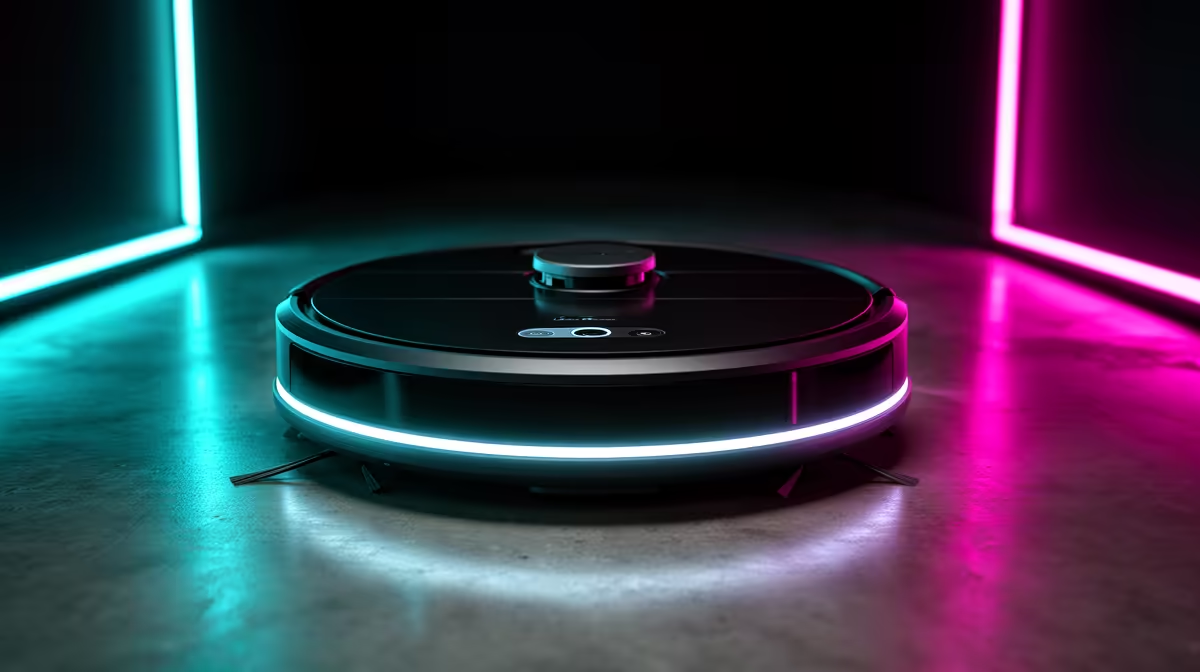
Strip away the marketing and a robot vacuum comes down to four decisions, not twenty. Brand badges and smart-home logos sell units, but they are not what makes one robot clean your floors well and another wander into a chair leg every five minutes. Choosing a robot vacuum well means getting four variables right for your specific home.
Quick Answer
The four things that actually decide performance are navigation type (LiDAR versus vSLAM), suction measured in Pascals (Pa), whether it has a self-empty dock, and how it mops. Match those four to your floor type and layout, and the brand or app ecosystem matters far less than the spec sheet suggests.
Variable one: navigation
How the robot finds its way is the single biggest divide. LiDAR uses a small spinning laser to measure distances and build an accurate map, and because lasers do not need light, it works in the dark. vSLAM uses a camera to recognise visual features and map from what it sees, which keeps the chassis slimmer but leans on ambient light and can lose its way in a dim room.
For a multi-room home with passages and night-time runs, LiDAR is the safer choice. For a smaller, well-lit flat, vSLAM can do the job at a lower price. Decide this first, because it shapes everything else.
Variable two: suction in Pascals
Suction is quoted in Pascals, and 2026 flagships throw around huge figures like 30,000Pa. Treat those as a ceiling, not a constant; the robot only draws full power on demanding surfaces. For hard floors and thin rugs, a solid mid-range figure lifts dust and crumbs without trouble. Very high suction earns its keep mainly on deep-pile carpet and stubborn pet hair, so do not overpay for a number your floors will never call on.
The more useful question than raw Pa is whether the robot ramps up automatically on carpet. Auto-boost on detecting a rug matters more in daily use than the headline maximum.
Variable three: the self-empty dock
This feature changes ownership more than any spec. Without it, you empty a small onboard bin after most runs. With it, the robot returns to a base that sucks its dustbin into a much larger bag you replace every month or two. For anyone who wants to set the robot going and forget it, a self-empty dock is the difference between an appliance and a chore. It adds cost and the dock takes up floor space, so weigh it against how hands-off you want to be.
Variable four: mopping
Mopping ranges from token to genuinely useful. The simplest robots drag a damp pad behind them, which is barely better than nothing on a dirty floor. Better systems lift the pad over carpet so they do not wet your rugs, wash the pad at the dock between passes, and dry it afterwards to avoid a musty smell. If your home is mostly hard tile or laminate, a capable mop is worth prioritising; if you are wall-to-wall carpet, it is largely irrelevant and you should spend that budget on suction and navigation instead.
The features that look important but are not
Spec sheets bury the four things that matter under a pile of features that sound impressive and change very little. Voice assistant support, app-controlled scheduling and pretty floor-plan editing are pleasant, but they do not affect how clean your floors get. A robot with a gorgeous app and weak navigation still misses corners; a plainer one that maps well does not.
Battery runtime is another number people fixate on unnecessarily. Most modern robots either cover a typical home on one charge or recharge mid-clean and resume where they left off, so the headline minutes rarely change the outcome. Likewise, smart-home badges tell you a robot will pair with an ecosystem, not that it cleans better. Treat all of these as tie-breakers between two units that already match your home on the four core variables, never as reasons to choose one in the first place.
Maintenance and the long-term cost
A robot vacuum keeps performing only if you maintain it, and that maintenance has a cost worth knowing before you buy. Side brushes, the main roller, filters and mop pads wear out and need periodic replacement, and a self-empty dock consumes disposable dust bags. A unit with cheap, easy-to-find consumables can work out far better value over a few years than a bargain model whose parts are awkward to source.
This is where buying through official local channels pays off. Genuine brushes, filters and bags are simple to order here rather than waiting on an overseas shipment, and an anti-tangle brush design saves you regularly cutting hair out of the roller. Budget a small annual amount for spares and the robot keeps its suction and mapping accuracy instead of quietly degrading.
Putting the four together for your home
Build the decision around your floors. A carpeted, multi-room home with pets points to LiDAR, strong suction with auto-boost, and a self-empty dock. A small tiled flat can do well with a slimmer vSLAM unit and a good mop, skipping the expensive dock. Once you have those four sorted, the choice between brands becomes mostly about price and local support. The smart home and appliances range at Evetech lets you compare units on these specs directly, and consumables like brushes and filters appear among the top-selling accessories.
A simple decision shortcut
If the four variables still feel like a lot, collapse them into one question: how hands-off do you want to be, and on what floors? A carpeted, multi-room home where you want true set-and-forget points to LiDAR, auto-boosting suction, a self-empty dock and obstacle avoidance, accepting a higher price for the convenience. A small, hard-floored flat where you do not mind emptying a bin points to a slimmer vSLAM unit with a decent mop and no dock, saving real money.
Work from your home outward to the spec, never the other way around. The most expensive robot on the shelf is the wrong buy if its strengths do not match your floors, and a mid-range unit chosen on the four core variables will out-clean a flagship picked on brand and badge. Get those four right and you will not regret the choice.
Frequently Asked Questions
Which is more important, suction or navigation?
For everyday cleaning, navigation matters more, because a robot that maps poorly misses areas and gets stuck regardless of suction. Get navigation right first, then choose suction to match your floor type.
Is a self-empty dock worth the extra money?
For most people, yes. It reduces maintenance to swapping a bag every month or two instead of emptying a small bin after each run, which is what makes a robot genuinely low-effort.
Do I need a high Pa number?
Only for deep carpet and heavy pet hair. For hard floors and thin rugs a strong mid-range figure is ample, and auto-boost on carpet matters more in practice than the maximum quoted Pa.
Does the mopping function actually clean?
It depends on the system. Basic drag-pad mopping is light maintenance only. Pad-lift, dock-washing and drying make mopping genuinely useful, so check which type a model offers before paying for the feature.
Does the brand matter at all?
Mainly for local support and app reliability rather than cleaning ability. Once the four core variables match your home, choose on price, warranty and parts availability rather than the badge.
Know your four variables and ready to compare on the specs that count? Browse the robot vacuums at Evetech and match a unit to your floors and layout.