Quick Answer
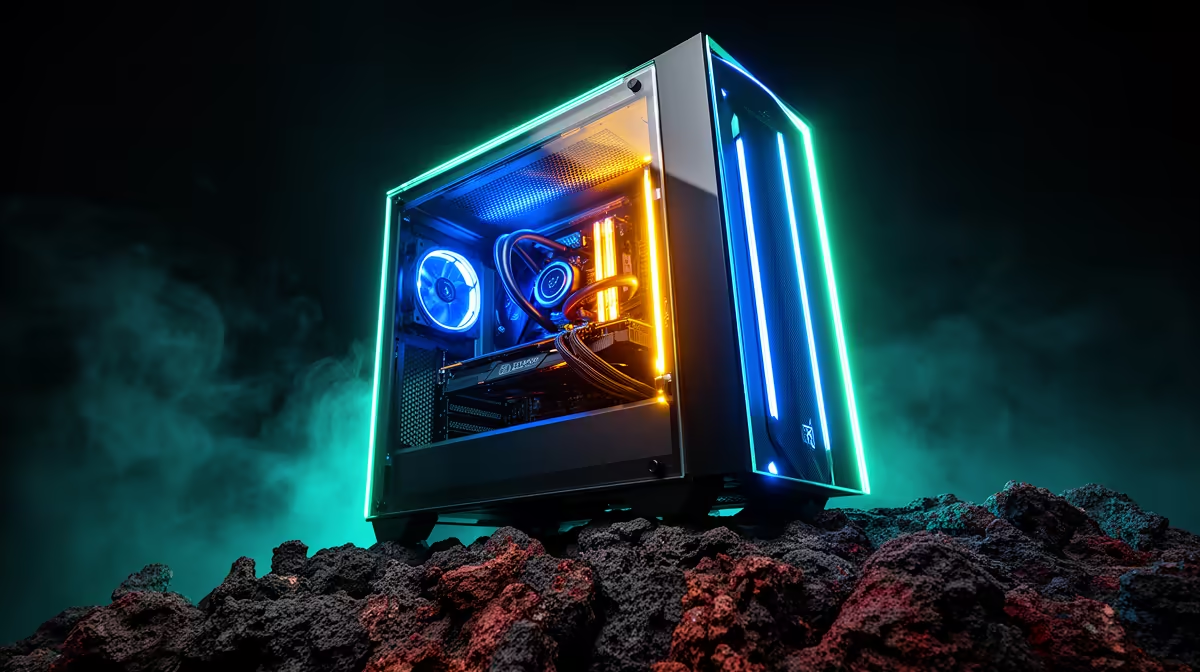
Tempered glass panels block almost no airflow when vents are positioned correctly, but they trap heat when paired with poor fan layout or insufficient intake area. The fix is a positive-pressure fan configuration, at least three 120 mm or two 140 mm front intakes pushing more air in than exhaust fans pull out, so hot air is continuously displaced before it accumulates.
Why Tempered Glass Cases Run Hotter 🌡️
A mesh front panel flows roughly four times more air than a solid tempered glass front, which is why purely aesthetic glass-front designs require deliberate compensation. The side panel glass itself is irrelevant to thermals because it covers a vent-free surface, but glass front panels block the primary intake path. Cases like the NZXT H510 with a glass front consistently measure 5 degrees Celsius to 10 degrees Celsius higher CPU and GPU temperatures than equivalent mesh-front builds under the same workload. The issue is compounded in South African summers where ambient temperatures in Gauteng or the Western Cape regularly exceed 30 degrees Celsius, pushing inlet air temperatures above what thermal models assume.
Fan Configuration and Airflow Direction 🔧
The most effective solution is to add high-static-pressure fans at the front intake positions and run them 10 percent to 15 percent faster than rear and top exhaust fans. This positive-pressure approach forces air through the radiator, over the VRMs, and past the GPU before exiting. For a glass-front case, also check the gap between the front panel and the chassis frame: some designs have 5 mm to 8 mm side gaps that allow ambient air to enter even though the glass blocks direct frontal flow. Supplementing these gaps with 92 mm fans mounted to the inner frame can recover 60 percent to 70 percent of the airflow lost to the glass panel. For builds with an RTX 5080 or higher, target a GPU junction temperature below 83 degrees Celsius under sustained load as a benchmark.
Cable Management and Internal Layout 🖥️
Cabling is the hidden thermal culprit in glass cases. Builders prioritise visible cable routing for aesthetics but sometimes leave a thick cable bundle running across the GPU intake shroud, restricting the 40 mm to 60 mm clearance that GPU coolers need. Route all modular PSU cables behind the motherboard tray first, leaving the GPU zone completely clear. An NVMe SSD running at full load generates 6 watts to 9 watts of heat in a confined M.2 slot; if your board has a heatsink cover for the M.2 slot, make sure the thermal pad is seated correctly. Keeping the interior tidy can lower GPU temperatures by 3 degrees Celsius to 5 degrees Celsius without spending a single rand on additional hardware.
SA Summer Airflow Tip ⚡
During South African summer months, placing your case on a desk rather than the floor gains you 5 degrees Celsius to 8 degrees Celsius cooler intake air immediately, since hot air stratifies near the floor. If you are in a room without air conditioning, a small desk fan blowing at the front panel intake gap can cut GPU temperatures by up to 12 degrees Celsius during extended gaming sessions.
FAQ
Does adding more fans always lower temperatures in a TG case?
Not automatically. Poorly aimed fans can create turbulence that reduces net airflow.
Should I remove the glass front panel entirely for better cooling?
Removing a glass front panel typically drops temperatures by 4 degrees Celsius to 8 degrees Celsius, but exposes internals to dust ingestion.
Do liquid coolers help in tempered glass cases?
Yes. Mounting a 240 mm or 360 mm AIO radiator at the front intake bypasses the glass panel restriction entirely because the radiator itself becomes the intake face. This is the most effective thermal upgrade for glass-front builds.
Glass aesthetic with better thermals?
Evetech carries mesh-front and hybrid cases, high-static-pressure fans, and AIO coolers suited to the full range of glass-panel PC builds.