Quick Answer
To get stable 4K/60Hz over a 5m HDMI 2.0 cable, use a cable rated for the full 18 Gbps HDMI 2.0 bandwidth, connect it directly from GPU or console to display without adapters or pass-throughs, and confirm your display's input is set to HDMI 2.0 mode (sometimes labelled Enhanced or Enhanced Format) in the display's own menu.
Choosing the Right 5m HDMI 2.0 Cable 🔧
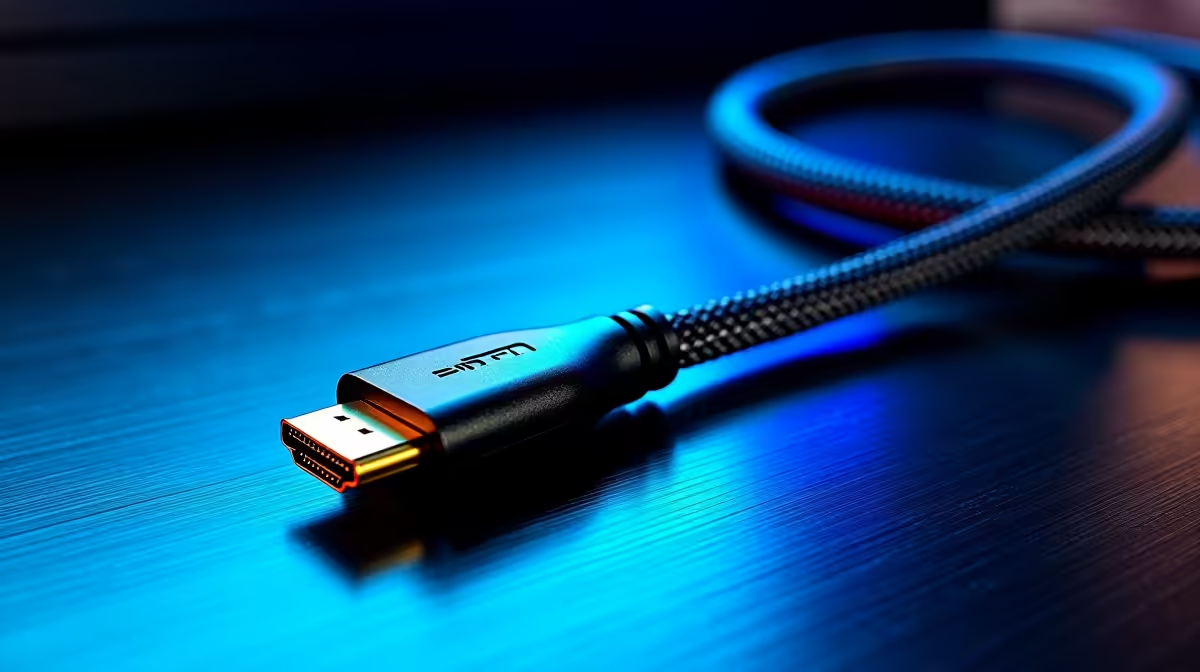
Not all cables marketed as HDMI 2.0 are built to sustain 18 Gbps over 5 metres. At shorter lengths (1 to 2 metres), marginal cables can get away with borderline construction, but at 5 metres the signal attenuation exposes any weakness in the cable's core conductors, shielding, or connectors. Look for cables specifically rated for 18 Gbps at 5 metres, ideally with a Premium Certified HDMI label (the silver holographic sticker on the packaging, not just a self-declared claim). Premium Certified HDMI cables are independently tested to deliver the full 18 Gbps needed for 4K/60Hz with HDR. In South Africa, a Premium Certified 5m HDMI 2.0 cable typically costs R350 to R600, stocked at Evetech.
Step-by-Step Setup for 4K 60Hz 📐
Step 1: Connect the cable directly from the HDMI 2.0 port on your GPU (or PS5/Xbox Series X) to the HDMI port on your display. Avoid HDMI switches or splitters in the chain for 4K/60Hz, as most affordable switches cap signal at 10.2 Gbps (HDMI 1.4 bandwidth). Step 2: On your display, navigate to the input settings and enable Enhanced or Enhanced Format on the HDMI port you connected to. On Samsung and LG TVs this is called HDMI UHD Colour; on Philips and Sony panels it is usually labelled Enhanced Format. Without this setting enabled, the display will negotiate HDMI 1.4 speeds and limit you to 4K/30Hz.
Troubleshooting Common 5m HDMI Issues 🛠️
If the display shows 4K but only at 30Hz, the Enhanced Format setting is likely not enabled on the display's input. If you see flickering or brief black screens, the cable may not sustain 18 Gbps at 5 metres under sustained signal load. Try connecting a shorter cable temporarily to confirm the cable is the issue before replacing it. If there is no signal at all, check that the GPU's HDMI port is HDMI 2.0 (some older GPUs have a mix of HDMI 1.4 and 2.0 ports on the back panel). HDMI 2.0 ports on modern Nvidia RTX 40-series and RTX 50-series cards are all on the same spec, but older RTX 30-series cards occasionally shipped with one HDMI 2.1 port rather than HDMI 2.0.
Route the Cable Away From Power Cables ⚡
HDMI cables running parallel to power cables or extension cords can pick up electromagnetic interference that causes occasional signal dropouts at 4K 60Hz. Route your 5m cable away from mains wiring where possible, or use a cable with double-layer shielding if your cable path must run near power sources. This is especially relevant in South African homes where power and AV cabling often share the same wall channels.
FAQ
Is HDMI 2.0 at 5 metres reliable enough for a permanent home theatre setup?
Yes, provided the cable is Premium Certified HDMI rated for 18 Gbps at 5 metres. For a permanent installation, secure the cable with cable clips rather than leaving it loose, as repeated bending at the same point degrades the internal conductors over time.
Can I get 4K/120Hz on a 5m HDMI 2.0 cable?
No. HDMI 2.0 is limited to 18 Gbps, which supports 4K/60Hz but not 4K/120Hz. For 4K/120Hz you need HDMI 2.1 at 48 Gbps. A 5 metre HDMI 2.1 cable is available but more expensive, typically R700 to R1,200.
Does 4K HDR require a different cable to 4K SDR over 5 metres?
HDR10 metadata is carried within the same 18 Gbps signal as 4K/60Hz video, so no different cable is needed. The display's Enhanced Format input setting must be enabled for the display to accept HDR metadata, regardless of cable length.
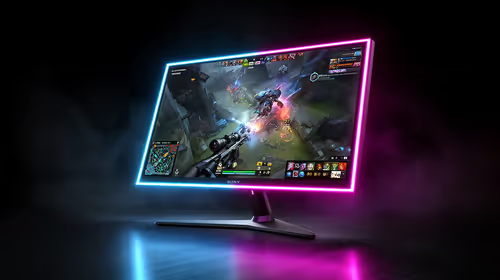
Setting up a 4K display in a lounge or home theatre?
Evetech stocks 5m HDMI cables alongside 4K monitors and TVs. Check the cables section for Premium Certified options that reliably deliver 4K/60Hz HDR across longer runs.