Quick Answer
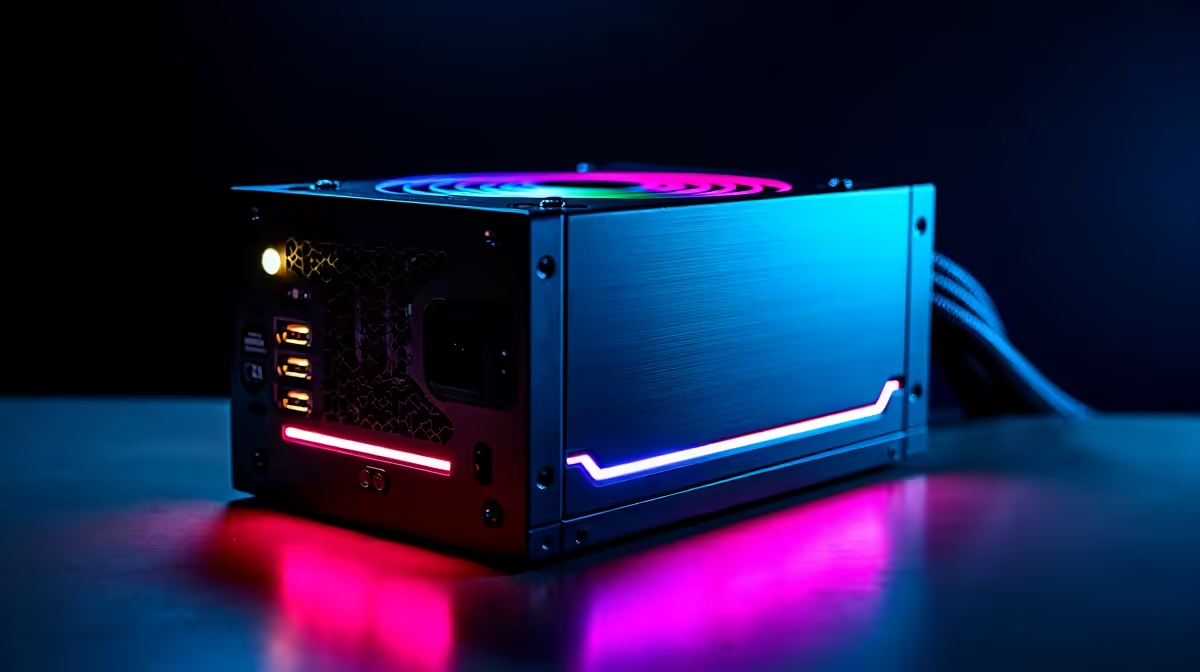
For a single-GPU gaming setup, yes: 1,600W is overkill. A flagship gaming build with an RTX 5090 and Ryzen 9 9950X peaks at around 900W to 950W, making a 1,200W unit the correct fit. A 1,600W PSU makes sense only when you run dual GPUs, a 32-plus-core CPU, or plan to future-proof for a second graphics card.
Defining High-End for South African Gaming 🎮
In South Africa, a high-end gaming setup in 2026 typically means an RTX 5090 or RTX 5080 paired with a mainstream high-core-count CPU like the Ryzen 9 9950X or Core Ultra 9 285K. At stock settings, the RTX 5090 TDP is 575W and the 9950X TDP is 230W. Adding storage, memory, and board overhead brings the system to around 870W to 950W at absolute peak under simultaneous CPU and GPU stress. Running this at 1,600W places the system at about 55% to 60% PSU load, which is within Titanium's efficiency sweet spot. However, a 1,200W unit runs the same system at 72% to 79% load, also well within the efficiency peak and with ATX 3.1 transient headroom to spare.
When 1,600W Stops Being Overkill 🔧
The calculus changes when the build scope expands. A second RTX 5090 adds 575W, pushing peak system draw to 1,450W to 1,550W, which needs a 1,600W unit at minimum. Content creators who simultaneously game while running GPU-accelerated rendering or video encoding in the background see sustained loads 15% to 25% higher than pure gaming, pushing a 5090 build closer to 1,100W. Extreme overclockers who push the GPU power limit to 120% or more of TDP add another 100W to 150W. In all three scenarios, 1,600W is the appropriate spec rather than overkill. For a pure gaming-only single-card build in South Africa, though, 1,200W Titanium is the better combination of price, efficiency, and physical size.
The Physical and Financial Cost of Over-Speccing 💰
A 1,600W PSU is physically larger (typically 200mm deep versus 160mm for 1,000W to 1,200W units), heavier (around 2.4kg versus 1.6kg), and more expensive by R2,000 to R3,500. In compact mid-tower cases, 200mm PSU depth can be a fitment issue. The electricity argument for 1,600W over 1,200W for a single-GPU build is neutral at best: both run the 900W system at similar efficiency percentages when matched to appropriate wattage-for-load ratios. Save the R2,000 to R3,500 premium for a better GPU cooler, a case upgrade, or additional NVMe storage.
Spec for Your Build Today, Plan for Expansion Tomorrow ⚡
If you are building a single-GPU system today but genuinely plan to add a second GPU within 12 months, buying the 1,600W now is smart. If a second GPU is a vague possibility rather than a committed plan, get the 1,200W now and sell it on when the time comes. PSUs from top brands hold resale value well in South Africa given continued demand.
FAQ
Can a 1,600W PSU damage a system that only draws 900W?
No. The PSU delivers exactly what the system requests. A higher wattage rating does not increase the power delivered; it increases the maximum available. Component damage from PSUs comes from voltage instability, not from over-wattage.
Will a 1,600W PSU be noticeably louder than a 1,200W unit in a gaming build?
At 900W system draw, a 1,600W unit runs at 56% load and its fan may stay in 0dB mode. A 1,200W unit runs at 75% load and its fan may spin just slightly faster. In practice, noise difference at typical gaming loads is minimal for quality units from both wattage classes.
Is there a meaningful price difference between 1,200W and 1,600W Titanium units?
Yes. A 1,200W Titanium unit is typically priced R2,000 to R3,500 less than the equivalent 1,600W Titanium unit from the same brand. For a single-GPU South African gaming build, that saving is better spent elsewhere in the component list.
Not sure whether to go 1,200W or 1,600W for your South African build?
Evetech stocks both wattage classes in Titanium and Platinum configurations. Browse the range and compare specs to find the unit that matches your build's actual power needs without overspending.