Quick Answer
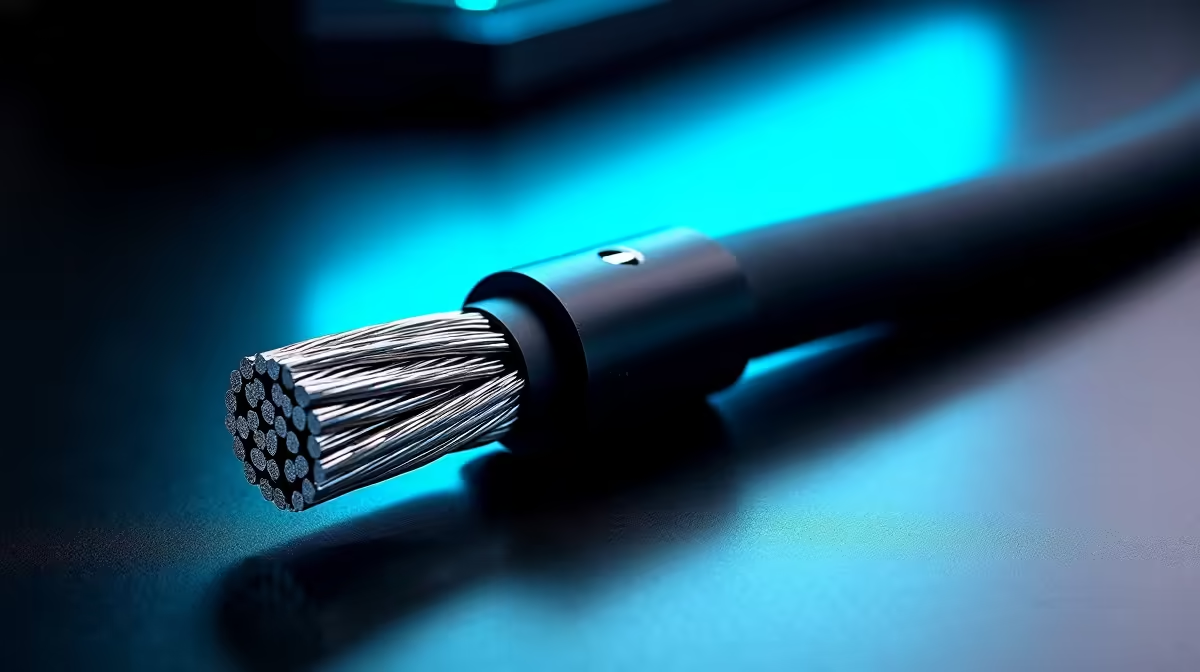
Triple shielding is not strictly necessary for every 4K editing workflow, but it becomes genuinely important when cable runs exceed 1.5m, when the workstation is in an electrically busy environment such as a shared office or studio, or when the editing setup requires sustained 10-bit 4K output. In those scenarios, triple shielding eliminates the intermittent signal errors that disrupt colour grading and proxy rendering.
The Editing Workflow Case for Triple Shielding 🎬
Professional 4K video editing typically requires 10-bit colour output at 3840x2160 and 60Hz or higher for smooth timeline scrubbing. DisplayPort 1.4 carries this at 32.4 Gbps, and HDMI 2.1 carries it at up to 48 Gbps. At these bandwidth levels, any EMI that penetrates the cable shielding causes bit errors that manifest as frame drops, colour banding, or brief blank-screen events during playback. In shared editing suites at South African production companies (Cape Town's film industry is a significant market), the density of LED studio lighting, wireless video transmitters, and networking switches creates a high-EMI environment where single-shielded cables struggle at 2m runs. Triple shielding eliminates this risk without requiring cable rerouting or equipment changes.
When Single Shielding is Sufficient 🔧
For a dedicated editing workstation in a quiet home office with cable runs under 1m and no nearby high-power wireless devices, a single-shielded DP 1.4 cable at R120 to R180 handles 4K 60Hz reliably. The electromagnetic environment of a typical South African suburban home office is not dense enough to break through single shielding at short cable lengths. The decision point is cable length combined with environmental EMI density. Under 1m in a quiet office: single shielding sufficient. Over 1.5m in a shared or professional environment: triple shielding recommended. A triple-shielded DP 1.4 cable adds roughly R80 to R150 to the price of a single-shielded equivalent, a modest premium for the assurance it provides in critical colour work.
Colour Reference Monitors and Cable Choice 🎨
For colour reference monitor workflows (a DCI-P3 calibrated panel alongside the main editing display), signal integrity ties directly to colour accuracy. A dropout that forces the monitor to renegotiate the DisplayPort link resets the HDR metadata handshake, temporarily shifting colour rendering. Triple shielding prevents these renegotiations. Evetech stocks triple-shielded DP 1.4 cables at R200 to R380 for 1m and 2m lengths.
Separate Power and Display Cables for Editing Setups ⚡
Route your display cable away from the power strip and monitor power cable by at least 15cm. Power cables carrying 230V AC radiate strong 50Hz interference that easily penetrates single-shielded display cables at parallel runs longer than 30cm. This simple routing adjustment reduces the most common source of 4K signal interruption in desk setups.
FAQ
Does cable shielding affect render times or export speed in video editing software?
No. Render and export performance is entirely determined by the CPU, GPU, and storage subsystem. Cable shielding affects only the display output signal, not the processing pipeline.
Is there a difference between triple-shielded HDMI and DisplayPort for 4K editing?
Both provide similar EMI protection when triple shielded. DisplayPort 1.4 is preferred for monitor connections because it supports higher refresh rates and better DSC implementation. HDMI 2.1 is preferred when the monitor or reference display has only an HDMI input.
Can poor cable shielding cause colour profile shifts in grading software?
Indirectly, yes. If a signal error forces the display to reconnect, the ICC colour profile and HDR metadata are re-negotiated. This is not a calibration issue; it is a connection stability issue that triple shielding prevents.
Running a serious 4K editing setup?
Evetech stocks triple-shielded DisplayPort 1.4 and HDMI 2.1 cables designed for sustained high-bandwidth professional use. Browse the cable section to spec out your workstation correctly.