Quick Answer
Thunderbolt 2 ports are fully backward compatible with Mini DisplayPort cables for video output: any mDP-to-DP cable connected to a Thunderbolt 2 port will carry 4K video at up to 60Hz using the DisplayPort protocol. The physical connector is identical; the only difference is that Thunderbolt 2 adds PCIe tunnelling over the same pins when used with Thunderbolt peripherals.
Understanding the Shared Physical Standard 🔌
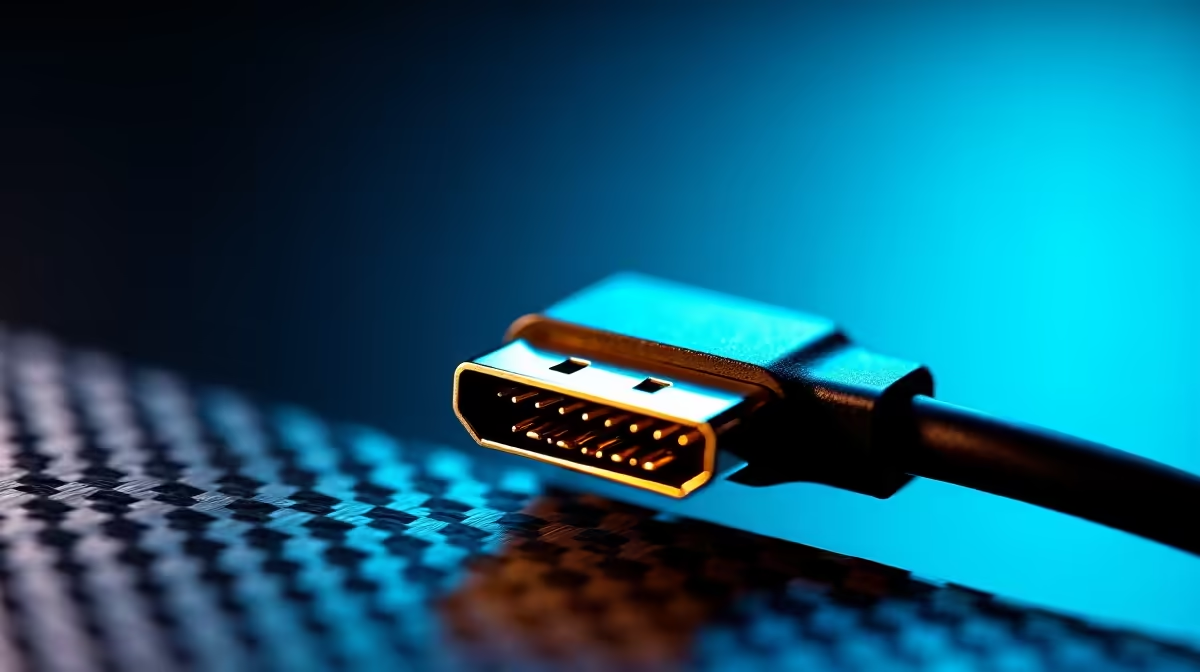
Apple and Intel designed Thunderbolt 1 and 2 to use the Mini DisplayPort connector specifically because it was already present on MacBooks and Mac Minis. The pins carry both Thunderbolt PCIe lanes and DisplayPort signals simultaneously, with the connected device determining which protocol activates. When you plug an mDP-to-DP cable into a Thunderbolt 2 port, the GPU side of the chip activates and the port operates as a standard Mini DisplayPort output. This means every MacBook Pro from 2013 to 2015 and every Mac Pro with Thunderbolt 2 can drive a 4K 60Hz monitor using nothing more than a passive mDP-to-DP cable, provided the GPU supports DP 1.2 or higher. For 4K 60Hz, DisplayPort 1.2 bandwidth of 17.28 Gbps is adequate.
Where Compatibility Breaks Down 🛠️
The main compatibility limitation appears when connecting Thunderbolt 2 devices (external GPUs, docks, storage) to modern systems with USB-C Thunderbolt 3 or 4 ports. These physically different connectors require an active Thunderbolt adapter, not just a passive cable. For pure video output, however, the path is simpler: a Thunderbolt 2 source with an mDP-to-DP cable to any standard DisplayPort monitor works reliably. Where it does not work is driving a DisplayPort display from a USB-C Thunderbolt 3 or 4 source using an mDP cable, because those ports use the USB-C physical form, not Mini DisplayPort. South African users upgrading from a 2014 MacBook Pro to a modern Windows laptop or M-series MacBook will need a USB-C to DisplayPort cable rather than the older mDP cable.
Choosing the Right Cable for Your Specific Setup 🔧
For a Thunderbolt 2 source driving a DisplayPort 4K monitor: buy a passive mDP-to-DP cable rated for 4K 60Hz, priced at R120 to R280 at Evetech. Confirm the cable is DP 1.2 certified on the packaging. For a Thunderbolt 3 or 4 source (USB-C) driving a 4K monitor with a DisplayPort input: buy a USB-C to DisplayPort cable or a mini dock with DP output. Do not attempt to use an mDP cable with a USB-C port via a physical adapter, as the resulting chain often fails to negotiate 4K reliably. Cable length under 2m performs best for passive cables; beyond 2m consider an active cable for 4K stability.
Verify Port Generation Before Ordering ⚡
Look for the Thunderbolt lightning-bolt symbol next to the port. Thunderbolt 1 and 2 show the symbol next to a Mini DisplayPort-shaped port. Thunderbolt 3 and 4 show the symbol next to a USB-C-shaped port. Ordering the wrong cable type is the most common mistake in this compatibility scenario.
FAQ
Can I connect a Thunderbolt 2 port to a USB-C monitor?
Yes, with a Thunderbolt 2 to USB-C adapter. Apple sold an official adapter for this purpose. Third-party adapters are available locally, though quality varies. Confirm the adapter explicitly states DisplayPort Alt Mode support for 4K output.
Does using an mDP cable on a Thunderbolt 2 port disable the Thunderbolt functionality?
No, only the DisplayPort video function activates. Thunderbolt PCIe tunnelling is only enabled when a Thunderbolt-compatible device is connected. Plugging in a video cable does not affect the port's other capabilities.
What is the maximum resolution Thunderbolt 2 can support via DisplayPort?
Thunderbolt 2 provides enough bandwidth for 4K at 60Hz using DisplayPort 1.2 timing. It cannot do 4K at 120Hz or 5K, which require DP 1.4 or higher.
Connecting a legacy Thunderbolt 2 machine to a 4K monitor?
Evetech stocks Mini DisplayPort to DisplayPort cables that work reliably with Thunderbolt 2 ports for 4K video output. Check the display cable section for available lengths.