Quick Answer
The optimal PWM fan curve for silent operation with adequate cooling is an S-curve: fans ramp slowly from around 25 to 35% PWM at idle, accelerate linearly through mid temperatures, and only reach maximum speed above 80 degrees Celsius. This keeps fans inaudible below 60 degrees CPU load while providing full cooling headroom when thermals demand it.
Why a Flat or Linear Curve Falls Short 📊
Default BIOS fan curves typically use a simple linear profile: a fixed RPM percentage per degree Celsius. These profiles often cause fans to ramp noticeably during light tasks like web browsing or document editing, where CPU temperatures may briefly touch 50 to 55 degrees Celsius on modern Ryzen 9000 or Intel Core Ultra processors. The solution is a custom curve that maintains a nearly flat low-speed profile up to 60 degrees, accelerates through 60 to 75 degrees, and reaches maximum speed only above 80 degrees, a threshold most office and gaming workloads rarely sustain.
Setting Up the S-Curve in BIOS and Software 🔧
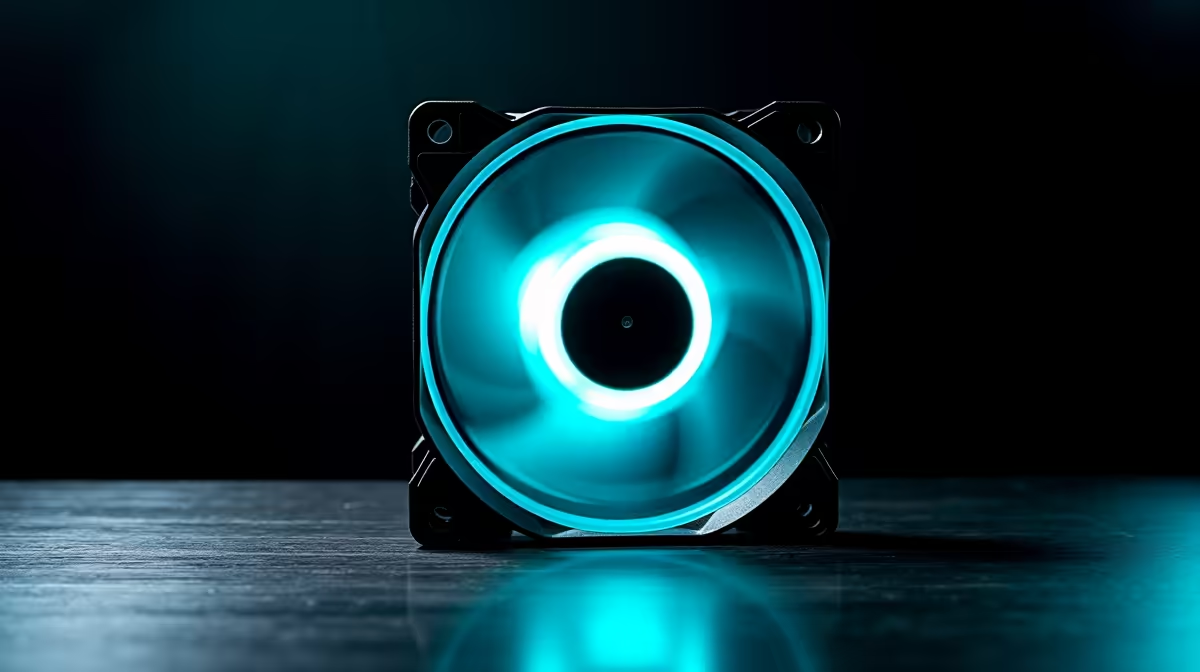
In your BIOS, navigate to fan control and select Q-Fan Control, Smart Fan, or equivalent. Set control mode to PWM rather than DC for 4-pin fans. Define temperature source as the CPU sensor rather than the motherboard ambient sensor for faster thermal response. Plot your curve points: at 40 degrees run fans at 25 to 30% PWM (roughly 350 to 500 RPM on 120mm fans). At 60 degrees, step to 50 to 55% PWM. At 70 degrees, step to 70 to 75% PWM. At 80 degrees and above, allow 100% PWM.
Acoustic Targets for South African Home Environments 🔊
In a South African home or apartment, ambient noise from street traffic and activity typically runs at 35 to 45 dB during daytime hours. A well-tuned PWM curve keeps case fan noise at 25 to 28 dB at idle, inaudible against ambient noise, and at 35 to 38 dB during sustained gaming load, blending into the environment. The key is minimum speed setting: 120mm fans that stop completely at low duty cycles cause an audible start-stop cycle that some users find more distracting than constant low-speed operation. Setting a 15 to 20% PWM floor keeps fans spinning slowly and silently without the start-stop behaviour.
Use the Temperature Hysteresis Setting ⚡
BIOS fan controllers include a hysteresis setting, typically 2 to 5 degrees Celsius, preventing fans from oscillating between speed steps when temperature hovers near a curve threshold. Set hysteresis to 3 to 4 degrees to avoid audible cycling that occurs when a fan repeatedly crosses the 60-degree threshold during light gaming. This single setting eliminates the most common source of fan noise complaints in custom-curve builds.
FAQ
What is the minimum PWM duty cycle before most case fans stop spinning?
Most 120mm PWM fans have a minimum operating threshold between 10 and 20% PWM. Below this threshold, the fan either stalls or stops entirely. Set your PWM floor to 20 to 25% to stay safely above the stall threshold across all fans in your build.
Should GPU and CPU fan curves be set independently?
Yes. GPU fans should respond to GPU temperature via MSI Afterburner or AMD Radeon Software. CPU case and tower fans should respond to CPU temperature via BIOS. Coupling them to the same source causes unnecessary noise from one component ramping while the other is cool.
How often should I review and adjust my PWM fan curve?
Review after any significant thermal component change: new CPU cooler, new GPU, new case configuration, or reapplied thermal paste. South African summer temperatures in Gauteng and KwaZulu-Natal can shift idle baselines by 5 to 10 degrees Celsius, occasionally requiring a curve adjustment.
Looking for PWM fans that give you precise speed control?
Evetech stocks a range of 120mm and 140mm PWM case fans with wide speed ranges and low minimum RPM, ideal for dialling in a custom S-curve. Browse the cooling accessories section to find the right fans for your build.