Quick Answer
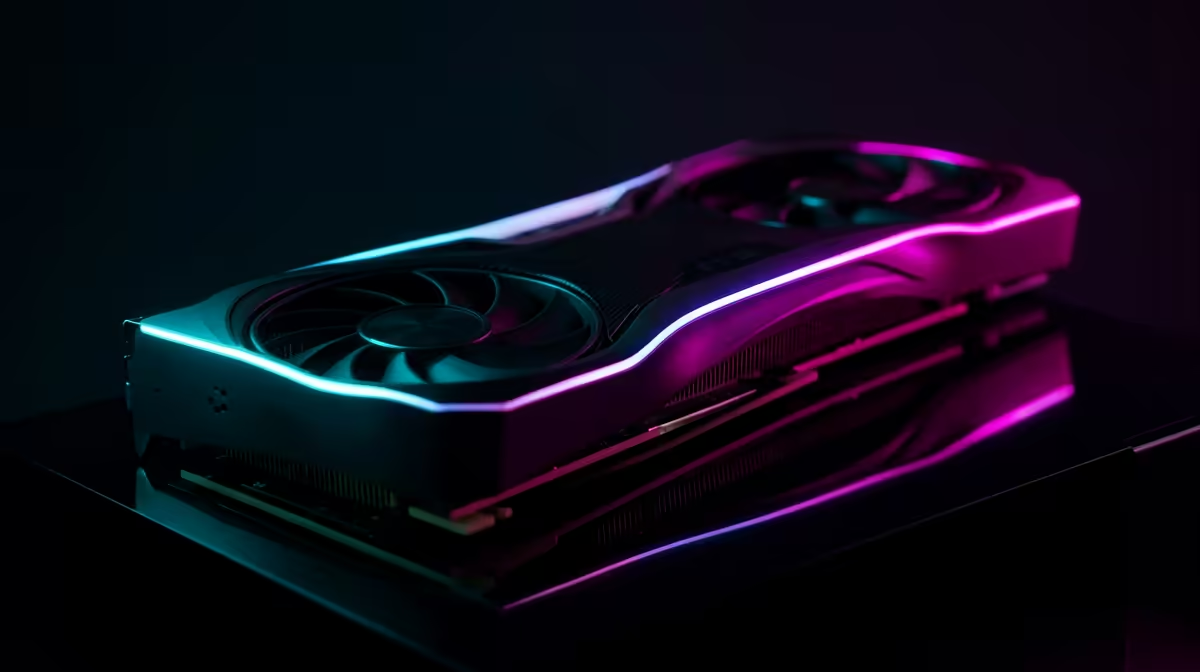
For SA streamers the RTX 5090 is a strong but premium choice: its powerful encoder and large VRAM let you game at 4K and stream at high quality on one PC without frame loss. The catch is cost and power draw, so it is worth it only for serious streamers, not occasional ones.
Pros For Streaming
The 5090's encoder produces clean, high-bitrate streams while you game, and its raw power means encoding barely dents your in-game frame rate. With ample VRAM it handles game capture, overlays and a browser of sources comfortably, so a single-PC stream-and-play setup runs smoothly at 1440p or 4K. For a streamer chasing quality and reliability, that headroom removes the usual single-PC compromises.
It also future-proofs the channel: you will not be re-buying a GPU as games and streaming software get heavier.
Cons For Streaming
The downsides are price, power and diminishing returns. The flagship cost is hard to justify unless streaming is a real income stream, and the 350-575W draw demands a 1000W PSU and a well-cooled case. A mid-to-high card already streams 1080p and 1440p cleanly thanks to modern encoders, so the 5090's advantage mainly shows at 4K or in very heavy multi-source productions.
FAQ
Do I need an RTX 5090 to stream well?
No. A mid-to-high GPU streams 1080p and 1440p cleanly using modern encoders. The 5090 helps most for 4K streaming or very heavy multi-source setups.
Can the 5090 game and stream on one PC?
Yes, comfortably. Its strong encoder and large VRAM let you play at high settings and stream at high bitrate from a single machine without noticeable frame loss.
What power supply does a 5090 streaming build need?
A 1000W unit. The card draws 350-575W, and with a high-end CPU and the rest of the system you want that headroom for stable transient handling.
If streaming is your income, pair the RTX 5090 at Evetech with a 1000W PSU and a well-ventilated case for a single-PC stream-and-play setup.