Here is the practical, SA-specific guidance that matches the gear to how you will actually use it.
Quick Answer
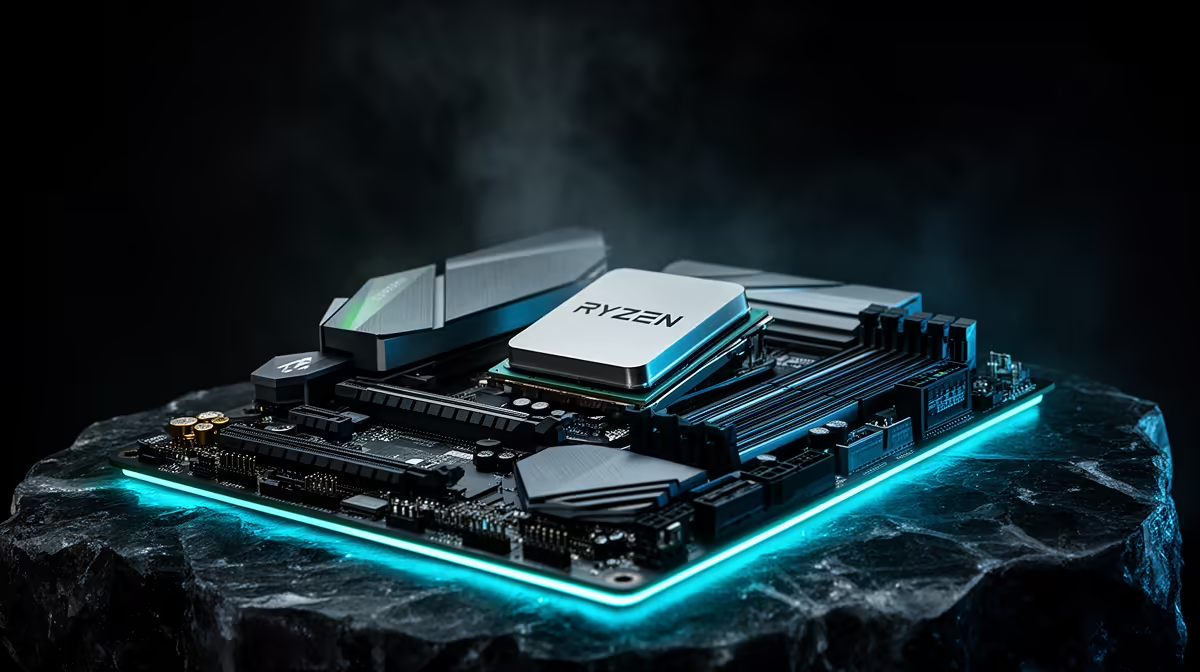
For 1440p ultrawide gaming the Ryzen 7 9800X3D is the best Rand-per-frame CPU you can buy: roughly R9,500-R11,500, eight cores, and 3D V-Cache that lifts 1% lows where it counts. It is GPU-bound at higher resolutions, so at 1440p ultrawide you pair it with the graphics card, not a more expensive CPU - spend the saving on the GPU instead.
How it performs at 1440p ultrawide
At 1440p ultrawide the 9800X3D's V-Cache still shows up in 1% lows and in CPU-heavy open-world and simulation titles, even as averages tilt GPU-bound. It comfortably feeds a 144-165Hz panel and leaves headroom for a future GPU upgrade, which is why it is the smart pairing for a high-refresh build at this resolution.
Building around it
A balanced 1440p ultrawide build puts the GPU first: a Ryzen 7 9800X3D, a B650 board, 32GB DDR5-6000 CL30, a 1TB Gen4 NVMe and a 750W Gold PSU, then the biggest GPU the budget allows. The CPU runs hot under load, so plan for a good 240mm-280mm AIO or a strong air cooler. Tower totals typically land R26,000-R38,000 depending on the graphics card you bolt on.
SA platform notes
The 9800X3D needs an AM5 board and DDR5 - it will not drop into an AM4 system, so budget for the platform if you are upgrading from Ryzen 5000.
FAQ
Is the 9800X3D worth it at 1440p ultrawide?
At 1440p ultrawide it is more about 1% lows and futureproofing than raw averages, since you are largely GPU-bound. Worth it if you plan to add a faster GPU later, otherwise a non-X3D Ryzen 7 saves money.
Do I need an AIO cooler for the 9800X3D?
A good 240mm-280mm AIO or a top air cooler is recommended; the chip runs hot under sustained load. A budget cooler will thermal-throttle it and waste the cache advantage.
9800X3D or 9950X3D for gaming?
For pure gaming the 9800X3D is the value pick - the 9950X3D's extra cores mostly help productivity. Spend the difference on the GPU unless you also do heavy rendering or compiling.
Buyer tip
Pair the 9800X3D with an AM5 B650 board and a 240mm+ AIO, then spend the rest on the GPU - that ordering is what wins on Rand-per-frame.