Quick Answer
The Asetek 8th Gen pump is an OEM liquid cooling assembly used by multiple AIO brands, featuring a redesigned impeller, improved ceramic bearing, and refined volute geometry that delivers more consistent coolant flow than previous generations. For SA builders running high-TDP CPUs in warm rooms, Gen 8 translates to lower thermal spikes and better sustained cooling stability.
How the Asetek Gen 8 Pump Works 🔧
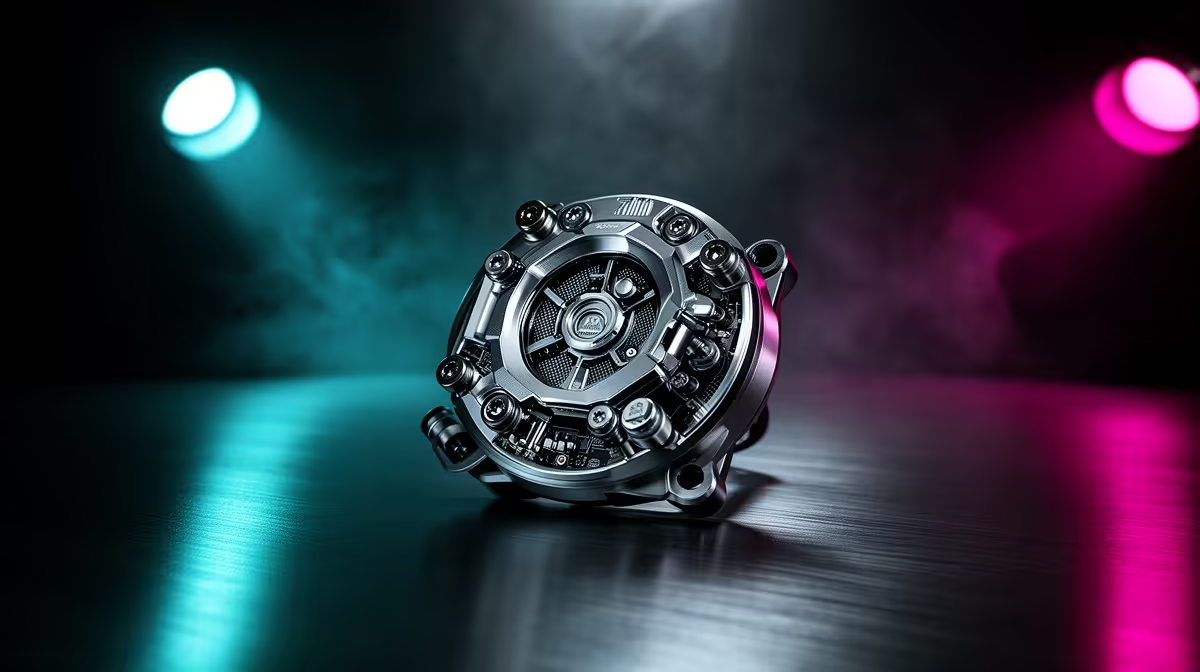
Asetek designs and manufactures the pump-and-cold-plate assembly that sits on your CPU. This unit consists of a motor driving an impeller in a sealed volute chamber, which pushes coolant through a copper micro-fin cold plate (the heat exchanger that contacts the CPU IHS) and into the radiator.
Why It Matters for High-TDP CPUs 💡
Consistency is the key word. Under a sudden load spike from a Ryzen 9 9950X or Core Ultra 9 285K going from idle to full Blender render, the CPU can shed 100 to 150W in under a second. A pump that momentarily reduces flow under this thermal shock causes a temperature overshoot (a spike to 90 to 95 degrees before the radiator catches up). The Gen 8 pump's tighter RPM control reduces this overshoot window. In a South African context where ambient room temperatures in summer reach 28 to 35 degrees Celsius, the baseline coolant temperature is already elevated, leaving less thermal buffer. Any pump inconsistency is amplified by high ambient, making the Gen 8's stability advantage more practically meaningful here than in a climate-controlled European lab environment.
Which Brands Use Asetek Gen 8 and What Do They Cost? 💰
Asetek supplies its pump assemblies as OEM components to AIO brands. Current Gen 8 users include Corsair (iCUE Elite Capellix XT line), Fractal Design (Celsius+ S36 Prisma), and selected NZXT Kraken models. The pump generation is typically listed in the AIO spec sheet or press materials. SA retail pricing for Gen 8 AIOs currently sits between R3,500 and R6,000 for 360mm configurations, compared to R1,800 to R2,800 for entry-level non-Asetek units. The premium reflects not just the pump quality but also the superior fan sets and tubing these higher-tier products bundle.
Run Your Pump at Max Speed for the First 24 Hours ⚡
Asetek recommends running a new AIO pump at maximum speed for the first 12 to 24 hours to settle any micro air bubbles in the coolant loop. After this break-in period, set the pump back to your preferred balanced or performance profile. A brief clicking or gurgling noise during the first few hours is normal and will resolve as bubbles clear.
FAQ
Can I identify an Asetek Gen 8 pump at a glance?
Not visually. Asetek pumps look very similar across generations from the outside. The generation is identified by the brand's marketing materials or the product spec sheet, which will reference Asetek Gen 8 explicitly if that is the pump used.
Is the Asetek Gen 8 pump repairable if it fails?
No. AIO pump assemblies are sealed units and are not serviceable by end users. A pump failure within the warranty period triggers a full unit replacement through the brand's warranty process. This is why local SA warranty support matters: an Asetek Gen 8 AIO without local distributor backing has no practical repair path.
Does the Asetek Gen 8 pump work better at 3-pin or 4-pin PWM headers?
Always use the 4-pin PWM header for the pump. The 4-pin connection allows precise RPM control by the motherboard or AIO software, which is how the Gen 8's refined motor driver delivers its improved consistency. A 3-pin DC connection provides less accurate speed control and undermines the Gen 8's main advantage.
Want a liquid cooler built around a proven pump platform?
Evetech stocks AIO coolers using Asetek Gen 8 technology across multiple brands and radiator sizes. Browse the CPU cooler section to find a Gen 8 AIO for your socket and build.